

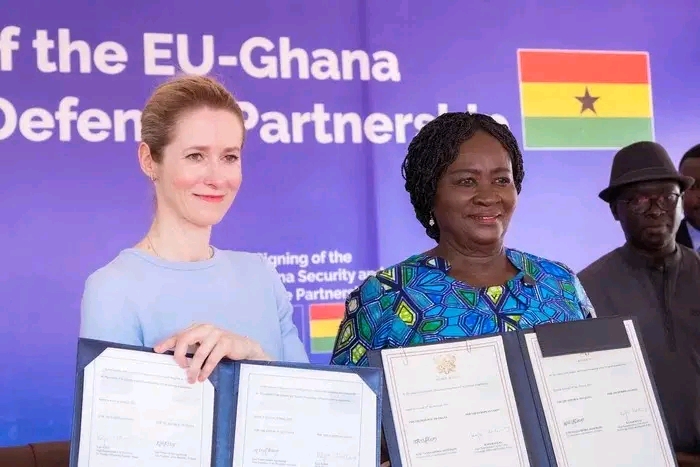
The Government of Ghana has firmly rejected claims that its newly signed security agreement with the European Union will allow foreign military bases or troops to be stationed in the country, describing such reports as misinformation.
In a strongly worded clarification issued by the Ministry of Foreign Affairs, authorities stated that the Security and Defence Partnership does not include any provision for hosting foreign forces on Ghanaian soil. The government stressed that the agreement fully respects Ghana’s sovereignty and territorial integrity.
“The agreement neither provides for the establishment of foreign military bases in Ghana nor does it permit the stationing of foreign troops on Ghanaian soil,” the Ministry emphasised.

The clarification follows growing public concern and debate after Ghana formally signed the defence partnership with the European Union in March 2026. The deal, which makes Ghana the first African country to enter such an arrangement with the EU, is aimed at strengthening cooperation on security challenges affecting both Ghana and the wider West African region.
According to government officials, the partnership is structured around collaboration rather than military presence. It focuses on areas such as counter terrorism, maritime security in the Gulf of Guinea, cybersecurity, border management, and support for peacekeeping and crisis response operations.
The Ministry further explained that the agreement builds on long standing relations between Ghana and the EU, formalising years of cooperation into a more coordinated and strategic framework. It also includes provisions for technical assistance, training, and equipment support for Ghana’s security agencies, rather than any deployment of foreign troops.
This distinction is critical. Ghana has historically maintained a foreign policy rooted in non alignment and has consistently resisted hosting foreign military bases. Officials reiterated that this principle remains unchanged, and any international cooperation will continue to prioritise national interest and independence.
The timing of the partnership reflects growing security concerns in the region. West Africa has faced increasing threats from violent extremist groups, particularly in the Sahel, with spillover risks affecting coastal states like Ghana. Maritime insecurity, piracy, and organised crime in the Gulf of Guinea have also intensified, prompting governments to seek stronger international cooperation.
By entering the agreement, Ghana aims to strengthen its security architecture without compromising control over its territory. The government insists that Ghana’s armed forces remain solely responsible for defending the country, and the partnership does not alter command structures or operational authority.
Officials also addressed what they described as widespread misinterpretations circulating in public discourse. They urged citizens to rely on official information and avoid drawing conclusions based on speculation or incomplete details about the agreement.

Beyond security, the deal signals Ghana’s broader diplomatic positioning. The country continues to engage global partners while maintaining a balance between cooperation and sovereignty, a stance that has defined its international relations for decades.
However, the controversy highlights a deeper issue. Public sensitivity around foreign military presence in Africa remains high, shaped by historical experiences and concerns about external influence. Even partnerships framed around cooperation can quickly trigger suspicion if not clearly communicated.
For the government, managing perception will be just as important as implementing the agreement itself. Transparency and consistent communication will be key to maintaining public trust as the partnership unfolds.
In practical terms, the EU Ghana defence partnership is expected to enhance capacity building, intelligence sharing, and operational readiness in addressing modern security threats. But the government’s message is clear and direct: cooperation does not mean occupation.
The assurance seeks to draw a firm line between strategic partnership and sovereignty, reinforcing Ghana’s long standing position that its territory will not host foreign military bases or troops under any bilateral or multilateral arrangement.
Stablecoins Africa: Billionaire’s deal boosts digital payments