

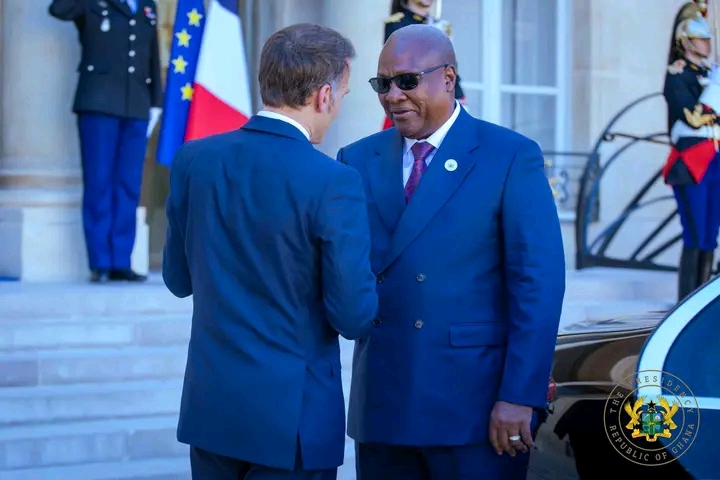
President John Dramani Mahama and Emmanuel Macron have taken a decisive step to recalibrate Ghana’s relationship with France following high level bilateral talks at the Élysée Palace, signaling a shift toward deeper strategic cooperation across health, infrastructure and economic recovery.
The meeting, which followed the conclusion of the One Health Summit 2026 in Lyon, placed Ghana at the center of France’s evolving engagement with Africa, particularly in areas where development and geopolitics now intersect. The summit itself brought together global leaders, health ministers and experts to address challenges spanning global health systems, food security and coordinated responses to emerging threats.
At the heart of the bilateral discussions was France’s decision to select Ghana as the first beneficiary of its newly introduced National Health Compact, a move that elevates Ghana’s position within France’s global health strategy. The decision is not symbolic. It reflects a calculated alignment between Ghana’s policy direction and France’s increasing focus on health diplomacy as a pillar of its international influence.

President Macron’s endorsement of the Accra Reset Initiative as “very important” underscores this alignment. The initiative, championed by President Mahama, is designed to reposition Ghana within global governance conversations, particularly in areas such as health security and economic restructuring. Its recognition at the summit signals that Ghana is not merely participating in global discussions but actively shaping them.
President Mahama, in turn, used the platform to reinforce Ghana’s economic narrative. His acknowledgment of support from France and China in Ghana’s debt restructuring highlights the country’s delicate balancing act between international partnerships and domestic recovery. It also points to a broader reality. Ghana’s economic stability remains closely tied to external cooperation, making these diplomatic engagements not optional but necessary.
Beyond health and economic recovery, the talks extended into areas that will define Ghana’s medium term trajectory. Discussions on the proposed Accra Kumasi Expressway indicate renewed momentum in infrastructure development, a sector that has historically suffered from financing constraints and execution delays. If implemented effectively, such projects could significantly reduce logistical bottlenecks and enhance internal trade efficiency.

The inclusion of artificial intelligence and technological advancement in the discussions reflects a forward looking dimension that many African partnerships often lack. Rather than focusing solely on traditional sectors, both countries are positioning their cooperation within the evolving digital economy. This signals a recognition that future competitiveness will depend not just on physical infrastructure but also on technological capacity.
Security also featured prominently, particularly in the context of regional instability across West Africa. Ghana’s role as a relatively stable democracy places it in a strategic position within the subregion. Strengthening cooperation with France in this area is not just about bilateral interests but about maintaining broader regional equilibrium.
Food security and year round agriculture were equally central to the discussions, reinforcing the link between economic resilience and agricultural transformation. In a region increasingly exposed to climate variability and global supply disruptions, this focus is both timely and necessary.
What makes this engagement significant is not the breadth of topics discussed but the convergence of interests. Ghana is seeking economic recovery, infrastructure expansion and technological advancement. France is recalibrating its presence in Africa, moving away from legacy perceptions toward more structured partnerships. The meeting at the Élysée Palace reflects this intersection.

However, the real test lies beyond the optics of diplomacy. Ghana has a history of ambitious bilateral agreements that struggle at the implementation stage. Infrastructure projects stall, policy frameworks lose momentum, and initial enthusiasm fades into bureaucratic inertia. The commitments made in Paris will only matter if they translate into measurable outcomes on the ground.
Responsibility now rests squarely on both governments. For Ghana, the challenge is execution and accountability. For France, it is consistency and delivery beyond diplomatic signaling. Failure on either side would reduce this engagement to another missed opportunity.
The broader implication is clear. Ghana is positioning itself as a credible partner in global governance and development, while France is redefining how it engages with African states in a changing geopolitical landscape. This meeting is not an endpoint. It is a marker of intent.
Whether that intent produces results will determine if this moment is remembered as a turning point or just another well documented conversation.