

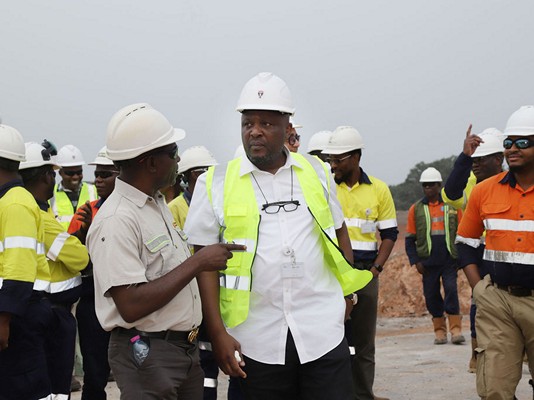
The Government of Ghana has formally awarded the Damang Gold Mine lease to Engineers and Planners Limited, a Ghanaian-owned mining firm founded by Ibrahim Mahama, marking one of the most consequential shifts in the country’s mining sector in recent years. The decision, reached after a competitive tender process, signals a deliberate policy move toward strengthening local ownership in large-scale mineral resource operations.
According to official disclosures, Engineers and Planners Limited emerged as the successful bidder following a technical and financial evaluation overseen by the Minerals Commission and the Ministry of Lands and Natural Resources. Competing firm Heath Goldfields Limited failed to meet the required technical threshold, effectively narrowing the field and clearing the path for the indigenous company’s selection.
The Damang mine, located in Ghana’s Western Region, has historically been operated by Gold Fields, which held the lease for nearly three decades. However, the government declined to renew the lease after its expiration in 2025, opting instead to transition the asset back under Ghanaian control as part of a broader strategic reset within the mining sector.
The transition is not abrupt but the culmination of a multi-year process. Evidence from industry documents shows that Engineers and Planners had been positioning itself for the acquisition as far back as 2022, leveraging its longstanding role as a contractor at the Damang site. This operational familiarity, combined with over three decades of mining services experience, placed the company in a uniquely advantageous position during the bidding process.

Government officials have emphasized that the decision was guided by both technical competence and financial readiness. Engineers and Planners reportedly demonstrated access to more than 500 million dollars in financing, surpassing the government’s minimum requirement and reinforcing its capacity to undertake what is widely considered a capital-intensive revival of the mine. The Damang asset is estimated to require between 600 million and 1 billion dollars in investment to restore full-scale production and extend its operational life.
Beyond financing, the company’s deep integration into the Damang operations played a decisive role. Having worked extensively on-site, Engineers and Planners possesses detailed knowledge of the mine’s geology, infrastructure, and workforce dynamics. This familiarity reduces transition risk and aligns with the government’s stated objective of ensuring continuity in production while safeguarding jobs.
The decision also reflects a broader policy shift. Ghana has increasingly sought to recalibrate its mining framework to ensure greater local participation and value retention. For decades, large-scale gold mining has been dominated by multinational firms, with limited indigenous ownership at the highest levels of operation. By awarding the Damang lease to a Ghanaian company, the government is signaling a clear intention to alter that balance.
However, the move is not without controversy. The ownership structure of Engineers and Planners, led by Ibrahim Mahama, the brother of President John Dramani Mahama, has already triggered public debate around governance, transparency, and perceived conflicts of interest. While authorities insist that the selection process was competitive and merit-based, the political optics of the decision are unavoidable.
From a policy standpoint, the government’s justification rests on economic nationalism and industrial capacity building. Officials argue that empowering local firms to operate major assets will deepen domestic expertise, retain more profits within the economy, and reduce reliance on foreign operators. This aligns with similar resource-nationalist strategies seen across Africa, where governments are seeking to capture greater value from extractive industries.
Yet the real test lies ahead. Managing a large-scale gold mine is significantly more complex than providing contract mining services. Engineers and Planners will be required to transition from a service provider to a full operator, assuming responsibility for exploration, production, environmental compliance, and long-term capital investment. The scale of this transition introduces operational and financial risks that cannot be ignored.

There are also broader market considerations. Gold Fields’ exit from Damang was partly influenced by declining reserves and questions about the mine’s long-term economic viability. Reviving the asset will require not only capital but also strategic planning to identify new reserves and optimize production efficiency. Failure to achieve this could undermine the very objective of local ownership by turning the mine into a financial burden rather than an economic asset.
For Ghana, the stakes extend beyond Damang itself. The success or failure of this transition will shape investor confidence in the country’s mining sector and influence future policy decisions on resource management. A successful handover could establish a model for indigenous participation in large-scale mining, while a failed one could reinforce skepticism about the viability of such transitions.
As the April 2026 handover date approaches, attention will increasingly focus on execution. The government has made a bold decision. The responsibility now shifts to Engineers and Planners to prove that local ownership can deliver not just political symbolism, but operational excellence and economic value.
Ghana joins growing African boycott of London energy summit over discrimination concerns