

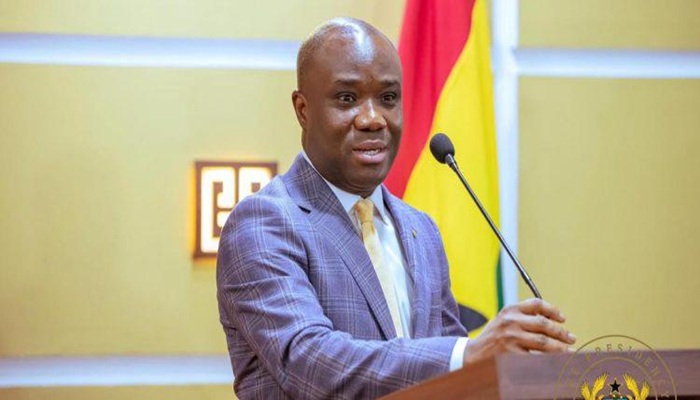
The government has signalled a clear shift in tone on one of Ghana’s most contested social debates, with Felix Kwakye Ofosu stating that LGBTQ-related issues are “not a priority” for Ghanaians, reinforcing a broader political stance that places economic and social concerns above identity-based policy debates.
According to remarks reported by MyJoyOnline, the Minister of State in charge of Government Communications argued that public attention in Ghana is overwhelmingly focused on bread-and-butter issues such as jobs, cost of living, and economic stability, rather than debates surrounding sexual orientation and gender identity. His comments come at a time when discussions around the controversial anti-LGBTQ bill continue to resurface in political discourse.
The statement is not isolated. It aligns with a consistent position within the current administration led by John Dramani Mahama, which has repeatedly framed LGBTQ matters as secondary to broader national priorities and rooted policy decisions in cultural context and public consensus.

At its core, the position reflects a political calculation grounded in public sentiment. Surveys and historical data show that societal attitudes toward LGBTQ issues in Ghana remain overwhelmingly conservative, with strong resistance shaped by cultural, religious, and traditional values. This creates a political environment where leaders face limited incentives to prioritise LGBTQ rights over economic reforms or governance challenges.
However, Kwakye Ofosu’s framing introduces a more explicit hierarchy of priorities. By stating that LGBTQ issues are not central to the national agenda, the government is effectively redefining the debate from one of rights to one of relevance. The implication is clear: policy attention will be directed where political and economic pressure is highest, not necessarily where global advocacy is loudest.
This position also serves a strategic purpose. Ghana has faced increasing international scrutiny over its stance on LGBTQ rights, particularly in relation to the proposed Human Sexual Rights and Family Values Bill. That legislation, which has drawn criticism from global human rights organisations, remains politically sensitive due to its potential economic implications, including warnings of reduced international funding and strained diplomatic relations.
By downplaying the issue domestically, the government creates room to manage external pressure without appearing to concede internally. It is a balancing act between sovereignty and diplomacy, one that many African governments have adopted in similar contexts.
Yet the argument that LGBTQ issues are not a priority raises a deeper question about governance itself. Public priorities are not static; they are shaped by leadership, policy framing, and institutional direction. Declaring an issue as secondary does not eliminate it, it simply postpones engagement. In practical terms, this means that legal ambiguities, social tensions, and international pressure will continue to exist beneath the surface.
There is also a structural contradiction embedded in the current stance. While the government insists the issue is not a priority, it continues to engage with related legislation and policy discussions. The anti-LGBTQ bill, for instance, remains a subject of parliamentary and political attention, indicating that the issue is not entirely peripheral.
Economically, the stakes are not negligible. Ghana’s development partnerships, access to funding, and global reputation are increasingly linked to governance standards, including human rights considerations. While domestic consensus may favour a conservative approach, the international system operates on a different set of expectations, creating friction that cannot be ignored indefinitely.

Ultimately, Kwakye Ofosu’s statement is less about dismissing LGBTQ issues entirely and more about redefining the political narrative around them. It signals a government intent on controlling the terms of the debate, prioritising economic recovery and social stability while keeping contentious social issues at the margins.
But that approach has limits. Issues that are labelled as non-priorities rarely disappear; they evolve, often resurfacing at moments of political or economic vulnerability. Ghana’s leadership may have succeeded in reframing the conversation for now, but the underlying tensions, both domestic and international, remain unresolved.
The question is no longer whether LGBTQ issues are a priority today. It is whether postponing them will make them easier or harder to confront tomorrow.
Lincoln University cancels Honorary Doctorate for president Mahama amid LGBTQ+ controversy