

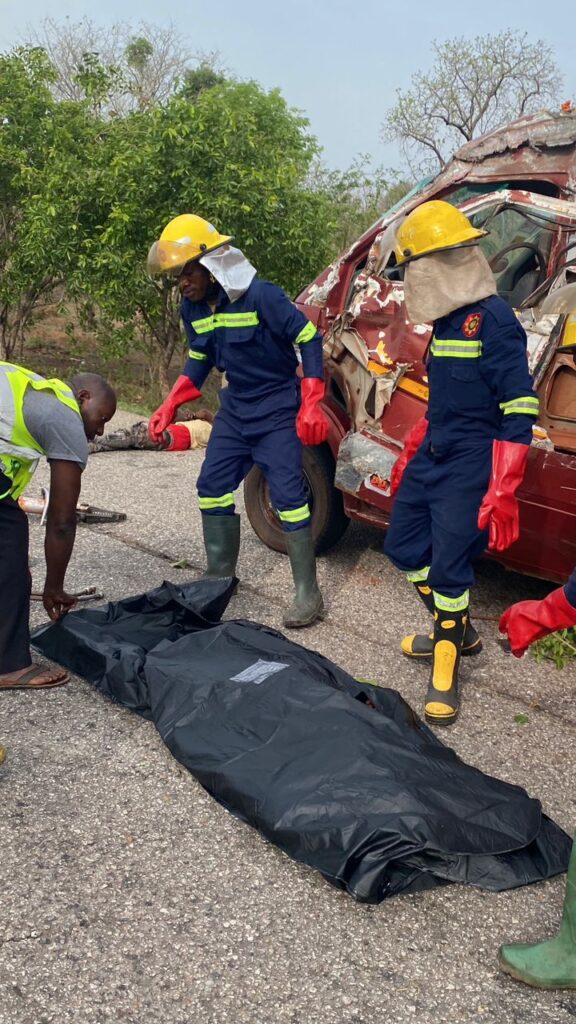
Four people have been confirmed dead and 14 others injured following a devastating road collision at Dawadawa along the Kintampo–Tamale Highway in the Bono East Region of Ghana. The accident, which took place in the early hours of Saturday, April 4, 2026, involved a Kia Rhino truck loaded with poultry feed and a Sprinter bus transporting passengers, adding another grim chapter to a highway that has long been synonymous with road carnage in the country.
The Ghana National Fire Service (GNFS), Bono East Region, received an emergency distress call at 06:55 GMT and immediately dispatched an eight-member rescue team to the scene, led by Assistant Station Officer Emmanuel Agyekum. On arrival, firefighters found both vehicles severely damaged, with several occupants trapped inside the wreckage. Rescue personnel worked under difficult conditions to free victims pinned inside the mangled vehicles. Four of those extracted were pulled out unresponsive and later confirmed dead, with their remains handed over to the police. Fourteen survivors who sustained varying degrees of injuries were transported to the Kintampo Municipal Hospital for emergency medical attention. The cause of the crash has not yet been determined, and investigations are ongoing.
The tragedy comes barely 24 hours after another deadly incident on the same highway corridor. On the morning of Friday, April 3, nine people lost their lives and 27 others were left in critical condition following a collision on the Kintampo–Tamale highway near Suronuase in the Kintampo North Municipality. That crash involved a passenger bus travelling toward Widaana in the Pusiga District and a cargo truck transporting tomatoes toward Kumasi, after the bus attempted to overtake two vehicles and veered into the path of the oncoming truck. Victims were transported to health facilities in Kintampo, Wenchi and Techiman, while those in the most critical condition were referred to the Komfo Anokye Teaching Hospital and the Tamale Teaching Hospital for specialised care.
The Kintampo–Tamale stretch has earned a fearsome reputation over many years. Analysts and journalists who have studied the corridor point to driver fatigue as one of the most persistent dangers, noting that many commercial buses travel overnight and drivers are often visibly exhausted by the time they reach the Kintampo area. The community of Dawadawa itself has featured in near-miss incidents involving drowsy drivers. Unlike many other highways in Ghana that suffer from poor road conditions, observers note that the physical state of this particular stretch is not the primary problem. The danger lies in driver behaviour, particularly speeding, overnight travel without relief drivers, and a general disregard for traffic regulations.

The Easter weekend has once again exposed the vulnerability of Ghanaian road users during festive periods, when travel surges dramatically. The National Road Safety Authority (NRSA), in collaboration with the Motor Traffic and Transport Department of the Ghana Police Service, rolled out a nationwide enforcement programme ahead of the Easter festivities, targeting speeding, dangerous overtaking, drunk driving and driver fatigue as key contributors to road accidents during high-travel periods. Despite these precautionary campaigns, the NRSA’s own data reveals that at least eight people die from road crashes every single day in Ghana, with the figure sometimes climbing higher.
The broader picture painted by road safety data is deeply troubling. Between January and November 2025, road traffic crashes killed 2,673 people in Ghana, representing an 18.5 per cent rise over the previous comparable period. The NRSA attributed the surge to speeding, drink-driving, unlicensed driving and the use of unregistered vehicles as the leading causes of crashes. Statistics from the National Road Traffic Crash and Casualty Situation Report recorded 13,320 crashes during that period, involving 22,532 vehicles and resulting in 15,173 injuries, of which 17 per cent were fatal. Males constituted approximately 80 per cent of fatalities, and 296 of those killed were under 18 years of age.
Authorities are once again urging the public to take road safety seriously. The GNFS, in its statement on the Dawadawa crash, called on drivers to exercise greater restraint and to strictly observe all road safety regulations. The NRSA has similarly reminded drivers to ensure vehicles are roadworthy before long journeys, to respect speed limits, wear seatbelts, and avoid distracted or impaired driving. The message is consistent and familiar, yet the death toll on Ghana’s roads continues to rise. What remains urgently needed is not only public education but sustained enforcement, improved accountability for commercial transport operators, and serious consideration of policies such as mandatory rest periods and dual-driver requirements for long-distance routes. Until those structural changes are made, tragedies like the one at Dawadawa will remain a predictable and recurring feature of Ghana’s festive seasons.
