

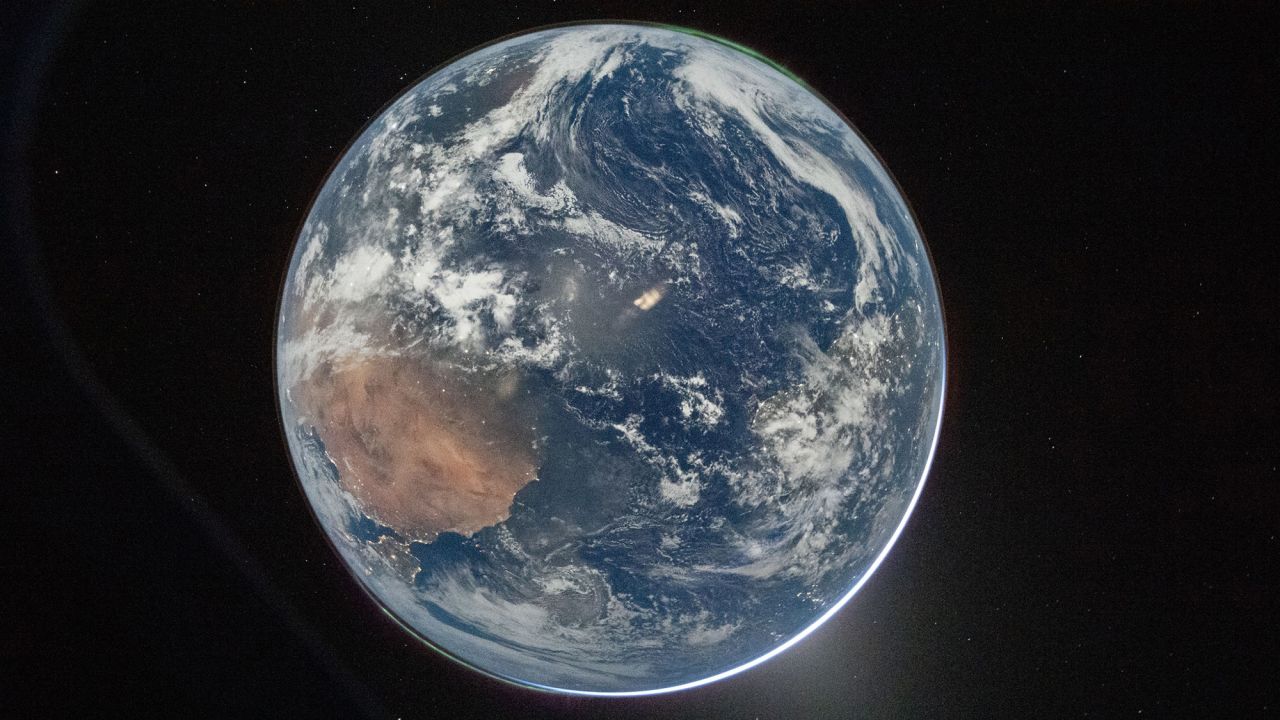
NASA’s Artemis II crew has released the first high resolution images of Earth taken during their historic journey toward the Moon, offering a striking visual reminder of humanity’s return to deep space travel for the first time in more than five decades.
The images, shared by NASA, were captured shortly after the crew completed a critical engine burn known as the trans lunar injection, which propelled the Orion spacecraft out of Earth’s orbit and set it on a trajectory toward the Moon. The mission is now in transit on a looping path that will take the astronauts around the far side of the Moon before returning to Earth, marking the first crewed mission beyond low Earth orbit since 1972.
One of the most prominent images, titled “Hello, World,” shows Earth suspended against the darkness of space, with the vast blue of the Atlantic Ocean clearly visible. The planet appears framed by a thin glowing layer of atmosphere, while faint green auroras shimmer near both poles. In the same frame, Venus is visible as a bright point of light, underscoring the depth of the cosmic backdrop captured by the Orion spacecraft.
NASA confirmed that the image was taken by mission commander Reid Wiseman, who described the experience as both technically challenging and visually overwhelming. According to mission communications, the crew had to adjust camera settings repeatedly due to the extreme distance and lighting conditions, which initially made it difficult to capture properly exposed images of Earth from space.

Another image taken by Wiseman, titled “Artemis II Looking Back at Earth,” shows the planet from one of Orion’s main viewing windows, highlighting the curvature of Earth and the transition between day and night across its surface. This boundary, known as the terminator, divides sunlight and darkness across the globe, creating a dramatic visual contrast that is often used by scientists to study atmospheric and environmental conditions.
The mission specialist Jeremy Hansen also reported moments of intense excitement among the crew after the engine burn was completed. He told mission control in Houston that the astronauts were “glued to the windows,” constantly taking photographs as they observed Earth from deep space for the first time in their mission profile. He added that the view of Earth illuminated by the Moon was particularly striking, describing it as a rare and breathtaking perspective.
At one point, Wiseman reportedly contacted mission control asking for advice on cleaning the spacecraft windows, which had become slightly smudged due to repeated handling during the intense photography sessions. The incident reflected the human side of the mission, as the astronauts balanced strict operational procedures with the awe of witnessing Earth from such an extraordinary distance.
NASA noted that the Artemis II mission represents a major milestone in its broader Artemis program, which aims to return humans to the Moon and establish a long term presence in lunar orbit and on the surface. The current flight is a key step in testing spacecraft systems, crew performance, and deep space navigation capabilities ahead of future lunar landings.
The spacecraft, Orion, is currently on a multi day trajectory that will carry the crew around the Moon’s far side. The astronauts are expected to pass behind the lunar surface on April 6 before beginning their return journey, with splashdown scheduled for April 10. This carefully planned path is designed to test navigation systems in deep space conditions and confirm the spacecraft’s ability to support human life far beyond Earth’s protective orbit.

NASA officials have described the mission as a critical rehearsal for future exploration, including eventual crewed missions to the lunar surface and potentially beyond. The success of Artemis II is expected to pave the way for Artemis III, which aims to land astronauts on the Moon for the first time in the 21st century.
Beyond its technical objectives, the mission has also captured global attention due to the powerful imagery being sent back to Earth. The photographs highlight not only scientific achievement but also the emotional and philosophical impact of viewing Earth as a fragile, isolated world in the vastness of space.
As Artemis II continues its journey, NASA says additional images and data will be shared with the public, offering an unprecedented look at both the Moon and Earth from deep space. The mission stands as a symbol of renewed human ambition in space exploration, blending cutting edge technology with a renewed drive to push the boundaries of what is possible beyond our planet.
SpaceX moves toward historic IPO with US$1.75tn valuation ambitions