

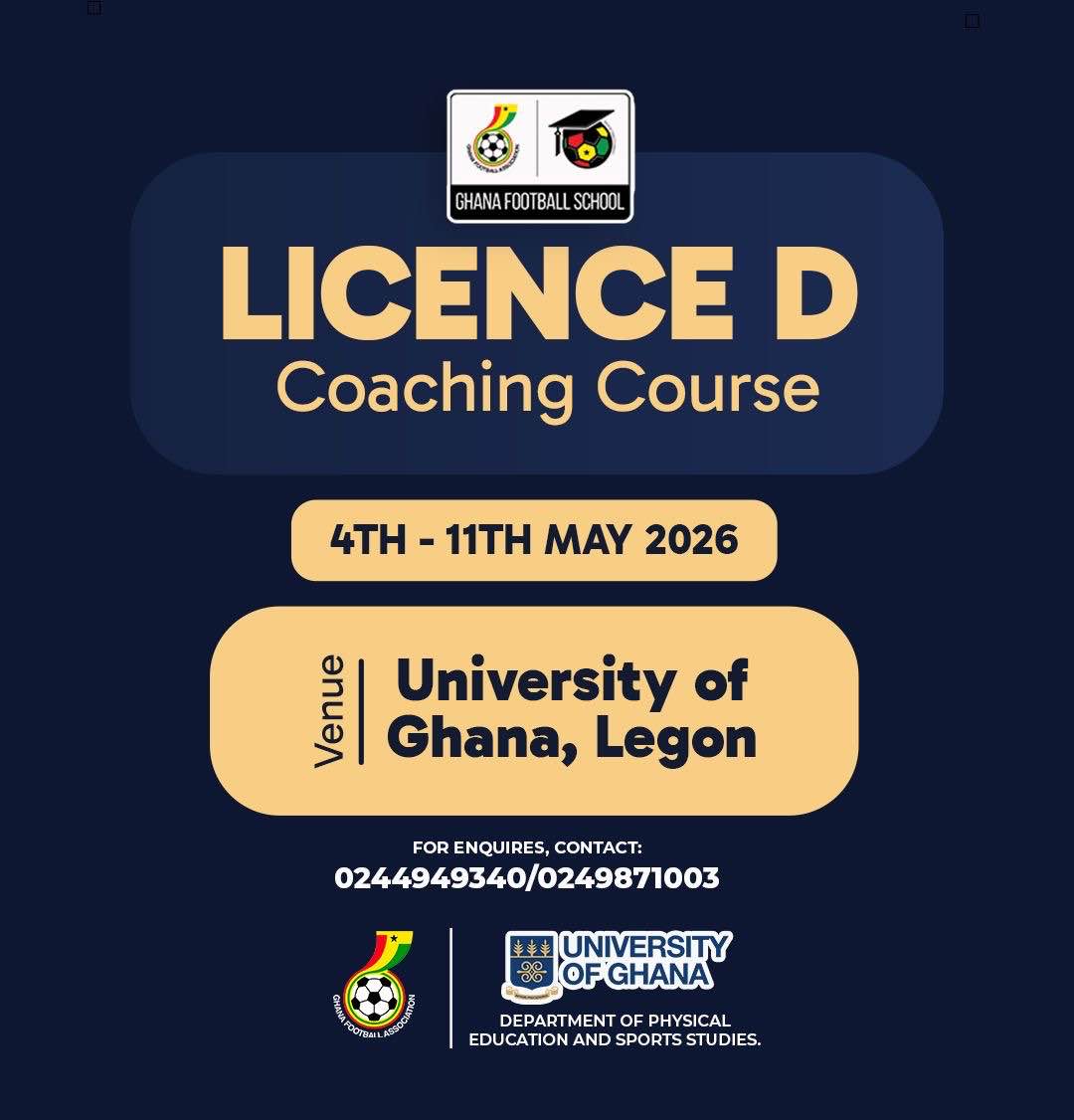
The Ghana Football Association (GFA) and the University of Ghana have announced a new collaboration to offer a Licence D coaching course, marking a significant step in advancing coaching education and grassroots football development in the country. The eight-day programme is scheduled to run from May 4 to May 11, 2026, at the University of Ghana campus. The initiative aims to equip aspiring coaches with both theoretical knowledge and practical skills to begin careers in professional football coaching.
The course is designed for students of Physical Education and Sport Studies at the University of Ghana, as well as other university students interested in football coaching. By combining classroom lectures with on-field practical sessions, the programme provides a comprehensive introduction to coaching fundamentals, modern training methods, and coaching psychology. Participants will be assessed through practical exercises and written examinations, and those who meet the required standards will be awarded the Licence D coaching certificate, enabling them to commence formal coaching within Ghana’s football ecosystem.
This collaboration forms part of the GFA’s broader objective under its Ghana Football School to strengthen football at the grassroots level by expanding the pool of qualified and certified coaches. By partnering with academic institutions, the Association is creating accessible pathways for young professionals and students to gain essential coaching qualifications. Football development experts believe that increasing the number of qualified coaches across the country can help nurture talent more effectively, ensuring young players receive proper guidance from well-trained mentors from an early stage.
Licence D coaching courses are foundational within the GFA’s coach education framework and serve as the first step in a structured pathway leading to higher coaching licences, including Licence C and beyond. Previous courses delivered in regions such as the Upper East and Volta Region have successfully trained dozens of coaches in theory and practical instruction, covering player development, tactics, and youth coaching methodologies.
These regional efforts have produced tangible results, with colts and women’s club coaches obtaining Licence D certificates and applying their skills to grassroots football in communities across Ghana. In recent years, the GFA has also made considerable efforts to ensure gender inclusion in coaching education, with women’s clubs and female coaches benefiting from fully funded coaching courses. This initiative has increased the number of women coaches at various levels of the game and expanded opportunities for female participation in technical roles.
The University of Ghana partnership is expected to build on these achievements by providing students with formal coaching exposure earlier in their professional journeys. The curriculum will emphasise modern coaching principles such as effective communication, session planning, fitness and injury prevention, child safeguarding, and foundational tactical understanding. Practical sessions will allow participants to apply theoretical insights on the football field, enhancing their confidence and readiness for real-world coaching scenarios.
In addition to training and assessment, there is an emphasis on mentorship and long-term development. The GFA encourages participants to remain engaged in continuous learning and to pursue further coaching qualifications as they advance. The Association’s technical directorate often provides follow-on opportunities and support for Licence D holders to progress to more advanced courses, reflecting a commitment to building a robust coaching culture nationwide.
Stakeholders in Ghanaian football have welcomed the collaboration with the University of Ghana, noting that university-based coaching education can bridge the gap between academic study and professional sport. Students who complete the course will not only gain certification but also a clearer understanding of the coaching profession’s ethical and technical expectations. This aligns with broader ambitions to professionalise coaching standards in Ghana and ensure that youth, colts, and women’s teams benefit from high-quality instruction that supports long-term player development.
As the football season progresses and interest in coaching careers continues to grow, the Licence D course represents an important opportunity for young Ghanaians to enter the coaching pathway with confidence. With rigorous training, assessment, and certification, participants will be better positioned to contribute meaningfully to the game’s growth at all levels and help shape the future of Ghanaian football.