

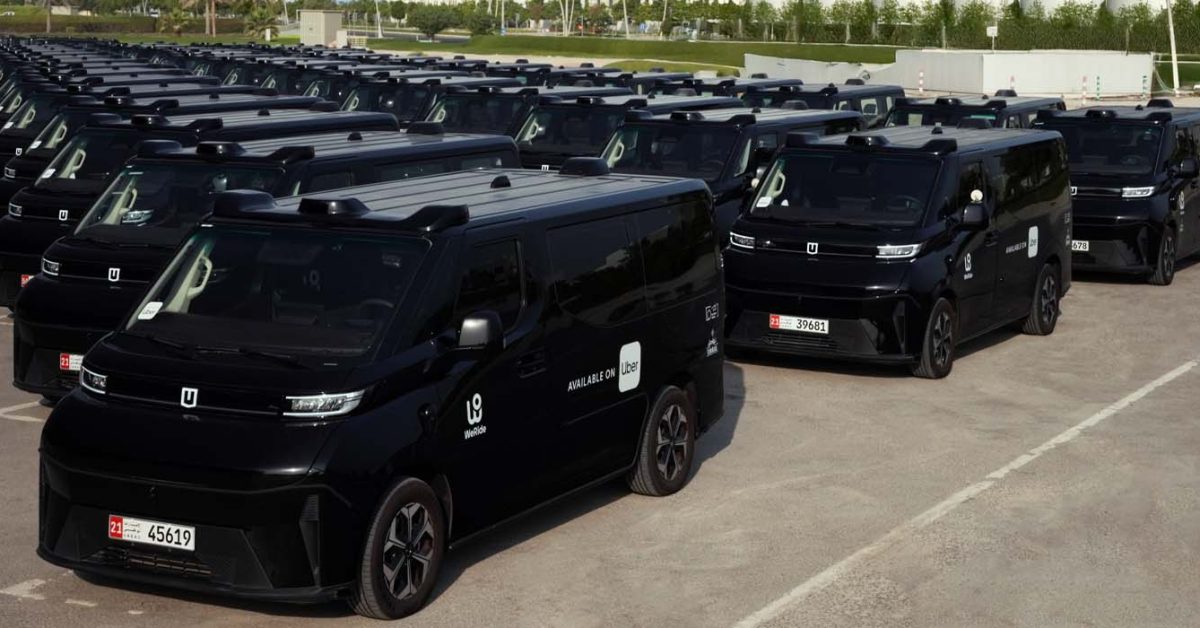
Uber has increased its stake in autonomous vehicle company WeRide as both firms accelerate the rollout of driverless robotaxi services in Dubai, marking a significant step forward in the global push toward commercial self-driving transport.
The partnership has now moved beyond pilot testing, with Uber and WeRide officially launching robotaxi operations in Dubai without a human safety operator onboard. The expansion positions the city as one of the early global hubs for fully autonomous ride-hailing services in real-world urban conditions.
The move reflects Uber’s renewed strategy of investing in autonomous mobility partnerships rather than building the technology entirely in-house. By strengthening its stake in WeRide, the company is signalling confidence in the Chinese autonomous driving firm’s ability to scale commercially viable self-driving systems.
Dubai, which has positioned itself as a testbed for future transport technologies, has been central to this rollout. The city’s regulatory environment, infrastructure investment and ambition to make 25 percent of all trips autonomous by 2030 have made it a natural launchpad for robotaxi services.

WeRide’s deployment in Dubai represents one of the first instances of fully driverless commercial ride-hailing in the Middle East. The service is expected to operate in designated zones, using pre-mapped routes and AI-powered navigation systems designed to handle complex urban traffic conditions.
The expansion also highlights intensifying competition in the global autonomous vehicle industry. Companies such as Waymo, Tesla and Baidu are all racing to scale robotaxi operations, with varying approaches to safety, regulation and deployment.
For Uber, the partnership is part of a broader pivot toward becoming a platform that integrates autonomous vehicles from multiple providers. Instead of owning fleets, the company is positioning itself as a mobility aggregator, connecting users to a mix of human driven and self-driving services depending on availability and regulation.
WeRide, meanwhile, is using international partnerships to expand its footprint beyond China, where it has already conducted extensive autonomous testing and limited commercial deployments. The collaboration with Uber gives it access to global markets and real-world operating environments that are critical for refining its technology.
Dubai’s Roads and Transport Authority has played a key role in enabling the rollout, working with private sector partners to establish regulatory frameworks for autonomous mobility. The city has consistently pushed for innovation in transport, including flying taxis and smart mobility systems, as part of its long term urban development strategy.
However, challenges remain. Fully autonomous driving in dense urban environments continues to face technical and regulatory hurdles, including edge cases in traffic behaviour, unpredictable pedestrian movement and liability frameworks in the event of accidents.
Despite these challenges, early deployments like the one in Dubai are seen as crucial testing grounds for scaling the technology. They allow companies to gather real world data, refine algorithms and build public trust in autonomous systems.

The Uber WeRide expansion also reflects a broader global trend in which mobility, artificial intelligence and urban planning are increasingly intersecting. Governments are actively experimenting with automation as a solution to congestion, emissions and transport inefficiency.
If successful, Dubai’s robotaxi rollout could become a model for other cities seeking to integrate autonomous vehicles into their public transport ecosystems. It also signals that the transition from experimental self-driving systems to commercial deployment is gradually becoming reality.
As the partnership scales, the focus will shift to safety performance, regulatory approval for wider geographic expansion and the economic viability of replacing human drivers in selected transport segments.
For now, the launch marks a significant milestone: driverless ride-hailing has moved from concept to commercial operation in one of the world’s most ambitious smart cities.
Uber Eats launches AI assistant to help with grocery cart creation