

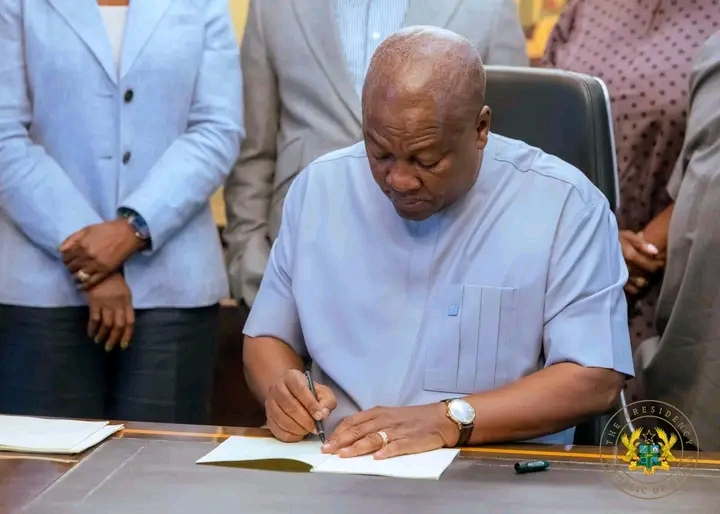
President John Dramani Mahama has assented to five significant pieces of legislation passed by Parliament, marking a broad legislative intervention aimed at restructuring Ghana’s security architecture, strengthening financial protections and advancing reforms in education and taxation.
The bills, signed into law on Tuesday March 31 2026, include the Security and Intelligence Agencies Act, the University of Engineering and Agricultural Sciences Act, the Ghana Deposit Protection Amendment Act, the Growth and Sustainability Levy Amendment Act and the Education Regulatory Bodies Amendment Act. The move represents one of the most comprehensive batches of legislation enacted simultaneously under the current administration, reflecting a multi sector reform agenda.
At the centre of the new laws is the Security and Intelligence Agencies Act, 2026, which introduces a significant institutional change by scrapping the Office of the Minister of National Security. Under the new framework, the President now has the authority to assign oversight of security agencies to any designated minister, a move intended to streamline coordination and reduce bureaucratic bottlenecks within the national security structure. The law also reverts the name of the National Intelligence Bureau back to its original designation, the Bureau of National Intelligence, in a bid to eliminate confusion with the National Investment Bank and restore institutional clarity.

The restructuring of Ghana’s intelligence architecture comes at a time when governments globally are seeking more flexible and integrated security systems capable of responding to complex threats. Analysts say the change could enhance executive control and coordination, although it also places greater responsibility on the presidency to ensure accountability and oversight.
Another major highlight of the legislative package is the University of Engineering and Agricultural Sciences Act, 2026, which establishes a new public university aimed at boosting Ghana’s capacity in technical and agricultural education. The institution will be headquartered at Bonsu in the Eastern Region, with additional campuses planned for Ohawu in the Oti Region and Acherensua in the Ahafo Region. The new university is expected to play a critical role in addressing skills gaps in engineering, agribusiness and applied sciences, sectors considered essential for Ghana’s industrialisation and food security strategies.
Education sector reforms are further reinforced through the Education Regulatory Bodies Amendment Act, which introduces greater flexibility for private tertiary institutions. The amendment allows such institutions to pursue charter status more easily, potentially expanding their autonomy and enhancing their ability to compete within Ghana’s higher education landscape. This aligns with broader efforts to diversify educational opportunities and improve quality assurance frameworks across the sector.
On the financial front, the Ghana Deposit Protection Amendment Act expands the scope of deposit insurance to include mobile money wallets and other digital financial platforms. This marks a significant step in recognising the rapid growth of digital finance in Ghana, where mobile money has become a dominant channel for transactions and savings. By extending protection beyond traditional banking deposits, the law aims to boost consumer confidence and safeguard financial inclusion gains.
The amendment reflects evolving global financial trends, where digital financial services are increasingly integrated into formal regulatory systems. Experts note that such measures are crucial in protecting users from systemic risks while encouraging broader participation in the digital economy.
The Growth and Sustainability Levy Amendment Act, 2026, introduces a key fiscal adjustment by reducing the levy on mining companies from 3 percent back to 1 percent. According to the President, the reduction is linked to the introduction of a sliding scale royalty system, which is expected to ensure that government revenue from the mining sector remains balanced while reducing the tax burden on companies. The decision signals an attempt to maintain Ghana’s attractiveness as a mining investment destination while ensuring that the country continues to derive value from its natural resources.

The legislative developments come within the broader context of the government’s ongoing reform agenda, which has included previous measures such as tax adjustments and economic policy interventions aimed at easing financial pressures on households and businesses . Together, the newly signed laws reflect a coordinated effort to address structural challenges across multiple sectors while positioning Ghana for long term growth.
The signing ceremony was attended by senior government officials, including members of the executive and key institutional leaders, underscoring the importance of the reforms. As implementation begins, attention will shift to how effectively the new laws translate into tangible outcomes across security, education and financial systems.
The package of legislation signals a clear policy direction focused on institutional reform, economic stability and social protection. However, the true impact will depend on enforcement, administrative efficiency and the ability of relevant agencies to operationalise the provisions effectively in the months ahead.
Mahama orders full probe into Big Push sole sourcing allegations