

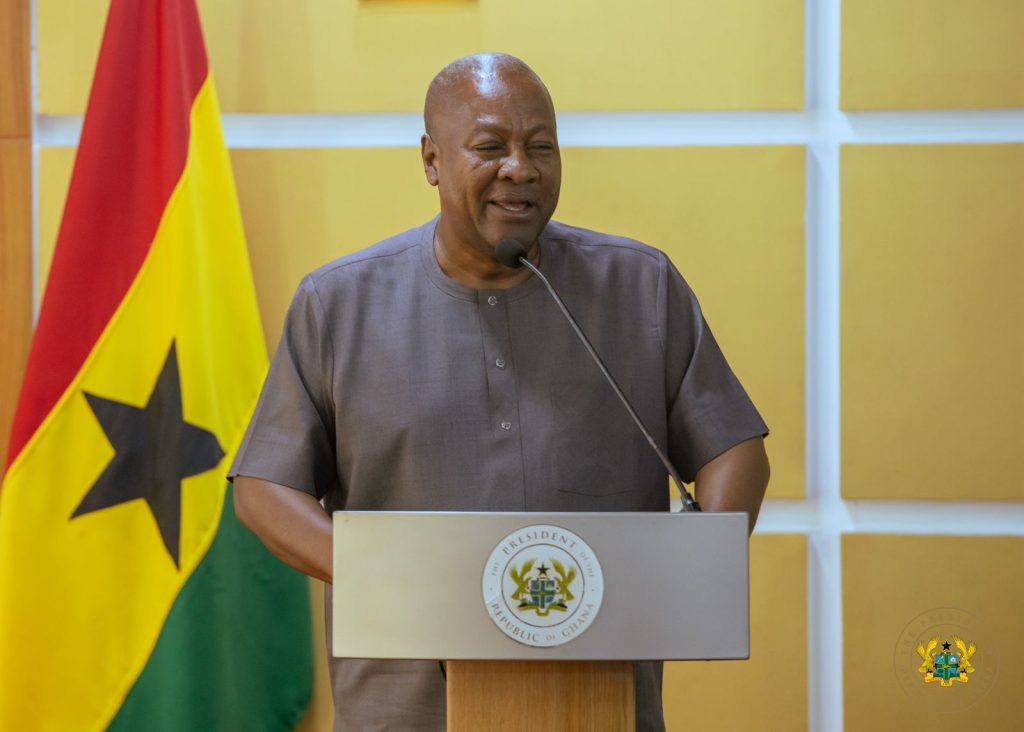
President John Dramani Mahama has widened the scope of the country’s security services recruitment initiative by directing that the number of new recruits be increased from 20,000 to 40,000 over the next four years. This decision was taken in response to briefings on the progress of the ongoing recruitment exercise and reflects an intensified focus on strengthening national security capacity.
The directive was announced following a high‑level meeting at the Presidency on March 16, 2026, which brought together the heads of Ghana’s security agencies, the Minister for the Interior, the Acting Minister for Defence, and senior presidential advisors. During the session, officials reviewed the current recruitment process and the challenges facing efforts to expand personnel across the Ghana Police Service, Ghana Armed Forces, Ghana Immigration Service, Ghana Prisons Service, Fire Service, and other key security bodies.
President Mahama said there was a clear need to increase the number of personnel in the security services to enhance the country’s ability to tackle crime, protect communities, and address evolving security threats. He directed that the total number of recruits be doubled from the previously planned 20,000 to 40,000, to be enlisted over four years.

In a statement, the President emphasised that the expansion of recruitment was not only about numbers but also about transparency and fairness, insisting that the selection process should be conducted openly and accountably to maintain public confidence. Key officials present at the meeting included the Chief of Staff, Secretary to the President, National Security Coordinator, and director-generals of the major security agencies.
The decision marks a significant shift from earlier projections for the recruitment exercise. In early March, the Minister for the Interior, Muntaka Mohammed-Mubarak, had highlighted the scale of interest from qualified applicants while also pointing to fiscal constraints limiting intake. More than 105,000 candidates, including tertiary graduates and WASSCE certificate holders, had qualified for medical screening, but only about 5,000 recruits were expected to be enlisted in the current phase due to budgetary limitations.

At the time, the Interior Minister had assured prospective recruits that their details would be retained for future recruitment rounds once Ghana had completed its economic programme with the International Monetary Fund. He indicated that the first phase of recruitment was aimed at addressing the immediate needs of 2025, with additional recruitment exercises to follow.
The President’s new directive effectively quadruples the average annual intake in the next four years, implying an average of 10,000 recruits annually, compared to the previously expected 5,000 for the current year alone. While details on the planned distribution of recruits across the various agencies have not yet been released, the broader target reflects a marked escalation in the government’s efforts to bolster security manpower.
Analysts say the expanded recruitment target aligns with broader security policy objectives outlined by the current administration, including ongoing institutional reforms to strengthen internal stability and improve national security outcomes. Bolstering the capacity of security agencies remains a central priority amid concerns over crime, cross-border threats, and internal communal tensions.
However, the increased target also raises questions about the fiscal implications of such rapid expansion given prior concerns about budgetary constraints. Government officials have not yet provided a detailed breakdown of how the expanded recruitment will be financed or the specific timeline for phased implementation beyond the four-year framework.

For many prospective recruits, the announcement offers renewed hope after months of uncertainty about their chances of enlisting. With a large pool of qualified applicants already screened, the expanded target could provide opportunities for thousands more Ghanaians aspiring to serve in the nation’s security forces, potentially reducing unemployment pressures among youth and graduates.
As the recruitment process progresses, the emphasis on transparency and accountability will be critical to ensuring that the expanded intake meets national needs while sustaining public trust in the institutions tasked with safeguarding Ghana’s security.