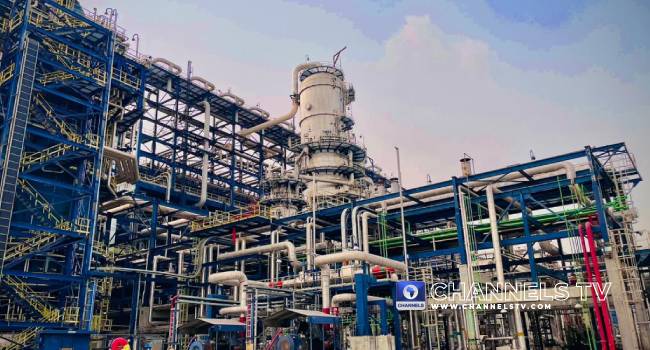
Dangote to build Africa’s largest detergent raw material plant as refinery reaches full capacity

0
156

Africa’s richest industrialist, Aliko Dangote, has announced plans to construct the continent’s largest Linear Alkyl Benzene production facility within the sprawling Dangote Refinery complex, marking a significant expansion of Nigeria’s petrochemical ambitions.

The new plant will produce 400,000 tonnes of Linear Alkyl Benzene annually, positioning Nigeria to potentially meet the entire African demand for the key detergent feedstock. Linear Alkyl Benzene, commonly referred to as LAB, is a critical raw material used in the manufacture of surfactants, the active cleaning agents found in soaps and detergents. It is not a finished consumer product but a foundational industrial input for detergent manufacturers.

Dangote disclosed the plan during a tour of the refinery with Bayo Ojulari, Group Chief Executive Officer of the Nigerian National Petroleum Company Limited. According to Dangote, the facility is expected to be completed within 30 months.

dangote

He noted that Africa currently has only two LAB plants, one in Algeria with a capacity of 100,000 tonnes and another in Egypt producing 50,000 tonnes annually. The proposed 400,000 tonne output in Nigeria would significantly exceed existing continental capacity and could eliminate the need for large scale imports of the product.

The development comes as the $20 billion Dangote Refinery, widely described as Africa’s largest single train refinery, moves toward stabilising full capacity fuel production. With refining operations advancing, Dangote is repositioning the site from a traditional refinery into a broader industrial hub hosting multiple petrochemical and manufacturing operations.

Industry analysts say the LAB project signals a strategic shift from basic refining to deeper value chain integration. By producing key petrochemical inputs locally, Nigeria could reduce foreign exchange pressure tied to imports while strengthening domestic manufacturing capacity.

Africa’s detergent manufacturers have historically relied on imported LAB from Europe, the Middle East and Asia due to limited local production. A large scale domestic supply could lower production costs, encourage new entrants into the sector and stimulate downstream industrial growth.

Dangote to build Africa’s largest detergent raw material plant as refinery reaches full capacity

The refinery complex already includes petrochemical components and is integrated with other Dangote Group operations spanning fertiliser, cement, agriculture and industrial manufacturing. The addition of a high capacity LAB plant further embeds the conglomerate within Africa’s industrial supply chains.

For Nigeria, the project aligns with broader policy goals of import substitution, industrialisation and economic diversification away from crude oil exports. Expanding petrochemical production enhances the country’s ability to capture more value from its hydrocarbon resources rather than exporting raw materials.

However, the project’s success will depend on sustained operational stability, infrastructure support and competitive pricing relative to global suppliers. While the proposed output exceeds current African capacity, demand growth, regional trade frameworks and logistics efficiency will shape its market impact.

dangote

If completed on schedule, the plant would represent one of the largest single investments in Africa’s detergent raw material sector and could position Nigeria as a dominant supplier of LAB across the continent.

Bono Region: Dangote Announces Plans to Establish a Sugar Refinery in Ghana

Author

  • Daniel Ablordey

    Daniel Ablordey is a Business Analytics student at the University of Ghana Business School and an emerging strategist at the intersection of data, markets, and narrative. With a keen analytical mind and a passion for African business and economic trends, he is building a career focused on translating complex data-driven insights into accessible, decision-relevant stories that matter.As a writer and editor with Insight Ghana, African Business Insight, and The African Journal, Daniel delivers sharp, high-impact analysis on current affairs, business developments, and emerging trends across the continent. His work is defined by precision, clarity, and a deep commitment to responsible journalism — ensuring that every story he tells is not only accurate but meaningful to the audiences it serves.Beyond his editorial work, Daniel serves as an Ecobank Youth Ambassador, where he actively promotes financial inclusion, digital banking, and financial literacy among young Ghanaians. His leadership experience spans academic, professional, and faith-based institutions, where he has consistently driven initiatives centered on growth, structure, and long-term impact.Grounded in the principles of Pan-Africanism and service, Daniel brings a rare combination of analytical rigour and storytelling depth to his work. Whether unpacking market behavior, profiling emerging business leaders, or covering cultural shifts shaping the continent, he approaches every assignment with strategic intent and editorial integrity.His broader ambition is to contribute to Africa's transformation by shaping how data, business, and storytelling intersect — not just locally, but on a global stage.

Previous articleGhana and Burkina Faso deepen strategic cooperation with seven comprehensive agreements
Next articleNigeria’s Innoson Group expands to 10,000 workers
Daniel Amenyo Ablordey
Daniel Ablordey is a Business Analytics student at the University of Ghana Business School and an emerging strategist at the intersection of data, markets, and narrative. With a keen analytical mind and a passion for African business and economic trends, he is building a career focused on translating complex data-driven insights into accessible, decision-relevant stories that matter.As a writer and editor with Insight Ghana, African Business Insight, and The African Journal, Daniel delivers sharp, high-impact analysis on current affairs, business developments, and emerging trends across the continent. His work is defined by precision, clarity, and a deep commitment to responsible journalism — ensuring that every story he tells is not only accurate but meaningful to the audiences it serves.Beyond his editorial work, Daniel serves as an Ecobank Youth Ambassador, where he actively promotes financial inclusion, digital banking, and financial literacy among young Ghanaians. His leadership experience spans academic, professional, and faith-based institutions, where he has consistently driven initiatives centered on growth, structure, and long-term impact.Grounded in the principles of Pan-Africanism and service, Daniel brings a rare combination of analytical rigour and storytelling depth to his work. Whether unpacking market behavior, profiling emerging business leaders, or covering cultural shifts shaping the continent, he approaches every assignment with strategic intent and editorial integrity.His broader ambition is to contribute to Africa's transformation by shaping how data, business, and storytelling intersect — not just locally, but on a global stage.