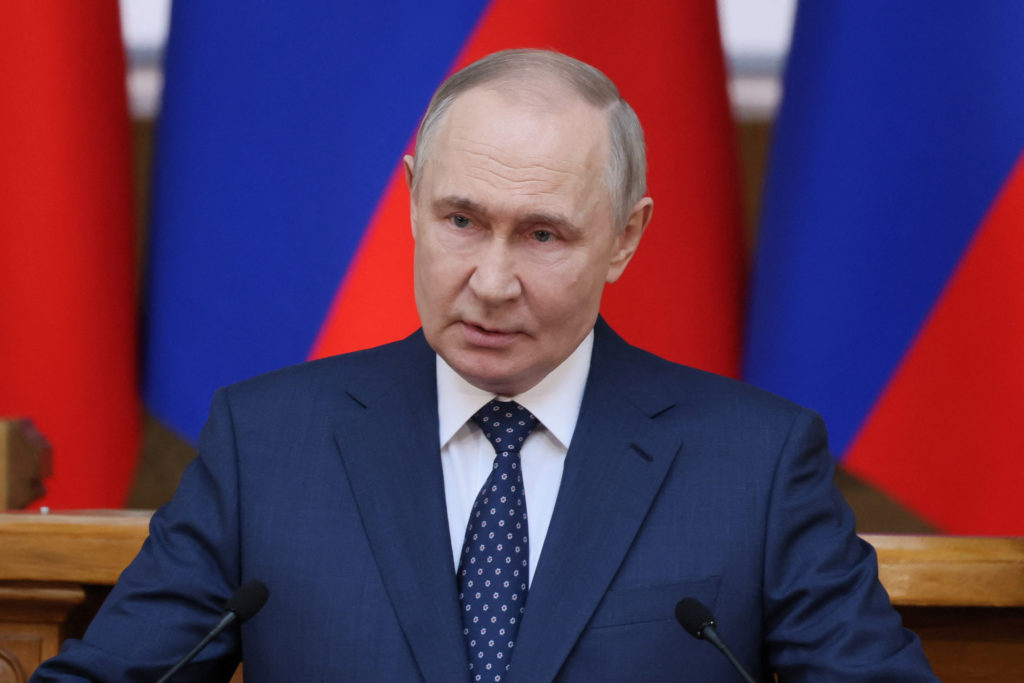
Putin calls development of Russia’s nuclear forces an “absolute priority”

0
132

Russian President Vladimir Putin has declared the continued development of Russia’s nuclear forces an “absolute priority,” underscoring a renewed emphasis on strategic deterrence following the expiration of the last remaining nuclear arms control treaty between Moscow and Washington.

Speaking in a video address marking Russia’s “Defender of the Fatherland Day,” Putin said the strengthening of the country’s nuclear triad, its land-based intercontinental ballistic missiles, submarine-launched ballistic missiles and strategic bombers, remains central to national security.

“The development of the nuclear triad, which guarantees Russia’s security and ensures effective strategic deterrence and a balance of forces in the world, remains an absolute priority,” he stated.

His remarks come after the expiry of the New START agreement earlier this month. The treaty had been the last major arms control framework limiting the strategic nuclear arsenals of Russia and the United States. With its expiration, the two largest nuclear powers are no longer bound by any bilateral nuclear arms control pact.

According to available estimates as of January 2025, Russia possesses more than 4,300 nuclear warheads, while the United States holds approximately 3,700. Together, the two countries account for more than 90 percent of the world’s nuclear weapons stockpile.

Putin calls development of Russia’s nuclear forces an “absolute priority”
Vladimir Putin

Putin also pledged to further reinforce Russia’s army and navy, citing lessons learned from nearly four years of war in Ukraine. Analysts note that both Russia and the United States are actively modernising their nuclear forces, upgrading delivery systems, warheads and command structures, in what many experts describe as a renewed nuclear arms competition.

The end of New START removes transparency mechanisms such as inspections and data exchanges, increasing uncertainty around force levels and deployments. Security analysts warn that without legally binding limits, the risk of miscalculation and strategic instability rises.

Efforts to revive arms control have so far produced no major breakthroughs. Diplomatic engagement between Moscow and Washington has remained strained, even after high-level meetings in recent years. With no successor agreement in place, the global nuclear framework enters what many observers view as a more volatile phase.

Putin’s emphasis on nuclear modernisation signals continuity in Russia’s long-term defence strategy: maintain strategic parity with the United States, ensure deterrence credibility and project military strength amid shifting geopolitical tensions.

Putin calls development of Russia’s nuclear forces an “absolute priority”

Trump–Putin Summit Ends Without Ukraine Breakthrough, Raising Diplomatic Questions

Author

  • Daniel Ablordey

    Daniel Ablordey is a Business Analytics student at the University of Ghana Business School and an emerging strategist at the intersection of data, markets, and narrative. With a keen analytical mind and a passion for African business and economic trends, he is building a career focused on translating complex data-driven insights into accessible, decision-relevant stories that matter.As a writer and editor with Insight Ghana, African Business Insight, and The African Journal, Daniel delivers sharp, high-impact analysis on current affairs, business developments, and emerging trends across the continent. His work is defined by precision, clarity, and a deep commitment to responsible journalism — ensuring that every story he tells is not only accurate but meaningful to the audiences it serves.Beyond his editorial work, Daniel serves as an Ecobank Youth Ambassador, where he actively promotes financial inclusion, digital banking, and financial literacy among young Ghanaians. His leadership experience spans academic, professional, and faith-based institutions, where he has consistently driven initiatives centered on growth, structure, and long-term impact.Grounded in the principles of Pan-Africanism and service, Daniel brings a rare combination of analytical rigour and storytelling depth to his work. Whether unpacking market behavior, profiling emerging business leaders, or covering cultural shifts shaping the continent, he approaches every assignment with strategic intent and editorial integrity.His broader ambition is to contribute to Africa's transformation by shaping how data, business, and storytelling intersect — not just locally, but on a global stage.

Previous articleMahamaCares builds modern cardiology centres at Korle Bu, Komfo Anokye and Tamale Teaching Hospitals
Next articleFrench engineering group Egis exits six Africa units amid legal dispute
Daniel Amenyo Ablordey
Daniel Ablordey is a Business Analytics student at the University of Ghana Business School and an emerging strategist at the intersection of data, markets, and narrative. With a keen analytical mind and a passion for African business and economic trends, he is building a career focused on translating complex data-driven insights into accessible, decision-relevant stories that matter.As a writer and editor with Insight Ghana, African Business Insight, and The African Journal, Daniel delivers sharp, high-impact analysis on current affairs, business developments, and emerging trends across the continent. His work is defined by precision, clarity, and a deep commitment to responsible journalism — ensuring that every story he tells is not only accurate but meaningful to the audiences it serves.Beyond his editorial work, Daniel serves as an Ecobank Youth Ambassador, where he actively promotes financial inclusion, digital banking, and financial literacy among young Ghanaians. His leadership experience spans academic, professional, and faith-based institutions, where he has consistently driven initiatives centered on growth, structure, and long-term impact.Grounded in the principles of Pan-Africanism and service, Daniel brings a rare combination of analytical rigour and storytelling depth to his work. Whether unpacking market behavior, profiling emerging business leaders, or covering cultural shifts shaping the continent, he approaches every assignment with strategic intent and editorial integrity.His broader ambition is to contribute to Africa's transformation by shaping how data, business, and storytelling intersect — not just locally, but on a global stage.