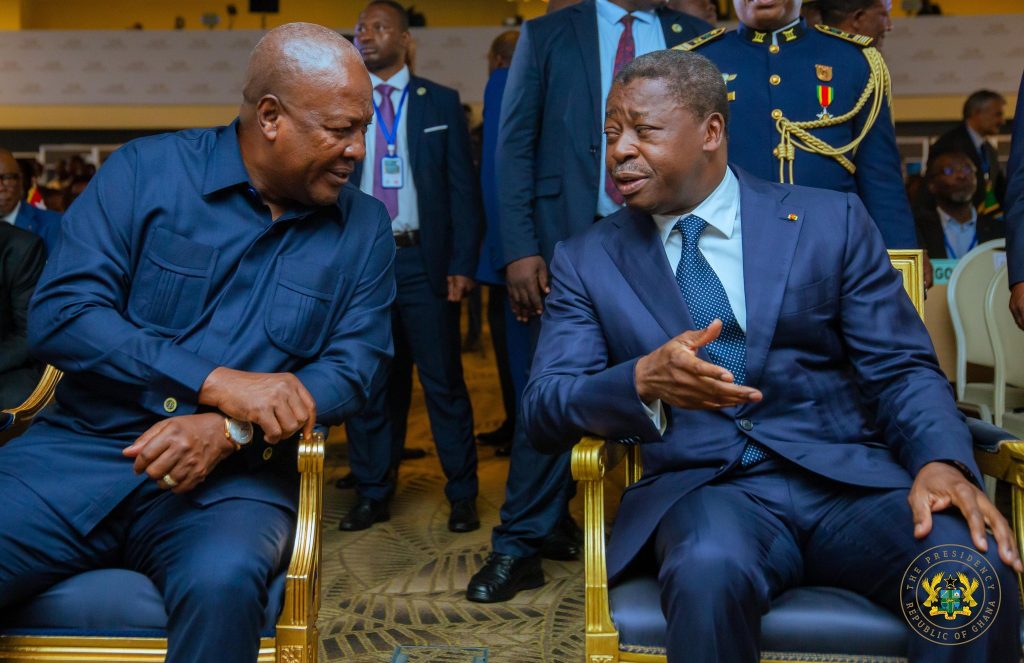
Ghana moves to international arbitration with Togo over maritime boundary dispute

0
193

The Government of Ghana has formally notified the Government of Togo of its decision to seek international arbitration to delimit the maritime boundary between the two neighbouring states under the framework of the United Nations Convention on the Law of the Sea.

The move comes after eight years of bilateral negotiations that, despite sustained diplomatic engagement, failed to produce a mutually agreed settlement. Authorities say the decision reflects Ghana’s commitment to resolving the dispute through established international legal mechanisms rather than allowing tensions to escalate.

Maritime boundary delimitation determines the precise division of offshore areas between coastal states, including rights over natural resources such as oil, gas, and fisheries. Under the United Nations Convention on the Law of the Sea, commonly referred to as UNCLOS, countries are encouraged to resolve overlapping claims either through negotiation or, where necessary, binding dispute settlement procedures such as arbitration or adjudication.

Ghana moves to international arbitration with Togo over maritime boundary dispute

Ghana’s notification signals a shift from diplomacy-led dialogue to a rules-based legal process. Officials indicate that recent incidents involving certain institutions of both countries heightened concerns about the potential for misunderstanding or operational friction in disputed waters. Seeking arbitration is being framed as a preventative step aimed at stabilizing the situation and safeguarding bilateral relations.

By invoking UNCLOS mechanisms, Ghana is aligning its approach with international maritime law standards. Arbitration under the convention typically involves the establishment of a tribunal to examine legal arguments, technical data, historical claims, and equidistance calculations before issuing a binding decision on boundary coordinates.

Government sources emphasize that the step is not adversarial in intent but rather procedural, intended to provide clarity and finality. The stated objective is to ensure an amicable and lawful resolution in the spirit of good neighbourliness and continued cooperation between Accra and Lomé.

ghana

The maritime boundary question is particularly sensitive in the Gulf of Guinea region, where offshore hydrocarbon exploration has increased over the past two decades. Clear delimitation reduces uncertainty for investors and prevents operational overlaps that can disrupt energy production or maritime security operations.

Ghana has previously relied on international adjudication to settle maritime disputes, notably in its case with Côte d’Ivoire at the International Tribunal for the Law of the Sea, which resulted in a binding ruling in 2017. That precedent may shape expectations about the current process with Togo.

While arbitration timelines can extend over several years, the decision to escalate the matter to a legal forum may provide interim stability by clarifying that both parties are pursuing resolution within a recognized international framework. Diplomatic engagement is expected to continue alongside the arbitration process.

Ghana moves to international arbitration with Togo over maritime boundary dispute

Ultimately, Ghana’s move underscores a preference for structured, law-based conflict management in regional affairs. Whether the arbitration leads to a swift settlement or a prolonged legal process, the emphasis remains on maintaining bilateral cooperation while securing legal certainty over maritime jurisdiction.

Togo’s Silent Struggle: Why the World Must Act on Worsening Abuses

Author

  • Daniel Ablordey

    Daniel Ablordey is a Business Analytics student at the University of Ghana Business School and an emerging strategist at the intersection of data, markets, and narrative. With a keen analytical mind and a passion for African business and economic trends, he is building a career focused on translating complex data-driven insights into accessible, decision-relevant stories that matter.As a writer and editor with Insight Ghana, African Business Insight, and The African Journal, Daniel delivers sharp, high-impact analysis on current affairs, business developments, and emerging trends across the continent. His work is defined by precision, clarity, and a deep commitment to responsible journalism — ensuring that every story he tells is not only accurate but meaningful to the audiences it serves.Beyond his editorial work, Daniel serves as an Ecobank Youth Ambassador, where he actively promotes financial inclusion, digital banking, and financial literacy among young Ghanaians. His leadership experience spans academic, professional, and faith-based institutions, where he has consistently driven initiatives centered on growth, structure, and long-term impact.Grounded in the principles of Pan-Africanism and service, Daniel brings a rare combination of analytical rigour and storytelling depth to his work. Whether unpacking market behavior, profiling emerging business leaders, or covering cultural shifts shaping the continent, he approaches every assignment with strategic intent and editorial integrity.His broader ambition is to contribute to Africa's transformation by shaping how data, business, and storytelling intersect — not just locally, but on a global stage.

Previous articleYaw Siki rejects royalties, labels “Wope Dodo” unholy
Next articleMajority Caucus front bench donates March salaries to Ghana Sports Fund
Daniel Amenyo Ablordey
Daniel Ablordey is a Business Analytics student at the University of Ghana Business School and an emerging strategist at the intersection of data, markets, and narrative. With a keen analytical mind and a passion for African business and economic trends, he is building a career focused on translating complex data-driven insights into accessible, decision-relevant stories that matter.As a writer and editor with Insight Ghana, African Business Insight, and The African Journal, Daniel delivers sharp, high-impact analysis on current affairs, business developments, and emerging trends across the continent. His work is defined by precision, clarity, and a deep commitment to responsible journalism — ensuring that every story he tells is not only accurate but meaningful to the audiences it serves.Beyond his editorial work, Daniel serves as an Ecobank Youth Ambassador, where he actively promotes financial inclusion, digital banking, and financial literacy among young Ghanaians. His leadership experience spans academic, professional, and faith-based institutions, where he has consistently driven initiatives centered on growth, structure, and long-term impact.Grounded in the principles of Pan-Africanism and service, Daniel brings a rare combination of analytical rigour and storytelling depth to his work. Whether unpacking market behavior, profiling emerging business leaders, or covering cultural shifts shaping the continent, he approaches every assignment with strategic intent and editorial integrity.His broader ambition is to contribute to Africa's transformation by shaping how data, business, and storytelling intersect — not just locally, but on a global stage.