

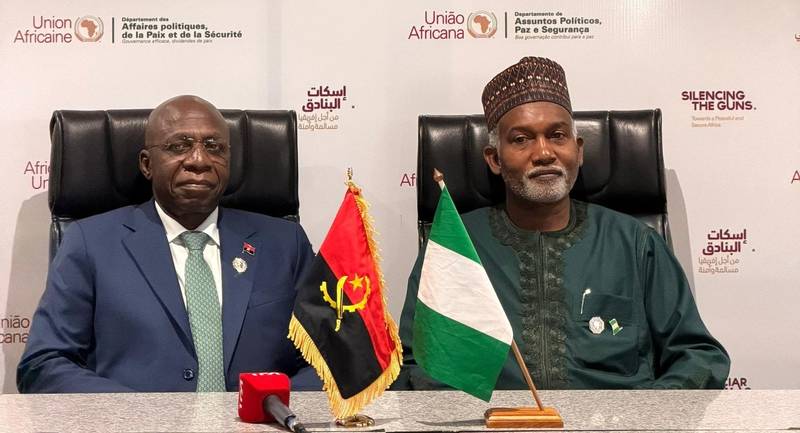
Nigeria and Angola have signed a visa waiver agreement for holders of diplomatic and official/service passports, marking a significant step toward strengthening bilateral relations and advancing African diplomatic mobility.
The agreement was formalized on the sidelines of the 39th Assembly of the African Union in Addis Ababa. Nigeria’s Minister of Foreign Affairs, Yusuf Maitama Tuggar, announced the development, describing it as a practical move to eliminate longstanding administrative barriers that have slowed official engagement between both nations.
Under the new arrangement, diplomats and government officials holding eligible passports will no longer require visas for travel between the two countries. The measure is expected to streamline diplomatic exchanges, facilitate high-level meetings, and enhance policy coordination across trade, security, and regional governance.

The pact builds on historic ties between Nigeria and Angola that date back to the era of African liberation movements. Over the decades, both countries have maintained diplomatic engagement rooted in solidarity and shared continental priorities. The new waiver transforms that symbolic goodwill into operational cooperation, reducing bureaucratic friction in official travel.
From an economic standpoint, the agreement aligns two of Africa’s major energy players. Angola ranks among the continent’s top crude oil producers, with petroleum accounting for more than 90% of its export earnings and a significant share of state revenue. Nigeria, Africa’s largest economy, also remains one of the continent’s leading oil exporters. Enhanced diplomatic mobility could facilitate deeper collaboration on energy policy, regional market stability, and investment flows.
For Nigeria, improved access to Angola strengthens engagement with southern Africa’s resource-rich economies and enhances coordination in multilateral forums. For Angola, easier movement into West Africa’s largest market opens doors to broader commercial and diplomatic opportunities.
The visa waiver also reflects a wider continental push toward visa liberalization. Policymakers and integration advocates argue that easing travel restrictions for officials and eventually broader categories of travelers is essential to achieving the African Union’s Agenda 2063 goals of economic integration and political cohesion. Several African countries, including Ghana, have taken steps to simplify visa regimes to encourage business, education, and diplomatic exchange.

While the current agreement applies specifically to diplomatic and official passport holders, it sets a precedent for expanded mobility frameworks in the future. Reduced travel barriers can accelerate negotiations, foster investment partnerships, and enhance joint responses to security and climate challenges.
Experts note that practical integration measures, such as reciprocal visa waivers, often have an outsized impact compared to high-level declarations. By facilitating faster movement of decision-makers, countries can shorten negotiation cycles and implement policy initiatives more efficiently.
The Nigeria–Angola visa waiver demonstrates a tangible commitment to deeper African cooperation. As more nations adopt similar agreements, diplomatic mobility may increasingly serve as a catalyst for trade growth, strategic alignment, and stronger continental unity.