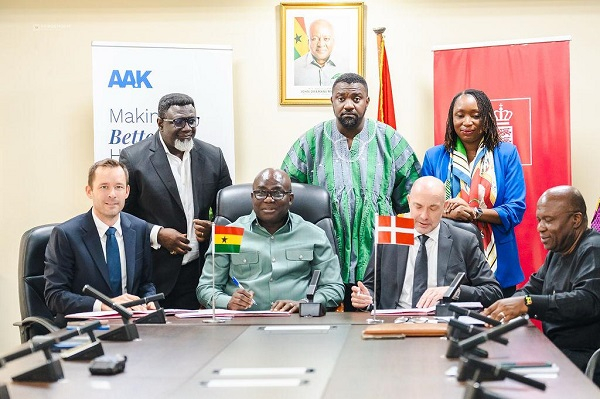
MoFA signs MoU with AAK to accelerate value addition in Ghana’s shea industry

0
112

The Ministry of Food and Agriculture (MoFA) has signed a strategic Memorandum of Understanding (MoU) with AAK Ghana Limited to accelerate value addition, boost competitiveness and drive sustainable growth in Ghana’s shea sector. The agreement formalises a long-term partnership between the Government of Ghana and one of the world’s leading producers and buyers of shea products.

The MoU was signed in Accra by Eric Opoku, Minister for Food and Agriculture, and Lasse Skaksen, Vice President and Head of AAK West Africa. The ceremony was attended by senior government officials, stakeholders from the agribusiness sector and Jakob Linulf, Ambassador of Denmark to Ghana, underscoring the strategic importance of the collaboration.

Under the agreement, the partners will work to enhance local processing capacity, strengthen participation of small and medium-scale enterprises (SMEs) in the shea value chain and improve Ghana’s competitiveness in global shea markets. Special emphasis will be placed on inclusive growth, with targeted support for women shea collectors, youth employment, and sustainable sourcing practices.

MoFA signs MoU with AAK to accelerate value addition in Ghana’s shea industry

AAK’s long-running Kolo Nafaso programme, which directly supports more than 230,000 women shea collectors through financing, capacity building and market access, will be expanded under the MoU to include an additional estimated 70,000 women, particularly in northern Ghana. The initiative also includes planned investments in logistics, warehousing and supply chain development designed to strengthen production linkages and improve product quality for value-added exports.

The MoU also outlines plans to establish the AAK Ghana Innovation Academy, aimed at boosting the technical skills and business capacity of local SMEs, enhancing youth employability and building expertise across the shea and broader plant-based oils and fats sector. Additionally, AAK intends to invest in local processing facilities using advanced technologies to create more than 100 jobs and increase export competitiveness.

mofa,mou
Shea Butter

MoFA says the partnership aligns with government priorities, including the Agriculture for Economic Transformation Agenda (AETA) and the Feed Ghana Programme, which seek to strengthen agro-processing, tree crop development and export-led growth. The initiative is also expected to support sustainable shea reforestation and parkland preservation in collaboration with stakeholders such as the Tree Crops Development Authority.

The MoU signals a significant step toward transforming Ghana’s shea industry from a primarily raw commodity sector into a competitive, value-driven pillar of the national economy, capable of generating higher earnings, creating jobs and enhancing rural livelihoods.

Shea Employers Association, GSEA wants ban on raw nuts export

Author

  • Daniel Ablordey

    Daniel Ablordey is a Business Analytics student at the University of Ghana Business School and an emerging strategist at the intersection of data, markets, and narrative. With a keen analytical mind and a passion for African business and economic trends, he is building a career focused on translating complex data-driven insights into accessible, decision-relevant stories that matter.

    As a writer and editor with Insight Ghana, African Business Insight, and The African Journal, Daniel delivers sharp, high-impact analysis on current affairs, business developments, and emerging trends across the continent. His work is defined by precision, clarity, and a deep commitment to responsible journalism — ensuring that every story he tells is not only accurate but meaningful to the audiences it serves.

    Beyond his editorial work, Daniel serves as an Ecobank Youth Ambassador, where he actively promotes financial inclusion, digital banking, and financial literacy among young Ghanaians. His leadership experience spans academic, professional, and faith-based institutions, where he has consistently driven initiatives centered on growth, structure, and long-term impact.

    Grounded in the principles of Pan-Africanism and service, Daniel brings a rare combination of analytical rigour and storytelling depth to his work. Whether unpacking market behavior, profiling emerging business leaders, or covering cultural shifts shaping the continent, he approaches every assignment with strategic intent and editorial integrity.

    His broader ambition is to contribute to Africa's transformation by shaping how data, business, and storytelling intersect — not just locally, but on a global stage.

Previous articleKarim Zito steps down as Asante Kotoko head coach ahead of Hearts of Oak clash
Next articleKumasi Shoe Factory advocates for compulsory local school footwear policy to revive production and boost jobs
Daniel Amenyo Ablordey
Daniel Ablordey is a Business Analytics student at the University of Ghana Business School and an emerging strategist at the intersection of data, markets, and narrative. With a keen analytical mind and a passion for African business and economic trends, he is building a career focused on translating complex data-driven insights into accessible, decision-relevant stories that matter.

As a writer and editor with Insight Ghana, African Business Insight, and The African Journal, Daniel delivers sharp, high-impact analysis on current affairs, business developments, and emerging trends across the continent. His work is defined by precision, clarity, and a deep commitment to responsible journalism — ensuring that every story he tells is not only accurate but meaningful to the audiences it serves.

Beyond his editorial work, Daniel serves as an Ecobank Youth Ambassador, where he actively promotes financial inclusion, digital banking, and financial literacy among young Ghanaians. His leadership experience spans academic, professional, and faith-based institutions, where he has consistently driven initiatives centered on growth, structure, and long-term impact.

Grounded in the principles of Pan-Africanism and service, Daniel brings a rare combination of analytical rigour and storytelling depth to his work. Whether unpacking market behavior, profiling emerging business leaders, or covering cultural shifts shaping the continent, he approaches every assignment with strategic intent and editorial integrity.

His broader ambition is to contribute to Africa's transformation by shaping how data, business, and storytelling intersect — not just locally, but on a global stage.