

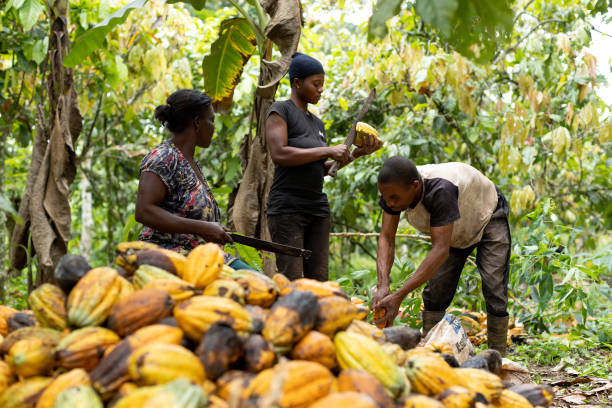
Ghana’s once-vibrant cocoa sector is under intense strain as growers face mounting arrears in payments and significant volumes of beans remain unsold, the Ghana Cocoa Board (COCOBOD) has said. At the centre of the turmoil are legacy forward-sales contracts signed at lower historical prices and a noticeable retreat by international buyers unwilling to purchase Ghanaian cocoa at elevated local prices developments that have disrupted the buying chain and placed pressure on farmers, licensed buying companies and the national regulator alike.
COCOBOD Chief Executive Dr. Ransford Anertey Abbey outlined the depth of the challenge at a press briefing, stressing that the payment delays and unsold inventory are not the result of fund misappropriation, as suggested on social media, but rather reflect deeper structural and market dynamics. He explained that the cocoa crop for the 2024–25 season was financed differently than in past years. Traditionally, COCOBOD had relied on a long-standing syndicated loan structure to fund purchases, but a breakdown in that system in 2022 forced the Board to pivot to alternative arrangements, including direct financing by buyers themselves.

The syndicated loan facility had long underpinned cocoa purchases in Ghana, providing working capital needed to buy beans from farmers at harvest before selling them into international markets. However, COCOBOD’s inability in 2022 to fully service interest and principal on its cocoa bills eroded lenders’ confidence and diminished appetite to finance subsequent crops. Following that breakdown, buyers stepped in to fund crops a move driven by necessity, not strategic planning creating a financing model that now complicates traditional operations.
Even during this period of market instability, COCOBOD entered into forward sales contracts for roughly 333,767 tonnes of cocoa at about GH¢41,600 per tonne, reflecting global prices when those agreements were signed. But as international cocoa prices surged, market conditions shifted. Today, global cocoa is trading at prices that translate to around GH¢64,000 per tonne or lower, while Ghana’s farmgate price was set at roughly GH¢80,640 per tonne to protect farmers from exchange rate volatility and high production costs.
This dislocation between domestic cocoa pricing and international market benchmarks is at the heart of the current crisis. With Ghana’s farmgate price significantly higher than prevailing global rates, buyers have increasingly opted to purchase beans from alternative markets where pricing is more competitive, leaving licensed buying companies (LBCs) holding unsold stocks and accruing debts in the process. According to Dr. Abbey, this pricing mismatch makes it commercially unviable for buyers to honour earlier agreements, particularly when the cost of Ghanaian beans exceeds international parity by a wide margin.
“How do you expect a buyer to purchase cocoa at GH¢96,000 when the same cocoa is trading on the market at GH¢64,000 or lower?” Dr. Abbey said, highlighting the business rationale behind buyers’ retreat from purchasing Ghana’s cocoa under the current pricing regime.
The evolving dynamics have left some LBCs in precarious positions. Some companies have delivered cocoa for which they remain unpaid, while others possess beans they have been unable to offload. Although COCOBOD reported that it has sold cocoa worth more than GH¢8.5 billion so far this season, a smaller portion remains without buyers, reflecting a broader contraction in buyer demand as purchasers seek cheaper origins.
The situation has triggered growing frustration among cocoa farmers, who have increasingly voiced concerns about delayed payments and the financial toll of unpaid deliveries. These delays have heightened anxiety across cocoa-growing regions and drawn attention to the fragile funding mechanisms supporting Ghana’s cocoa value chain. Data from industry groups indicate that funding challenges have persisted since the previous 2023–24 season, when COCOBOD failed to secure its usual syndicated financing, forcing LBCs to rely on high-cost bank loans that eroded their liquidity and capacity to sustain operations.
Beyond buyer retreat and pricing mismatches, broader structural weaknesses have long constrained the sector. Forward sales arrangements, which lock in prices in advance, have, in some cases, locked COCOBOD into uncompetitive pricing during periods of market volatility. Additionally, the reliance on syndicated loans historically central to financing cocoa purchases has created a cycle of debt and rollover contracts, undermining operational flexibility and compromising the Board’s ability to respond to changing global market conditions.
In response to concerns raised on social media that cocoa funds had been diverted toward vehicle purchases, Dr. Abbey clarified that any acquisition of pick-ups or other vehicles was financed through internally generated funds and intended to address logistical shortcomings in cocoa-producing districts not sourced from crop proceeds owed to farmers.
Looking beyond the immediate crisis, Dr. Abbey acknowledged that the sector’s difficulties reflect deeper systemic issues and underscored the need for a sustainable new funding model. The government, in consultation with the Ministry of Finance and industry stakeholders, is reportedly developing a revamped financing framework to reduce reliance on raw bean exports and syndicated debts, with plans to have the new structure in place for the 2026–27 season. He appealed for patience from farmers as COCOBOD works toward stabilising the situation and fulfilling its commitment to settling all payments.

“This is their sweat. They deserve to be paid,” Dr. Abbey affirmed, reiterating COCOBOD’s pledge to resolve the arrears.
The unfolding crisis in Ghana’s cocoa sector highlights the complex interplay between global commodity pricing, domestic policy decisions and financing mechanisms. As the country grapples with aligning farmgate pricing to international realities and securing dependable financing, the livelihood of millions of cocoa farmers and Ghana’s reputation as a leading cocoa exporter hangs in the balance. Recent reports indicate that unresolved sales, payment delays, and structural debt burdens pose not only short-term operational challenges but also potential long-term implications for production capacity, export revenues and rural economic stability across cocoa-producing regions.
In this context, the urgency of reforming the cocoa financing model, enhancing market responsiveness and fostering sustainable buyer relationships has never been clearer. Without timely intervention and structural adjustments, the sector’s capacity to drive Ghana’s foreign exchange earnings and support rural livelihoods could face further strain.