

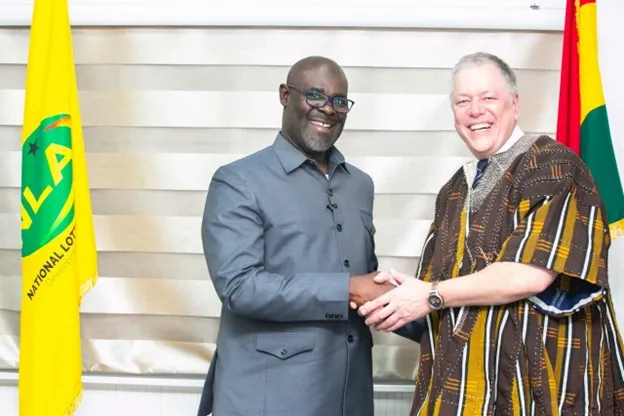
The President of the World Lottery Association (WLA), Mr. Andreas Kotter, has emphasised the organisation’s commitment to enhancing the lottery industry across Africa, highlighting opportunities for collaboration, development and responsible gaming. The pledge came during a strategic visit to Accra, Ghana, where Mr. Kotter and senior WLA officials met with leadership of the National Lottery Authority (NLA) to assess Ghana’s capacity to host major lottery events, including the prestigious World Lottery Summit in 2028.
Mr. Kotter’s visit, accompanied by Mr. Lucas Esposito, WLA Executive Director, and Mr. Francois Pellaud-Pautrot, WLA Events Coordinator, underscored the association’s renewed focus on Africa as a region with significant potential for lottery market growth, development of best practices, and expanded contributions to societal causes. The delegation’s visit involved extensive meetings, a tour of potential summit facilities and engagements with government and lottery stakeholders to explore ways to fortify the industry.
Focus on Africa and support for member states
At a meeting with NLA Director-General Mr. Mohammed Abdul-Salam and Deputy Director-General Mr. Eric Yeboah Wadie, Mr. Kotter expressed admiration for Ghana’s evolving lottery landscape and the NLA’s forward-looking vision. He highlighted Ghana’s strategic role in supporting the development of lottery operations throughout Africa, noting that the decision to consider Ghana for the World Lottery Summit in 2028 sends a strong signal of confidence in the continent’s capacity to host globally significant events.
“I saw your vision that Ghana wants to have footprints and become an organisation of choice and blueprint in Africa,” Mr. Kotter said, recognising the NLA’s efforts to position the country as a leader in lottery governance, operations and impact. “This is the right way, and you will get every support that you can get from me as a person to fulfil this vision,” he added.
Mr. Kotter praised the NLA’s corporate social responsibility programmes and the societal impact of lottery operations in Ghana. These activities not only generate revenue but also support community initiatives, education, healthcare and critical infrastructure through the distribution of lottery proceeds. This aligns with the broader mission of the WLA, where member lotteries globally are expected to generate significant contributions to good causes and reinforce responsible gambling principles.
Engaging infrastructure and local capacity
A key objective of the visit was to conduct a reconnaissance of Accra’s conference infrastructure, including major venues that could host delegates from around the world during the 2028 World Lottery Summit. Mr. Kotter noted that the team’s on-site assessment was crucial for bridging theoretical planning with practical realities. He said that visiting the facilities and experiencing Ghana’s cultural and historical context firsthand would help inform the WLA Executive Committee’s decision.

The visit also included engagements outside the NLA offices. The WLA delegation observed proceedings at Ghana’s Parliament House, where they were acknowledged by the First Deputy Speaker, Hon. Bernard Ahiafor. This parliamentary interaction highlighted the national significance of the lottery sector in Ghana’s regulatory and economic framework.
Collaborations on responsible gaming and regulation
In discussions with Samuel Awuku, Member of Parliament for Akuapim North and immediate past Director-General of the NLA, the delegation explored collaborative strategies to promote responsible gaming and combat illegal lottery activities key priorities for both national authorities and international associations. The emphasis on cracking down on illicit operations and enhancing regulatory frameworks echoes broader WLA principles, which include strong commitments to player protection and the mitigation of gambling-related harm.
The WLA’s focus on responsible gaming is reinforced through structured frameworks that encourage member lotteries to adopt industry best practices, balance revenue goals with social considerations, and proactively respond to risks associated with gambling addiction and youth participation. These frameworks have been influential in shaping national lottery policies in many jurisdictions and are expected to play a central role in future initiatives across Africa.
A milestone for lottery development in Africa
Should Ghana be chosen as the host of the World Lottery Summit in 2028, it would mark a historic achievement as the first West African country to host the event. The summit, which brings together leaders from lottery operators, associations, regulators and partners across the globe, serves as a key platform for sharing insights, innovations and setting strategic directions for the industry.
The NLA has built a track record of hosting regional and international engagements. In December 2025, Ghana hosted the African Lotteries Association (ALA) Board of Directors meeting in Accra, followed by seminars on responsible gaming that drew global participation. These events demonstrated Ghana’s organisational capacity and commitment to advancing the lottery sector elements that could strengthen its bid for the 2028 summit.
Director-General Mr. Abdul-Salam expressed gratitude for the high-level visit and the opportunity for Ghana to be considered as a host nation. He described the delegation’s visit as a memorable moment for the NLA, reflecting the organisation’s growing stature within the global lottery community. There is optimism that the interaction will further enhance institutional ties and open avenues for deeper collaboration between the WLA, NLA and other regional bodies like the African Lotteries Association.
Broader implications for the industry
The WLA’s renewed engagement with Africa underscores the region’s growing importance in the global lottery landscape. African lotteries are increasingly recognised for their potential to contribute to public revenues, support community development, and implement robust governance systems. The shared vision for stronger regulatory capacity, elevated industry standards, and enhanced collaboration could influence how lotteries operate and are perceived across the continent.
By strengthening institutional frameworks, promoting responsible gaming and facilitating knowledge exchange, the WLA and its members aim to boost confidence among stakeholders, attract investment in gaming technology, and reinforce the lottery sector’s contributions to socio-economic development.
As deliberations continue and preparations advance, stakeholders will be watching closely to see whether Ghana’s commitment pays off with the opportunity to host the 2028 World Lottery Summit an event that could place the country at the forefront of lottery innovation and governance in Africa.