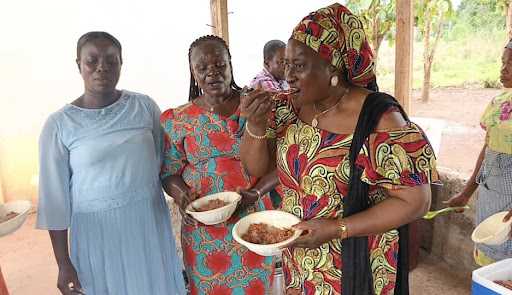
School Feeding Programme to Expand to Over 1,000 Pupils in Rural Basic Schools – Coordinator

    0
    144

    The National School Feeding Programme (NSFP) is poised to deepen its impact by adding more than 1,000 students from rural public basic schools currently excluded from the scheme. The announcement was made by the programme’s National Coordinator, Hajia Fati Forgor, during a stakeholder engagement on October 11, 2025, as part of efforts to enhance nutrition and learning outcomes in underserved communities.

    Since its inception, the NSFP has been a critical pillar in Ghana’s education and health strategy, providing daily meals to over 4 million schoolchildren across the country. The expansion aims to reach schools in remote regions where nutritional deficits and school absenteeism are most pronounced. According to Forgor, this move reflects the government’s commitment to ensuring that no child is left behind due to hunger.

    She explained that the additional students will come from “non-beneficiary public basic schools” in rural districts that have so far been outside the programme’s coverage. These are often small schools with minimal resources, lacking road access or adequate infrastructure to support food delivery logistics. The NSFP plans to work closely with regional and district education offices to identify eligible schools and ensure that meals are delivered reliably.

    The coordinator stressed that the expansion is driven by data pointing to strong links between nutrition and academic performance. Undernourished children are more likely to be absent from school, perform poorly in examinations, and drop out entirely. By extending feeding support to these newly identified students, the programme seeks not just to fill stomachs but to strengthen learning, reduce inequality, and improve retention rates in rural areas.

    To implement the expansion, Forgor indicated that the NSFP will incorporate improved logistical systems, including expanded storage facilities, local sourcing of food items, and community participation in meal preparation. The programme also aims to partner with local farmers to supply produce, thereby creating a market link between agriculture and education in rural districts.

    School Feeding Programme to Expand to Over 1,000 Pupils in Rural Basic Schools - Coordinator

    While the addition of 1,000 pupils may seem modest relative to the millions already served, education and nutrition experts welcome the gesture as a meaningful step toward equity. They note that targeting the most marginalized schools can catalyze broader improvements in educational access and child well-being.

    This initiative comes at a critical time when many rural communities continue to grapple with food insecurity, reduced household income, and climate-driven agricultural stress. By bolstering the social safety net within schools, the NSFP may mitigate some of these pressures and support resilience among vulnerable families.

    The success of the expansion will depend heavily on sustained funding, transport infrastructure, and effective monitoring to prevent wastage, leakage, or delays. Over the coming months, the NSFP is expected to roll out pilot deliveries in selected districts and gather feedback for scaling further.

    Eduwatch Calls for Financially Sound Caterers in Ghana’s School Feeding Programme

    Author

    • Daniel Ablordey

      Daniel Ablordey is a Business Analytics student at the University of Ghana Business School and an emerging strategist at the intersection of data, markets, and narrative. With a keen analytical mind and a passion for African business and economic trends, he is building a career focused on translating complex data-driven insights into accessible, decision-relevant stories that matter.

      As a writer and editor with Insight Ghana, African Business Insight, and The African Journal, Daniel delivers sharp, high-impact analysis on current affairs, business developments, and emerging trends across the continent. His work is defined by precision, clarity, and a deep commitment to responsible journalism — ensuring that every story he tells is not only accurate but meaningful to the audiences it serves.

      Beyond his editorial work, Daniel serves as an Ecobank Youth Ambassador, where he actively promotes financial inclusion, digital banking, and financial literacy among young Ghanaians. His leadership experience spans academic, professional, and faith-based institutions, where he has consistently driven initiatives centered on growth, structure, and long-term impact.

      Grounded in the principles of Pan-Africanism and service, Daniel brings a rare combination of analytical rigour and storytelling depth to his work. Whether unpacking market behavior, profiling emerging business leaders, or covering cultural shifts shaping the continent, he approaches every assignment with strategic intent and editorial integrity.

      His broader ambition is to contribute to Africa's transformation by shaping how data, business, and storytelling intersect — not just locally, but on a global stage.

    Previous articleMore Than a Drink: 5 Clever Everyday Uses of Akpeteshie in Ghanaian Homes
    Next articleJuaboso Government Hospital to Be Expanded to 120 Beds, Minister Announces
    Daniel Amenyo Ablordey
    Daniel Ablordey is a Business Analytics student at the University of Ghana Business School and an emerging strategist at the intersection of data, markets, and narrative. With a keen analytical mind and a passion for African business and economic trends, he is building a career focused on translating complex data-driven insights into accessible, decision-relevant stories that matter.

    As a writer and editor with Insight Ghana, African Business Insight, and The African Journal, Daniel delivers sharp, high-impact analysis on current affairs, business developments, and emerging trends across the continent. His work is defined by precision, clarity, and a deep commitment to responsible journalism — ensuring that every story he tells is not only accurate but meaningful to the audiences it serves.

    Beyond his editorial work, Daniel serves as an Ecobank Youth Ambassador, where he actively promotes financial inclusion, digital banking, and financial literacy among young Ghanaians. His leadership experience spans academic, professional, and faith-based institutions, where he has consistently driven initiatives centered on growth, structure, and long-term impact.

    Grounded in the principles of Pan-Africanism and service, Daniel brings a rare combination of analytical rigour and storytelling depth to his work. Whether unpacking market behavior, profiling emerging business leaders, or covering cultural shifts shaping the continent, he approaches every assignment with strategic intent and editorial integrity.

    His broader ambition is to contribute to Africa's transformation by shaping how data, business, and storytelling intersect — not just locally, but on a global stage.