

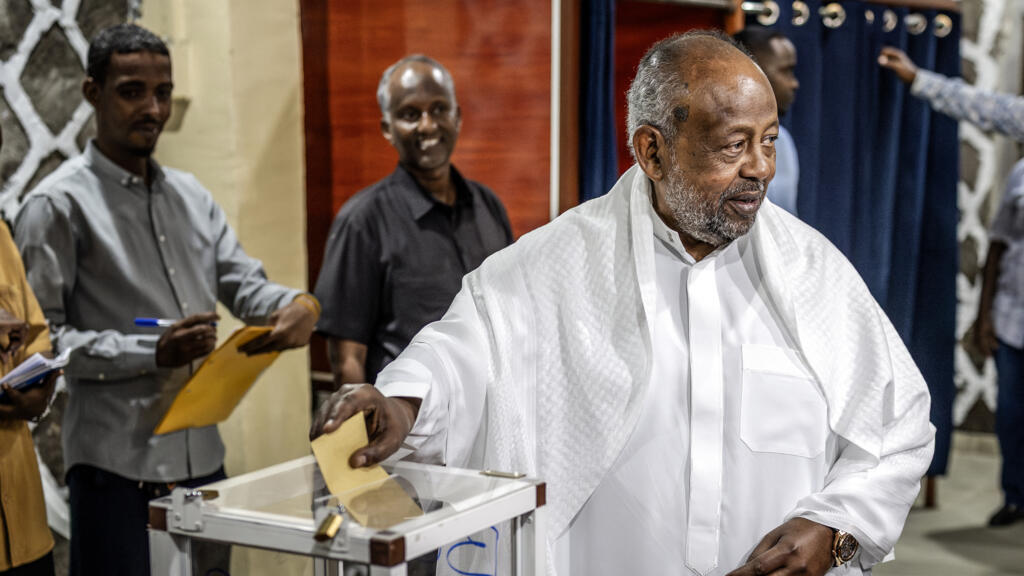
Djibouti’s long serving leader Ismail Omar Guelleh has secured a sixth term in office after winning the country’s latest presidential election with an overwhelming 97.8 percent of the vote, according to official results, further entrenching one of Africa’s most enduring political reigns.
The victory extends Guelleh’s rule to nearly three decades, having first assumed power in 1999 after succeeding his uncle, Hassan Gouled Aptidon, who himself governed the Horn of Africa nation for 22 years. Together, the two men have effectively shaped Djibouti’s political trajectory for more than four decades under a tightly controlled system of governance.
Official figures indicate that Guelleh faced minimal electoral competition in the latest vote, with only one challenger, a relatively little known opposition candidate, while major opposition parties boycotted the election entirely. This absence of strong political contest has become a defining feature of Djibouti’s electoral landscape, raising persistent concerns about the depth of democratic participation in the country.

The scale of the victory mirrors previous elections. In 2021, Guelleh secured more than 97 percent of the vote, a pattern that has reinforced perceptions of political dominance by the ruling establishment. Analysts note that such margins are rarely seen in competitive democratic systems, particularly where opposition structures are weak or excluded.
The latest election also followed key constitutional changes that cleared the path for Guelleh’s continued rule. Lawmakers removed the presidential age limit and eased restrictions that previously required a referendum for constitutional adjustments, effectively allowing the 78 year old leader to run again without institutional barriers. These changes have drawn criticism from observers who argue they consolidate power around the presidency rather than strengthening democratic institutions.
Despite these concerns, Djibouti has maintained a reputation for relative stability in a region often marked by conflict. Strategically located at the entrance to the Red Sea along the Bab el Mandeb strait, the country has become a critical hub for global trade and military operations. It hosts foreign military bases from major powers including the United States, China, France and Japan, generating significant revenue and geopolitical relevance.
This strategic importance has, in many ways, insulated the government from external pressure. While human rights organisations have repeatedly raised concerns over restrictions on political freedoms, press activity and opposition movements, authorities have consistently rejected allegations of repression and defended the electoral process as legitimate.

Economically, Djibouti’s model has centred on leveraging its geography. The country serves as a vital gateway for landlocked Ethiopia, one of Africa’s fastest growing economies, and has invested heavily in port infrastructure and logistics services. This has helped sustain growth and attract foreign investment, even as political pluralism remains limited.
The broader implication of Guelleh’s re election is not just continuity, but consolidation. With opposition participation weakened and constitutional barriers removed, the presidency remains the dominant force in Djibouti’s political system. The outcome reinforces a governance model where stability is prioritised, but at the cost of competitive political space.
Attention is now likely to shift toward long term succession dynamics. At 78, Guelleh’s continued hold on power inevitably raises questions about what comes next and whether the country will eventually transition toward a more open political system or maintain its current trajectory.
For now, the message from the ballot is clear. Djibouti has chosen continuity, decisively and overwhelmingly. Whether that continuity translates into sustained progress or prolonged political stagnation will depend on decisions that extend far beyond election results.