

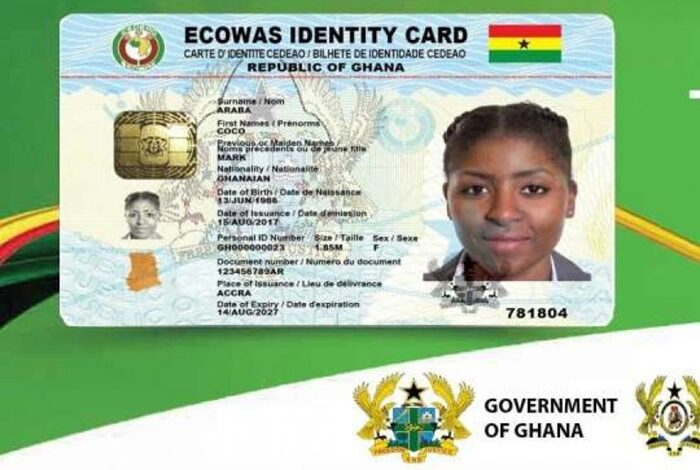
The National Identification Authority (NIA) has issued a firm clarification stating that the Ghana Card is not currently activated for financial transactions. The Authority dismissed circulating claims suggesting otherwise as inaccurate and misleading, urging the public to rely strictly on official communications. It also acknowledged that while discussions are ongoing among policymakers and financial regulators about possible future integration of the card into financial systems, no final decision or rollout has been approved.
This clarification comes at a sensitive moment in Ghana’s fast evolving digital economy, where identity systems and financial technology are increasingly intersecting. Over the past few years, the Ghana Card has become the backbone of national identification, linking citizens to banking services, SIM registration, tax systems, and public service access. The expectation that it would eventually evolve into a full financial authentication tool has been building steadily, especially as the Bank of Ghana and other institutions push for deeper financial inclusion and tighter digital verification frameworks.
The immediate significance of the NIA statement is stabilising. In practical terms, it prevents misinformation from driving premature behavioural shifts in the financial sector. If citizens mistakenly believe the card is already enabled for transactions, it could open the door to fraud attempts, phishing schemes, and exploitation by unregulated fintech actors. Ghana’s digital finance ecosystem has already faced pressure from scam networks leveraging mobile money platforms, and any confusion around identity-based transactions could amplify that risk.

For banks and fintech companies, the clarification reinforces the need for caution in product communication and system design. Many financial institutions have been positioning themselves for a future where the Ghana Card becomes a central authentication layer for Know Your Customer processes and transaction verification. However, the NIA’s statement effectively resets expectations, signalling that integration remains a policy discussion rather than an operational reality.
For ordinary citizens, the impact is equally important. Ghana’s financial inclusion agenda has significantly expanded access to mobile money and banking services, especially in rural areas. The idea of a single national ID enabling seamless financial transactions has been widely discussed as the next step in reducing friction in the system. By confirming that this stage has not yet been reached, the NIA is drawing a clear boundary between existing services and future possibilities, helping to prevent misinformation-driven financial decisions.
This development also fits into a broader African trend where governments are consolidating digital identity systems to support economic modernization. Countries like India, through Aadhaar, have already demonstrated how national ID systems can be deeply integrated into financial ecosystems. Ghana appears to be moving in a similar direction, but the caution expressed by the NIA suggests a more phased approach, likely shaped by concerns around data protection, cybersecurity, and institutional readiness.
In comparison to past policy shifts, this moment reflects a familiar pattern in Ghana’s digital governance journey: rapid public expectation followed by institutional correction. A similar dynamic occurred during earlier phases of SIM card re-registration and digital address system rollouts, where public perception often outpaced actual system capability. Each time, authorities have had to step in to realign expectations with operational reality.

Economically, the ripple effect is subtle but important. Fintech innovation may slow slightly in areas that were assuming immediate Ghana Card based transaction capabilities. However, the correction also creates a healthier environment for long term planning. Businesses now have a clearer timeline uncertainty, which, while less exciting, is more stable for infrastructure investment and compliance design.
Looking ahead, the central question is no longer whether the Ghana Card will eventually become a financial authentication tool, but how Ghana will manage the transition when it happens. Will the system be open enough to encourage innovation, or tightly controlled to prioritise security and state oversight? And more importantly, is Ghana building the institutional capacity fast enough to support a fully integrated digital identity economy without exposing citizens to systemic risk?