

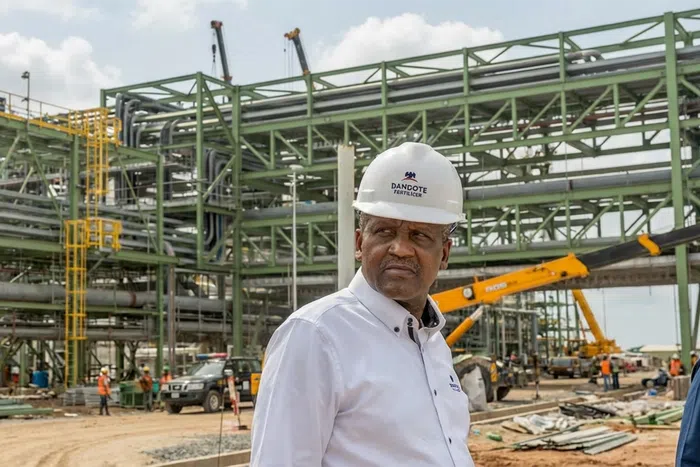
Africa’s long standing dependence on external energy supply chains is being tested again, and this time the response is coming from within the continent. Nigeria’s Dangote refinery has rapidly positioned itself as a critical supplier of gasoline and fertiliser to African countries grappling with disruptions triggered by the Iran war, marking a shift that is as strategic as it is overdue.
The 650,000 barrels per day facility, the largest refinery in Africa, has ramped up exports across West, Central and East Africa at a time when traditional supply routes from the Middle East have been severely constrained. According to industry reports and statements from the refinery’s owner, about 17 cargoes of gasoline have already been shipped to African markets, while urea exports have also been redirected toward the continent to meet rising demand.
This surge is not happening in isolation. The ongoing conflict involving Iran has disrupted global oil flows, particularly through key transit routes such as the Strait of Hormuz, forcing countries worldwide to scramble for alternative supply sources. Africa, which imports a significant portion of its refined fuel, has been hit especially hard, with fuel prices rising sharply across multiple economies.
In this context, the Dangote refinery has emerged as a regional stabiliser. By increasing exports, it has helped cushion supply shortages and reduce the severity of disruptions in several African countries. The refinery is now supplying markets that previously depended heavily on imports from Europe and the Middle East, effectively shortening supply chains and reducing logistical vulnerabilities.

Yet the development exposes a deeper contradiction. Even as Africa’s largest refinery scales up production and exports, domestic fuel prices in Nigeria continue to hit record highs. The reason is straightforward. Refining capacity alone does not insulate an economy from global crude oil price shocks. As long as crude remains priced on international markets, local refining can improve availability but not necessarily affordability.
This is the uncomfortable reality policymakers must confront. The refinery is solving a supply problem, not a pricing problem. The expectation that domestic refining would automatically lead to cheaper fuel has proven overly simplistic. Global price dynamics still dominate, and without mechanisms such as local currency pricing or targeted subsidies, consumers remain exposed.
At the continental level, however, the implications are more transformative. For decades, Africa exported crude oil only to import refined products at a premium, effectively outsourcing value addition. The Dangote refinery disrupts that model. It demonstrates that large scale refining capacity within Africa can alter trade patterns, retain value within the continent and enhance energy security.
The shift is already visible. Data shows a significant increase in petroleum product exports from Nigeria to other African countries, with shipments rising sharply as the refinery reached full capacity. Countries such as Ghana, Cameroon, Tanzania and Togo have turned to the refinery as an alternative supply source, signalling a reconfiguration of Africa’s energy map.
The inclusion of urea exports adds another layer of strategic importance. Fertiliser shortages can have cascading effects on food production and inflation, particularly in agrarian economies. By redirecting urea supply toward African markets, the refinery is not only addressing energy needs but also supporting agricultural resilience at a time of global uncertainty.
Still, the sustainability of this model depends on one critical factor. Crude supply. The refinery’s ability to maintain output hinges on consistent access to feedstock, and recent reports indicate that Nigeria’s national oil company has increased crude allocations to support operations. Without this alignment between upstream supply and downstream processing, the gains could be short lived.
There is also a broader strategic lesson here. Africa’s vulnerability to external shocks is not accidental. It is the result of decades of underinvestment in refining, infrastructure and regional trade integration. The Dangote refinery is a corrective measure, but it is not a complete solution. One facility, no matter how large, cannot fully offset a continent wide structural deficit.

What it does provide is a proof of concept. It shows that Africa can build, finance and operate complex industrial infrastructure at scale. It challenges the assumption that the continent must remain dependent on external systems for critical supplies.
The real question now is whether this moment triggers replication or complacency. If other African countries follow Nigeria’s lead in building refining capacity and strengthening intra-African energy trade, the continent could significantly reduce its exposure to global shocks. If not, the current crisis will pass, and the underlying vulnerabilities will remain intact.
For now, the Dangote refinery is carrying a disproportionate share of the burden. It is acting as both a commercial enterprise and a de facto regional stabiliser. That dual role underscores both its importance and the fragility of the system it is supporting.
Africa is not short of resources. It is short of systems that convert those resources into resilience. The Dangote refinery is a step in the right direction. The question is whether it becomes the foundation of a broader transformation or just a temporary shield against the next crisis.