

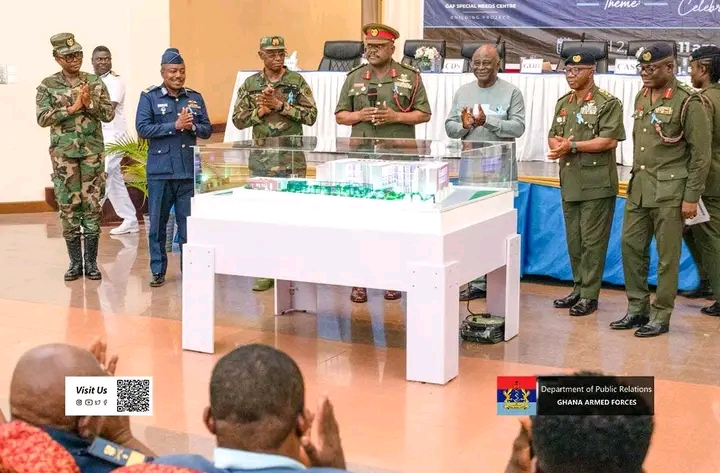
The Ghana Armed Forces has launched a Special Needs Centre project aimed at transforming autism care and support systems in the country, marking a rare but significant institutional intervention in Ghana’s underdeveloped special education and neurodevelopmental care space.
The initiative, unveiled at Burma Camp in Accra as part of activities marking World Autism Awareness Month, signals a shift in how state institutions are beginning to engage with developmental disorders that have long been overlooked in national policy conversations. Autism Spectrum Disorder remains poorly understood in Ghana, with stigma, late diagnosis, and limited access to specialised services continuing to define the experience of affected families.
At its core, the project is designed to deliver structured, professional and individualised support for children with special needs. According to official details, the planned facility will include more than 40 classrooms, therapy units, recreational spaces and administrative infrastructure, positioning it as one of the most comprehensive institutional responses to autism care in the country to date.

The ambition goes beyond infrastructure. Military leadership has framed the centre as a platform for early intervention, specialised education and long term developmental support. The facility is expected to provide speech and language therapy, behavioural interventions, occupational therapy and psychological services, addressing gaps that have persisted for years due to the high cost and limited availability of such care in Ghana.
The urgency of the intervention is difficult to overstate. In Ghana, many children with autism are diagnosed far later than global averages, often between the ages of eight and nine, compared to early childhood diagnosis in more developed healthcare systems. This delay significantly reduces the effectiveness of intervention strategies and places additional emotional and financial strain on families.
The problem is not only medical but social. Misconceptions about autism remain widespread, with many cases still interpreted through cultural or spiritual lenses rather than clinical understanding. This has contributed to stigma, exclusion and, in some instances, neglect. The Armed Forces’ involvement introduces an institutional voice that could help shift public perception from marginalisation to inclusion.
There is also a strategic dimension to the project that extends beyond healthcare. Increasingly, global discussions around neurodiversity emphasise the potential contributions of individuals on the autism spectrum, particularly in areas requiring high levels of focus, pattern recognition and analytical thinking. In advanced economies, individuals with autism are already contributing to sectors such as cybersecurity, data analysis and software development. Ghana has yet to systematically tap into this potential.

However, the success of the Special Needs Centre will depend less on its launch and more on its execution. Ghana’s track record with social infrastructure projects is uneven, often characterised by strong initial momentum followed by funding gaps, maintenance challenges and limited scaling. A single centre, regardless of its quality, cannot meet nationwide demand. Without a clear framework for expansion, training and integration into the broader health and education systems, the project risks becoming an isolated intervention.
There is also the issue of accessibility. Specialised care in Ghana remains heavily concentrated in urban areas, leaving rural communities largely underserved. If the centre operates as a standalone facility without outreach mechanisms or satellite support systems, its impact will be limited to a narrow segment of the population.
Responsibility now rests on multiple fronts. The military has initiated the project, but long term sustainability will require collaboration with the Ministries of Health, Education and Gender, as well as private sector and civil society actors. Training specialised professionals, subsidising therapy costs and integrating inclusive education policies will be critical to ensuring that the project translates into measurable national impact.
The broader significance of the initiative lies in what it represents. For decades, autism care in Ghana has been driven largely by private foundations and individual advocacy efforts. The entry of a major state institution into this space signals a potential shift toward more structured, policy backed intervention.

Yet the real test is still ahead. Building a centre is the visible part of the effort. Building a system that supports children with autism across the country is the harder, more consequential task.
Ghana Armed Forces Withdraws Military Protection for Civilians and Public Officials