

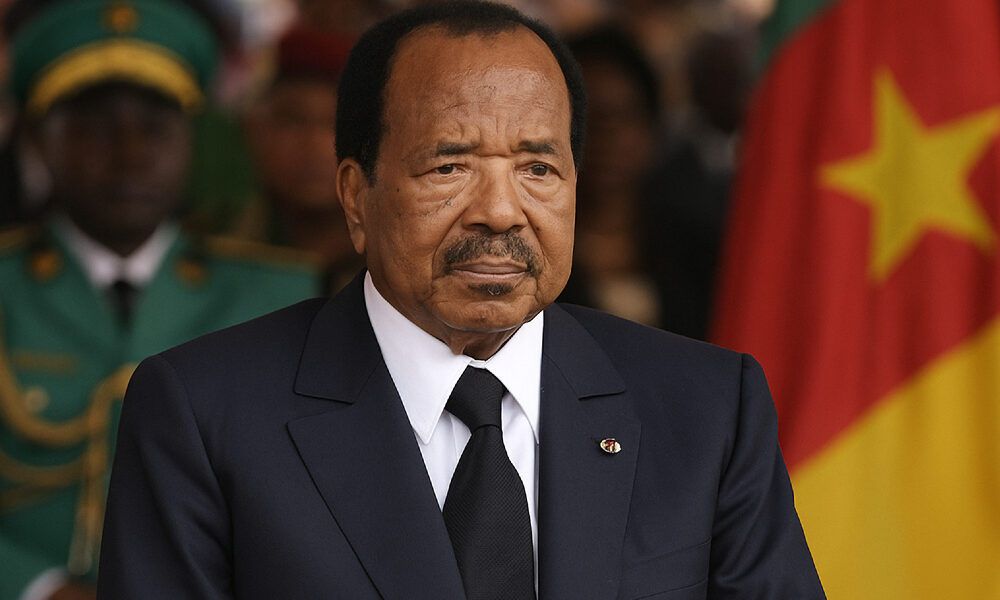
Cameroon’s parliament has just handed a 92-year-old president, the oldest sitting head of state in the world, the legal authority to choose his own successor. That is not constitutional reform. That is dynastic planning dressed in legislative language.
The amendment passed last week by a joint session of the National Assembly and Senate restores the office of vice president, abolished in 1972. On its face, the move addresses a real governance gap. In practice, it does something far more consequential: it removes the Cameroonian electorate from the single most important political decision a democracy can make, and places that decision entirely in the hands of Paul Biya, a man who has governed the country since 1982 and whose grip on state institutions is, by any honest measure, near-total.
The architecture of the arrangement matters.
The vice president, once appointed, will complete the remainder of the president’s term upon Biya’s death, resignation, or incapacity but will exercise only such powers as the president chooses to delegate while still in office. This is not succession planning. It is subordination by constitutional design, creating a deputy who is entirely dependent on the ruler’s continued blessing and whose democratic legitimacy rests on nothing more than a presidential decree.

What is missing here is not a mechanism. It is mandate.
Opposition figures and legal scholars have correctly identified the obvious democratic alternative: a joint presidential ticket, where the vice president is elected alongside the president with the public’s explicit consent. Several African constitutions already provide for this. That path was available. It was rejected. The reasons for that rejection are not obscure.
The practical implications should concern Cameroon’s international partners.
The country receives substantial development assistance from the European Union, France, the United States, and multilateral institutions, all of whom have, at various moments, tied engagement to governance benchmarks. An amendment that removes electoral legitimacy from presidential succession, passed in a parliament where independent oversight is structurally limited, tests the credibility of those benchmarks. More concretely, the Anglophone crisis, now in its eighth year, has left the northwest and southwest regions in a condition of persistent low-intensity conflict. Any succession process that lacks visible democratic legitimacy risks being read by those regions not as stability, but as the continuation of a system they already regard as exclusionary.
Accountability here runs in two directions.
The parliamentarians who passed this amendment with a large majority bear direct responsibility for codifying a framework that privileges presidential preference over popular will. But the international community, particularly France, which maintains deep institutional ties to Yaoundé, cannot indefinitely fund and diplomatically shield a system that moves consistently away from democratic norms while invoking stability as its justification. Stability purchased by suppressing electoral legitimacy is a short lease on order, not a durable investment in governance.

For the continent, the precedent is the problem.
Africa has, over the past decade, seen a series of constitutional amendments engineered to extend incumbency or eliminate term limits from Guinea to Ivory Coast to Rwanda. Cameroon’s amendment is structurally distinct in that Biya is not extending his own term, but the underlying logic is identical: the incumbent shapes the rules that determine who governs next. Each such move normalises the practice, narrows the political imagination of the region, and makes the African Union’s governance frameworks, already regarded with scepticism, harder to enforce with coherence.
The identity of whoever Biya appoints as vice president will define Cameroonian politics for a generation. That decision will be made by one man, in private, without electoral accountability, and ratified by a parliament with no meaningful power to refuse it. When that appointment is announced, observers will call it historic. They will be right, but not in the way governments prefer the word to be used.
Cameroon has not resolved its succession problem. It has transferred ownership of it.