

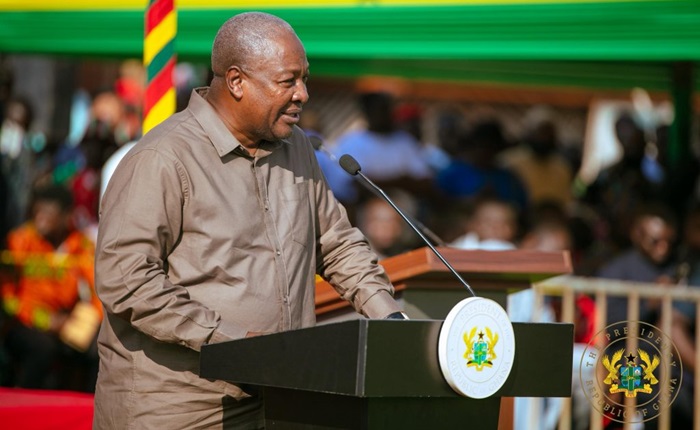
President John Dramani Mahama has announced a 60 hectare irrigation project aimed at transforming Ghana’s tomato sector by enabling year round production and significantly reducing post harvest losses that have long plagued farmers and the agricultural value chain.
The initiative forms part of a broader government strategy to modernise agriculture, improve food security, and reduce the country’s dependence on imported vegetables. The project will deploy irrigation infrastructure across key farming communities, ensuring a consistent water supply that allows farmers to cultivate tomatoes throughout the year rather than relying on seasonal rainfall patterns.
Irrigation has been identified as a critical bottleneck in Ghana’s agricultural productivity, particularly in the vegetable sub sector. According to the President, without reliable water systems, farmers are unable to sustain continuous production, leading to supply shortages during dry seasons and gluts during harvest periods. These fluctuations not only affect market prices but also contribute to significant post harvest losses when surplus produce cannot be stored or processed efficiently.

The 60 hectare project is designed to address both challenges simultaneously. By ensuring steady production cycles, it will stabilize supply and reduce the extreme swings in availability that often result in waste. In addition, the project is expected to incorporate complementary infrastructure such as storage, sorting, and packaging facilities to improve the handling of harvested tomatoes and extend their shelf life.
Ghana’s tomato sector has long struggled with inefficiencies across the value chain. Despite strong local demand, domestic production has consistently fallen short, forcing the country to rely heavily on imports from neighboring countries. At the same time, a significant portion of locally produced tomatoes is lost due to poor storage, transportation challenges, and inadequate processing capacity. Recent data suggests that post harvest losses can account for a substantial share of the overall supply gap, further weakening the sector’s performance.
The irrigation project is expected to play a key role in reversing this trend by supporting farmers with reliable water access, improved inputs, and better market linkages. Government officials have indicated that farmers participating in similar initiatives are already receiving improved seeds, fertilizers, and agronomic training, along with digital advisory services to enhance productivity and efficiency.
Beyond production, the initiative also aims to strengthen the broader agricultural value chain by connecting farmers to guaranteed buyers and structured markets. This approach is intended to reduce uncertainty for farmers, ensuring that increased production translates into stable incomes rather than oversupply and price crashes.
The project aligns with the government’s wider agricultural agenda, which emphasizes irrigation expansion, value chain development, and the promotion of a 24 hour agricultural economy driven by technology and consistent production cycles. Authorities believe that such interventions are essential for building a resilient agricultural system capable of supporting both domestic consumption and export growth.
Experts note that irrigation based farming could significantly improve yields and productivity in Ghana, particularly in regions where rainfall is unpredictable. By reducing dependence on seasonal weather patterns, farmers can plan production more effectively, invest in higher value crops, and adopt modern farming techniques that require consistent water supply.

The focus on tomatoes is particularly strategic given the crop’s importance in Ghanaian diets and its role in the local economy. Tomatoes are widely consumed across the country and are a key input for food processing industries. However, the sector has been constrained by supply inconsistencies and post harvest inefficiencies, making it a priority area for government intervention.
If successfully implemented, the 60 hectare irrigation project could serve as a model for similar initiatives across the country, demonstrating how targeted infrastructure investment can unlock agricultural productivity and reduce food losses. It also reflects a growing recognition that achieving food security in Ghana will require not just increased production, but also better management of what is already produced.
As the country continues to grapple with rising food demand and economic pressures, initiatives like this are expected to play a crucial role in strengthening domestic agriculture, improving farmer livelihoods, and reducing reliance on imports.