

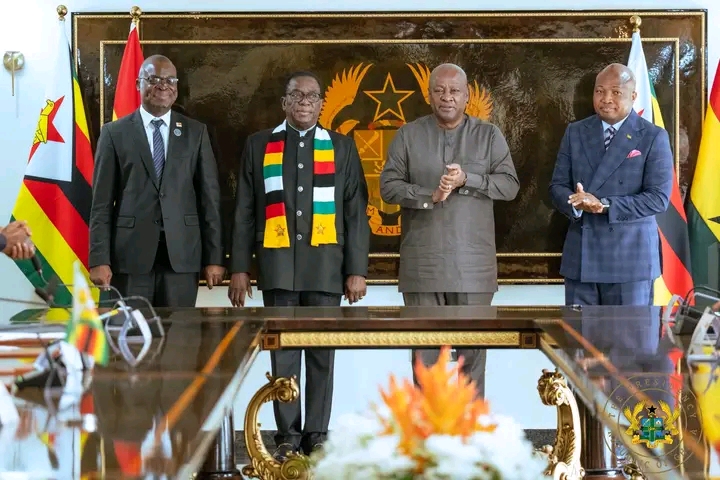
Ghana and Zimbabwe have taken a significant step toward deepening diplomatic and economic relations following the signing of multiple Memoranda of Understanding aimed at strengthening cooperation across key sectors. The agreements, concluded during the state visit of Zimbabwe’s President Emmerson Mnangagwa to Ghana, signal a renewed commitment by both nations to translate historical ties into practical development outcomes.
The newly signed agreements span a wide range of sectors considered critical to national development and regional integration. These include political and diplomatic consultations, energy, health, tourism, sports, trade and investment, archives management, foreign service training, and cultural cooperation. In addition to these frameworks, both countries formally adopted the agreed outcomes of the inaugural session of the Ghana Zimbabwe Permanent Joint Commission for Cooperation, a mechanism designed to ensure sustained engagement and structured implementation of bilateral initiatives.
The strengthening of institutional collaboration reflects a broader shift in African diplomacy, where countries are increasingly prioritising actionable partnerships over symbolic alliances. Ghana and Zimbabwe’s renewed engagement underscores a shared understanding that economic transformation requires deliberate coordination, particularly in areas such as trade facilitation, industrial growth, and human capital development.

President John Dramani Mahama described the visit as both productive and forward looking, emphasising that it represents more than a ceremonial engagement. According to him, the discussions have laid a clear roadmap for advancing cooperation, backed by renewed political will and a shared determination to deliver measurable results. His remarks highlight a growing expectation among African leaders that bilateral agreements must move beyond policy frameworks and yield tangible benefits for citizens.
A central theme emerging from the discussions is the role of the private sector in driving economic collaboration. Both countries acknowledged that government level agreements alone are insufficient to unlock the full potential of bilateral relations. As a result, there is a strong emphasis on fostering business to business partnerships, encouraging investment flows, and creating enabling environments for entrepreneurs and industries to thrive. Institutions such as the Ghana Export Promotion Authority and ZimTrade are expected to play pivotal roles in facilitating this engagement by connecting businesses, promoting exports, and supporting cross border trade initiatives.
President Mnangagwa, in his closing remarks, reinforced the urgency of implementation, stressing that the real value of the agreements lies in their impact on ordinary citizens. His call for ministers and government officials to prioritise execution reflects a broader concern across the continent, where many agreements fail to deliver due to weak follow through. By emphasising accountability and timely action, Zimbabwe’s leadership is signalling a shift toward results driven governance in its foreign relations.
The agreements also align with broader continental goals, particularly within the framework of the African Union and the African Continental Free Trade Area. By strengthening bilateral ties, Ghana and Zimbabwe are positioning themselves to better leverage regional opportunities, enhance intra African trade, and contribute to the continent’s long term economic integration agenda. This approach is increasingly important as African countries seek to reduce dependence on external markets and build resilient, self sustaining economies.

On the global stage, both leaders reaffirmed their shared commitment to Pan Africanism and coordinated engagement in international institutions such as the United Nations. This includes advancing common positions on key global issues, defending shared interests, and promoting a unified African voice in an evolving geopolitical landscape. Such alignment is particularly relevant at a time when global power dynamics are shifting and developing regions are seeking greater influence in decision making processes.
Beyond policy and diplomacy, the renewed partnership carries symbolic weight rooted in a shared history of struggle, solidarity, and mutual support. Both Ghana and Zimbabwe have long been associated with the ideals of African independence and unity, and this latest engagement serves as a reminder of those enduring connections. However, the current focus is firmly on the future, with both nations seeking to harness their relationship as a catalyst for economic growth, innovation, and social development.
The success of these agreements will ultimately depend on the ability of both governments to maintain momentum, ensure coordination across ministries, and actively involve stakeholders at all levels. If effectively implemented, the partnership has the potential to unlock new opportunities, strengthen economic resilience, and deliver lasting benefits to citizens in both countries.
