

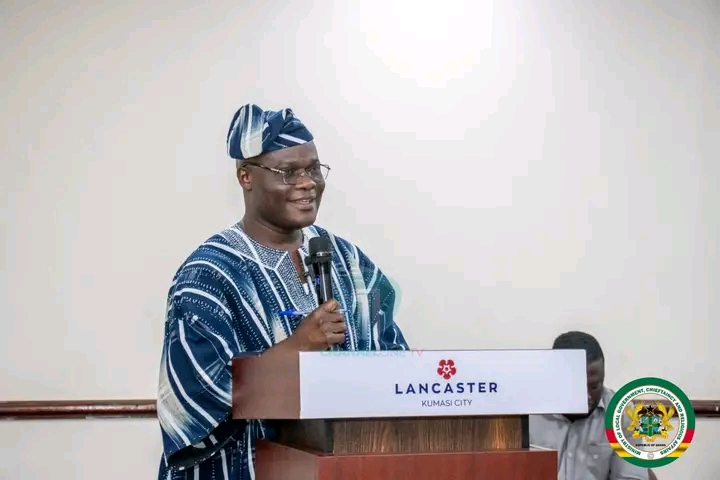
The Minister for Local Government, Ahmed Ibrahim, has officially launched the maiden Special Orientation and Leadership Development Programme for female Metropolitan, Municipal and District Chief Executives in Kumasi, in a move aimed at strengthening women’s leadership in Ghana’s decentralised governance system.
The two day programme, held in the Ashanti Regional capital, is themed “Breaking Barriers, Building Legacies” and is designed to equip female MMDCEs with the skills, clarity and confidence required to deliver impactful and people centred governance at the local level.
The initiative reflects a growing national push to increase women’s participation in leadership, particularly within local government structures where representation has historically been low. While Ghana has made progress in decentralisation, stakeholders have repeatedly raised concerns about the limited number of women in top district leadership roles, calling for deliberate efforts to close the gender gap.

Speaking at the launch, the minister emphasised that the programme is not just symbolic but a strategic intervention to enhance performance, accountability and leadership effectiveness among female appointees. He noted that MMDCEs play a critical role as frontline implementers of government policy and must therefore be equipped with the right mindset and tools to succeed.
The orientation is expected to cover key areas such as governance systems, public financial management, community engagement, conflict resolution and ethical leadership. These areas are consistent with broader government training frameworks for MMDCEs, which prioritise service delivery, accountability and grassroots development.
Participants are also being exposed to practical leadership modules aimed at strengthening decision making and improving their ability to navigate the complex political and administrative environment at the district level. The programme places strong emphasis on confidence building and strategic thinking, particularly as female leaders often face additional socio cultural and institutional barriers in leadership spaces.
The theme of the programme underscores a deliberate shift toward redefining leadership narratives for women in governance. “Breaking barriers” reflects the need to challenge long standing structural and societal constraints, while “building legacies” highlights the expectation that female MMDCEs will drive lasting development outcomes in their respective districts.
Kumasi, as host city, provides a strategic setting for the programme, given its central role in local governance and regional administration. The Ashanti Region remains one of Ghana’s most significant administrative zones, with a large number of Metropolitan, Municipal and District Assemblies, making it a key hub for policy implementation.
The initiative also aligns with Ghana’s broader decentralisation agenda, which seeks to bring governance closer to the people and ensure inclusive participation across all levels of society. By targeting female MMDCEs specifically, the programme aims to ensure that women are not only represented but are also effective and influential in decision making processes.

Beyond capacity building, the programme is expected to foster networking and peer learning among participants, creating a support system that can help female leaders share experiences, challenges and best practices. This collaborative approach is seen as essential in strengthening leadership resilience and promoting innovation in local governance.
The launch of the programme comes at a time when there is increasing global attention on gender inclusion in governance. Development partners and civil society organisations have consistently advocated for policies that empower women to take on leadership roles, recognising the link between gender equality and sustainable development.
For the government, the success of this initiative will be measured not just by participation but by tangible outcomes at the district level. Improved service delivery, stronger community engagement and more responsive governance are expected to be key indicators of impact.
As Ghana continues to deepen its decentralisation efforts, initiatives such as this signal a shift toward more inclusive and performance driven local governance. The challenge now lies in sustaining the momentum and ensuring that the lessons from the programme translate into real change across communities.
Orange Market boost: Fidelity empowers 40 young entrepreneurs