

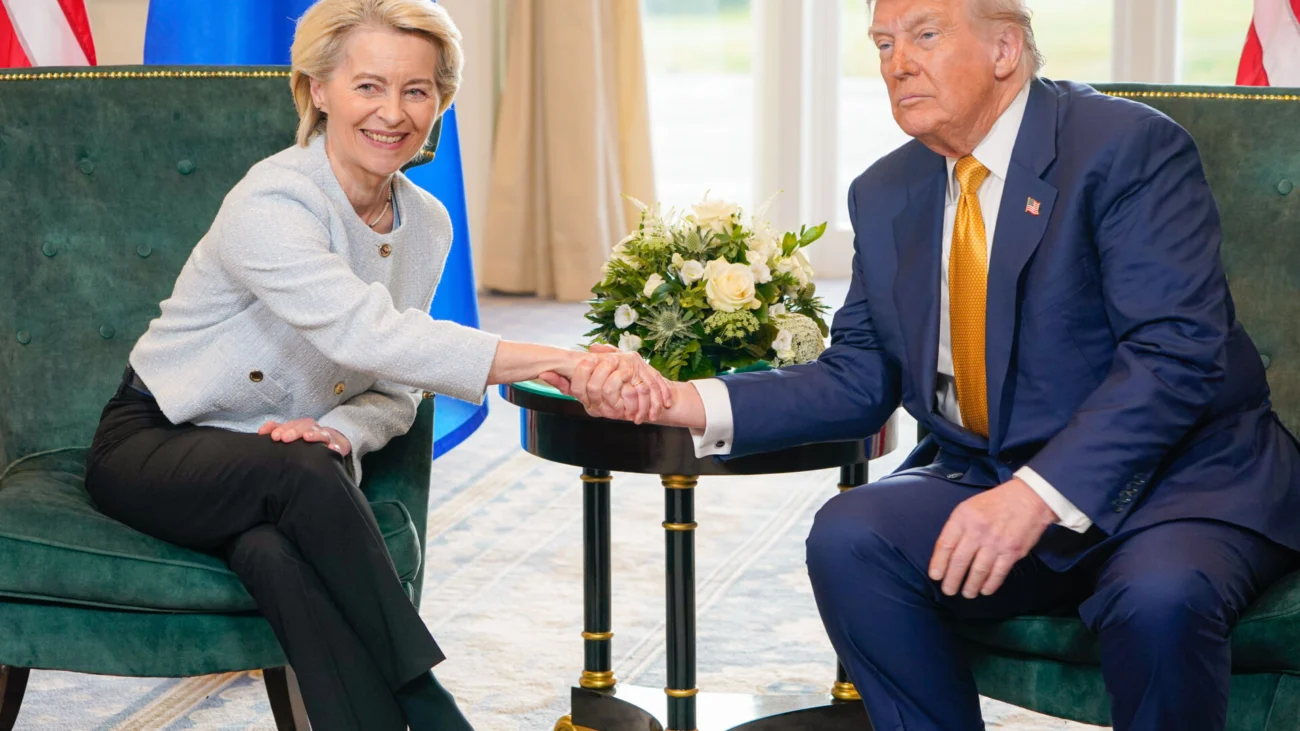
European Union lawmakers have moved a step closer to implementing a major transatlantic trade agreement with the United States, but not without drawing clear red lines that reflect deep concerns over fairness, stability and energy security.
The European Parliament approved the framework of the so called Turnberry agreement, originally negotiated in 2025, with a strong majority vote. However, lawmakers attached a series of conditions that must still be endorsed by EU member states before the deal can fully take effect, particularly before tariffs on US goods are reduced to zero.
At the heart of the agreement is a significant shift in tariff structures between the two economic powers. The European Union has agreed to eliminate most tariffs on US industrial goods, opening its market further to American exports. In return, the United States has committed to capping tariffs on EU goods at around 15 percent, a move designed to prevent a full scale trade conflict but still widely seen as uneven.

That imbalance has been one of the most controversial aspects of the deal. Several European lawmakers have openly described it as imperfect, but ultimately necessary to preserve transatlantic trade stability. The EU and US together account for a massive share of global trade and economic output, making any disruption between them a global risk.
To counter these concerns, lawmakers inserted multiple safeguards into the agreement. These include mechanisms that allow the EU to suspend or revise the deal if the United States fails to comply with its terms, imposes new tariffs, or takes actions that harm European industries.
Among the key protections are clauses that link tariff reductions to US compliance, as well as provisions that allow the agreement to expire or be revoked if conditions deteriorate. These measures are essentially a defensive strategy, reflecting fears that future policy shifts in Washington could undermine the deal.
This caution is not theoretical. The agreement has already faced delays due to tensions between both sides, including disputes over trade policies and geopolitical issues. European lawmakers had previously held back approval amid concerns that the US could introduce new tariffs that would contradict the spirit of the agreement.
Beyond tariffs, energy has emerged as a critical pressure point in the negotiations. The United States has warned that failure to implement the deal could affect Europe’s access to favourable liquefied natural gas supplies, which have become increasingly important as the EU seeks to diversify energy sources.
The agreement reportedly includes commitments by Europe to purchase large volumes of American energy, highlighting how trade and energy security are now deeply intertwined. With global tensions affecting energy markets, maintaining stable access to US LNG is seen as strategically important for Europe’s economic resilience.
This adds another layer of urgency to the deal. For Europe, the agreement is not just about trade liberalisation but also about securing energy supply in an increasingly volatile geopolitical environment. For the United States, it represents both an economic opportunity and a tool of influence in global energy markets.

Despite the progress in Parliament, the deal is not yet final. EU member states must still approve the attached safeguards, and further negotiations are expected before full implementation. Talks between EU institutions and national governments are likely to shape the final version of the agreement, with a possible conclusion in the coming months.
Business communities on both sides of the Atlantic have largely welcomed the move, seeing it as a step toward predictability after years of trade tensions. However, critics argue that the EU may be conceding too much in exchange for stability, especially given the asymmetry in tariff commitments.
The broader implication is clear. This deal is less about achieving perfect balance and more about managing risk in a fragile global economy. It reflects a shift toward pragmatic trade diplomacy, where stability and strategic interests often outweigh ideal economic terms.
As negotiations move forward, the real test will be whether the safeguards hold up in practice. If they do, the agreement could stabilise one of the world’s most important economic relationships. If not, it could reopen the door to the kind of trade tensions that both sides are trying to avoid.
EU banks’ euro-pegged stablecoin in talks with crypto exchanges to boost liquidity