

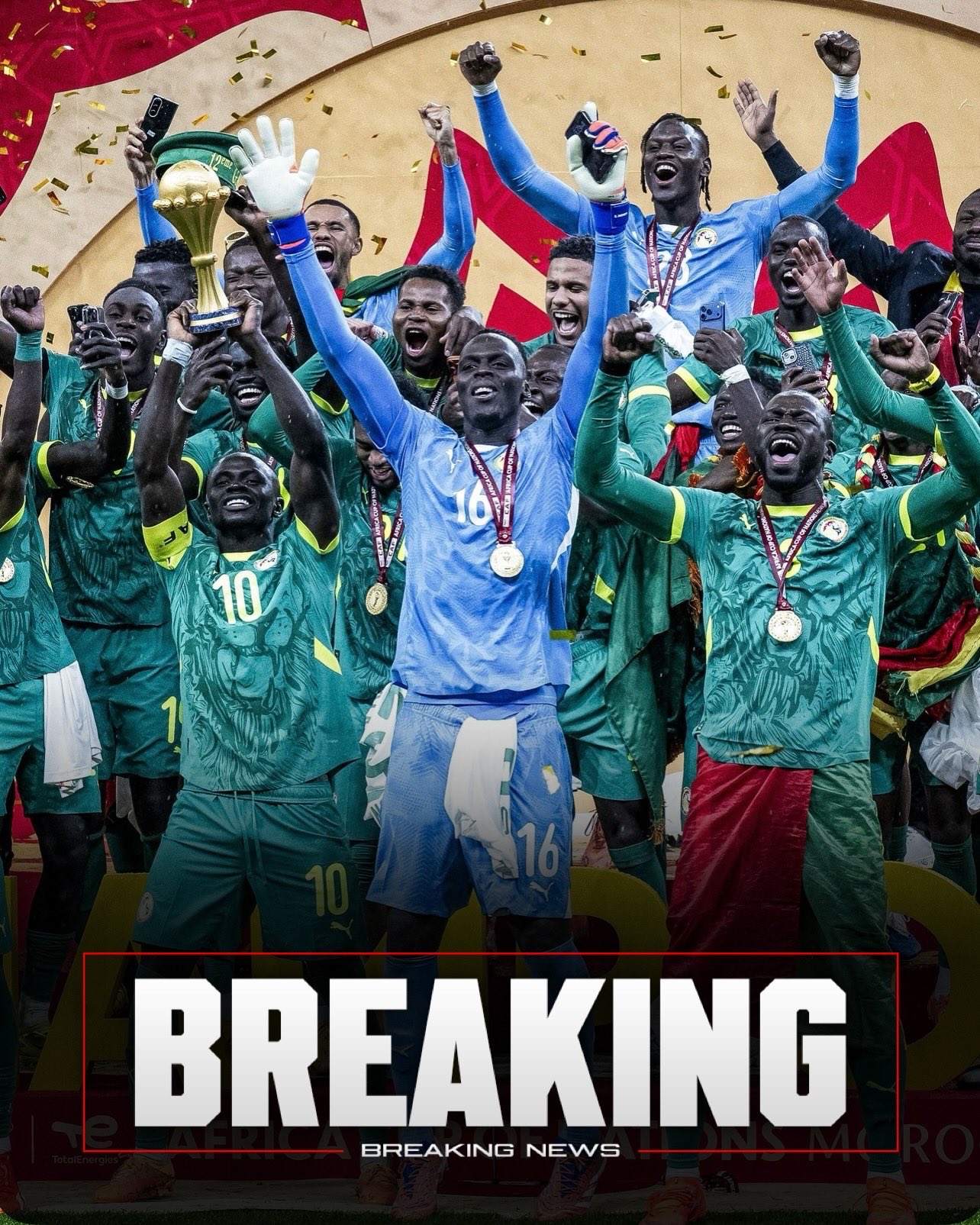
The Court of Arbitration for Sport has officially registered an appeal by the Senegalese Football Federation in a high-stakes legal challenge that could reshape the outcome of the 2025 Africa Cup of Nations and test the credibility of football governance on the continent.
Filed on 25 March 2026, the appeal seeks to overturn the Confederation of African Football’s controversial decision to strip Senegal of their AFCON title and instead declare Morocco as champions. The Senegalese federation is asking CAS to set aside the ruling and restore Senegal as the rightful winners of the tournament, setting the stage for one of the most consequential legal disputes in African football history.
From triumph to controversy
The dispute stems from the dramatic AFCON 2025 final played in Rabat, where Senegal initially secured a 1–0 victory after extra time. However, the match was marred by chaos after Senegalese players briefly walked off the pitch in protest of a controversial refereeing decision involving a penalty awarded to Morocco.
Although the players returned and completed the match, CAF later ruled that the walk-off constituted a breach of its regulations. Invoking disciplinary provisions, the governing body declared Senegal to have forfeited the game and awarded Morocco a 3–0 victory, effectively handing them the title.
The decision shocked fans, players, and analysts across Africa, as it overturned an on-field result weeks after the final whistle.
CAS steps in as final arbiter
With the appeal now formally registered, CAS becomes the ultimate authority to determine the legitimacy of CAF’s ruling. The process will involve the appointment of an independent arbitration panel, followed by a procedural timetable leading to a final verdict.

Senegal’s legal argument centers on the proportionality and interpretation of CAF’s rules. The federation maintains that a temporary protest, especially one that did not lead to match abandonment, should not result in forfeiture of a completed final.
They are also seeking clarity on the legal grounds used by CAF, arguing that the decision lacks transparency and undermines the integrity of the sport.
A crisis of confidence in African football
Beyond the legal arguments, the case has triggered a broader crisis of confidence in African football administration. Critics argue that CAF’s decision sets a dangerous precedent by allowing administrative rulings to override results determined on the pitch.
The backlash has been intense. Fans and officials in Senegal have described the ruling as unjust, while some observers have questioned whether external influence or institutional bias played a role.
The controversy has also drawn scrutiny from football experts who warn that such decisions risk damaging the global reputation of African competitions. The perception that rules can be inconsistently applied or retroactively enforced threatens to erode trust among players, supporters, and sponsors alike.
Morocco’s position and divided reactions
While Senegal pushes for reinstatement, Morocco maintains that the decision aligns with existing regulations. From their perspective, the rules governing player conduct and match continuity were clearly violated, justifying CAF’s intervention.
This divide has created a polarized football landscape across Africa. In Morocco, many fans view the ruling as justice served under the law. In Senegal and beyond, it is widely seen as an overreach that undermines sporting fairness.
The controversy has also reignited debates about governance structures within CAF and the balance of power among member associations.
Legal and sporting implications
The CAS ruling will carry far-reaching consequences. If Senegal’s appeal succeeds, it could lead to the reinstatement of their title and potentially force reforms in how CAF handles disciplinary cases. It would also reinforce the principle that results on the field should remain paramount.
On the other hand, if CAS upholds CAF’s decision, it could validate stricter enforcement of regulations, even in high-stakes matches like tournament finals. Such an outcome may prompt teams to exercise greater caution during disputes but could also deepen concerns about fairness and proportionality.
More than just a trophy
At its core, this case is about more than who lifts the AFCON trophy. It represents a clash between legal interpretation and sporting justice, between administrative authority and the sanctity of on-field competition.

For Senegal, the appeal is a fight to reclaim what they believe was rightfully earned. For CAF, it is a test of its regulatory framework. And for African football as a whole, it is a defining moment that could shape governance standards for years to come.
CAS is expected to proceed with appointing an arbitration panel and setting a hearing schedule in the coming weeks. While no timeline has been confirmed for a final decision, the case is likely to attract global attention given its implications.
Until then, the 2025 AFCON title remains in dispute, leaving fans, players, and officials in a state of uncertainty.
What is clear, however, is that the final whistle has not yet been blown on this controversy.