

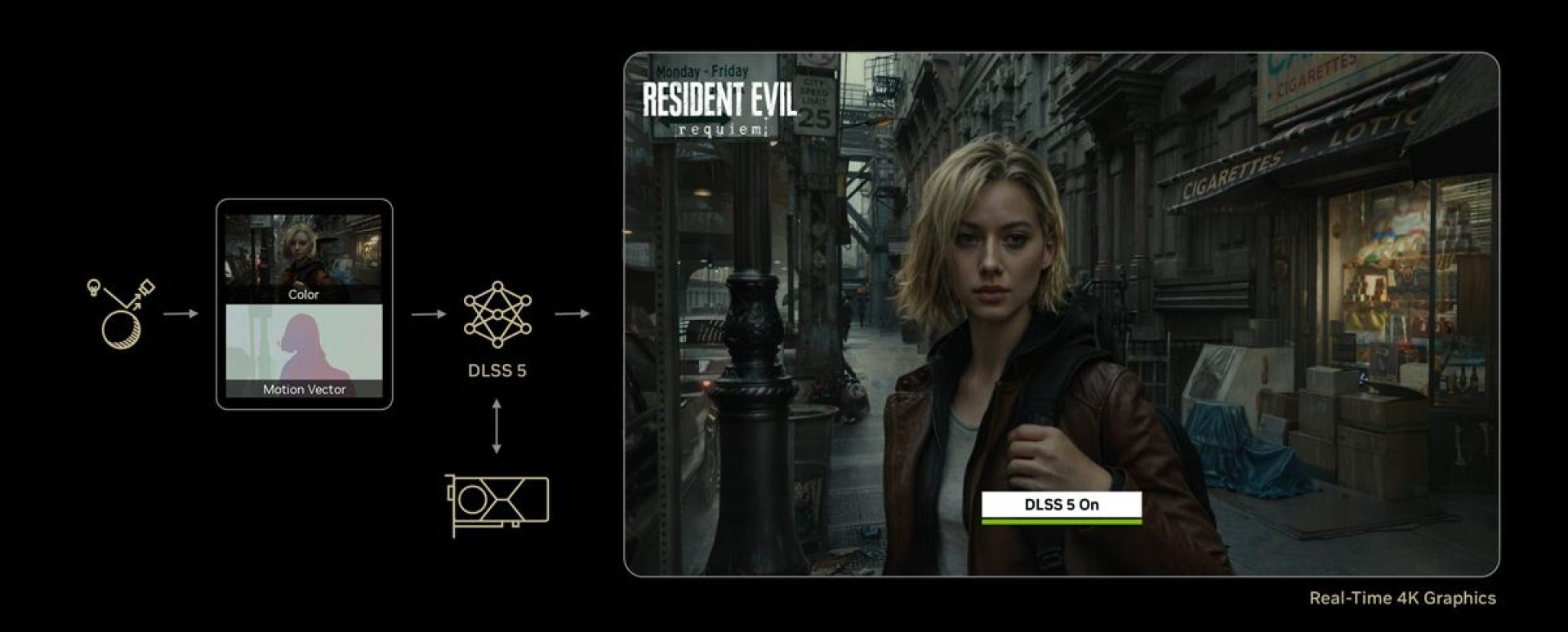
Nvidia has introduced its latest graphics innovation, DLSS 5, a major upgrade to its Deep Learning Super Sampling technology that uses generative artificial intelligence to significantly enhance realism in video games while laying the groundwork for applications far beyond gaming.
The new system builds on previous DLSS versions by combining traditional rendering techniques with generative AI models trained to reconstruct and enhance images in real time. Instead of simply upscaling lower resolution frames, DLSS 5 generates entirely new visual details, producing sharper textures, more accurate lighting and smoother motion that closely mimics real world environments.
According to Nvidia, the technology leverages structured graphics data from game engines alongside AI models to predict how scenes should look, effectively filling in gaps that would otherwise require heavy computational power. This allows games to achieve photorealistic quality without sacrificing performance, a long standing challenge in the gaming industry.
Chief executive Jensen Huang described DLSS 5 as a step toward a future where graphics are no longer limited by hardware constraints alone. By shifting part of the rendering workload to AI, Nvidia is redefining how images are created, moving from purely physics based rendering to a hybrid approach that blends computation with machine learning.
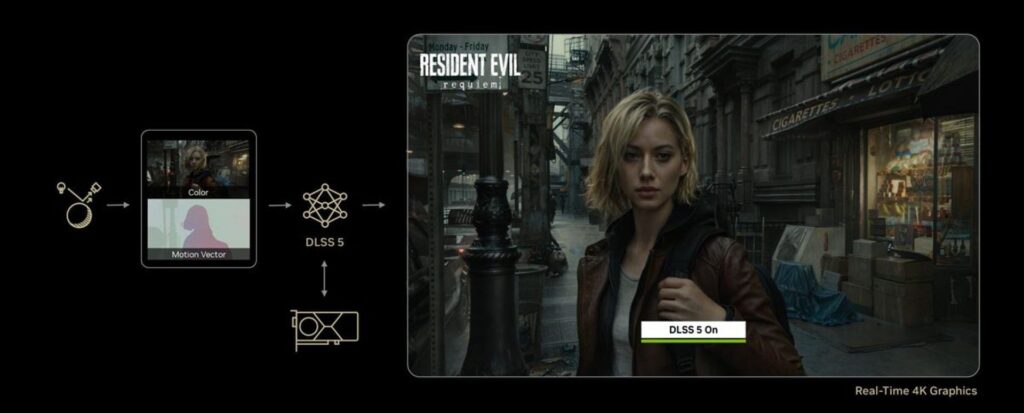
The implications extend beyond gaming. Nvidia believes the same generative AI techniques could be applied in industries such as film production, architecture, automotive design and virtual reality. In these fields, the ability to generate high fidelity visuals in real time could reduce production costs and accelerate design workflows.
For example, filmmakers could use similar technology to create realistic visual effects without extensive post production, while architects and engineers could visualise complex structures with greater accuracy during the design phase. In the automotive sector, AI driven rendering could enhance simulation environments used for testing autonomous vehicles.
The launch also reflects a broader trend in the technology sector, where generative AI is increasingly being integrated into core systems rather than treated as a standalone tool. By embedding AI directly into the graphics pipeline, Nvidia is positioning itself at the forefront of this shift.
DLSS has already become a key feature in many modern games, particularly those requiring high frame rates and detailed environments. With DLSS 5, Nvidia is aiming to push the boundaries further, delivering near cinematic quality visuals while maintaining smooth gameplay performance.

Industry observers note that the success of DLSS 5 will depend on adoption by game developers, who must integrate the technology into their titles. However, given Nvidia’s dominant position in the GPU market, many expect rapid uptake, especially among studios seeking to differentiate their games through visual quality.
The development also intensifies competition in the graphics space, with rivals exploring their own AI driven rendering solutions. As the race for realism continues, the integration of generative AI is likely to become a defining feature of next generation graphics technologies.
Nvidia’s latest advancement signals a shift in how digital visuals are created, blending traditional rendering with AI generated enhancements to achieve levels of realism that were previously difficult to attain. As the technology matures, its influence could extend well beyond gaming, reshaping industries that rely on high quality visual simulation.