


Ghanaians are set to pay slightly less for electricity and water beginning April 1, 2026, after the Public Utilities Regulatory Commission (PURC) announced a downward adjustment in utility tariffs for the second quarter of the year. The regulator disclosed that electricity tariffs will decrease by an average of 4.81 percent, while water tariffs will drop by 3.06 percent, marking a modest relief for consumers across the country.
The decision forms part of PURC’s quarterly tariff review mechanism, which allows the commission to adjust utility prices periodically to reflect changes in key economic indicators affecting the operations of electricity and water service providers. According to the commission, the adjustments are designed to balance consumer affordability with the financial sustainability of utility companies responsible for delivering essential services.
Quarterly tariff review mechanism
The PURC explained that the quarterly tariff review system tracks fluctuations in several economic and operational factors that influence the cost of providing electricity and water services. These factors include the exchange rate between the Ghana cedi and the United States dollar, domestic inflation levels, the country’s electricity generation mix, and the cost of fuel such as natural gas used in thermal power generation.
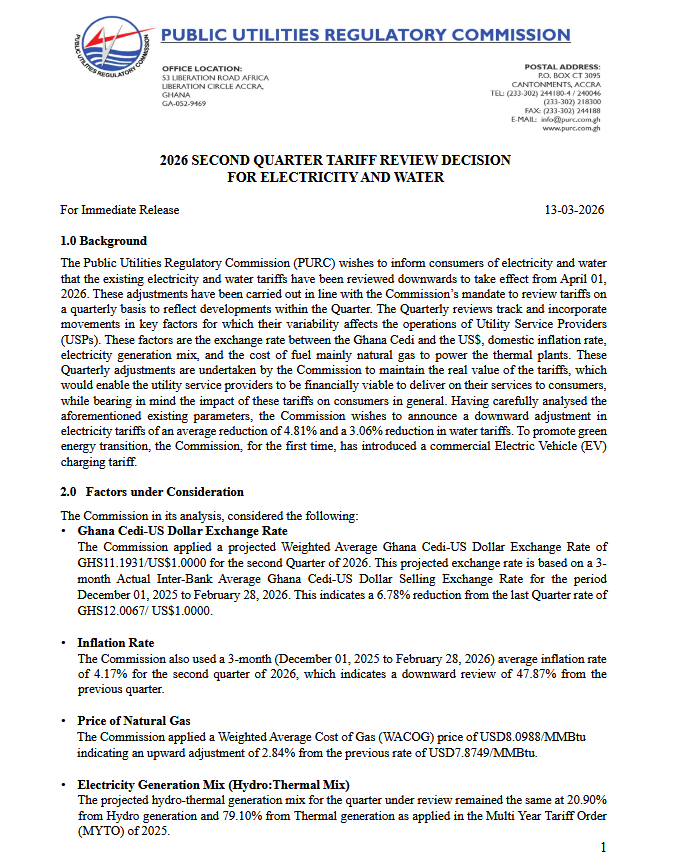
For the second quarter of 2026, the commission applied a projected weighted average exchange rate of GH¢11.1931 to US$1, based on a three month interbank average between December 2025 and February 2026. This figure represents a significant reduction compared with the previous quarter’s exchange rate of GH¢12.0067 to the dollar. The improvement in the exchange rate contributed partly to the downward adjustment in tariffs.
The review also incorporated a three month average inflation rate of 4.17 percent, reflecting a sharp decline compared with the previous quarter. However, the weighted average cost of gas used for electricity generation increased slightly to US$8.0988 per MMBtu, representing a modest rise from earlier levels. Despite the increase in gas costs, overall conditions supported a reduction in tariffs.
Impact on electricity consumers
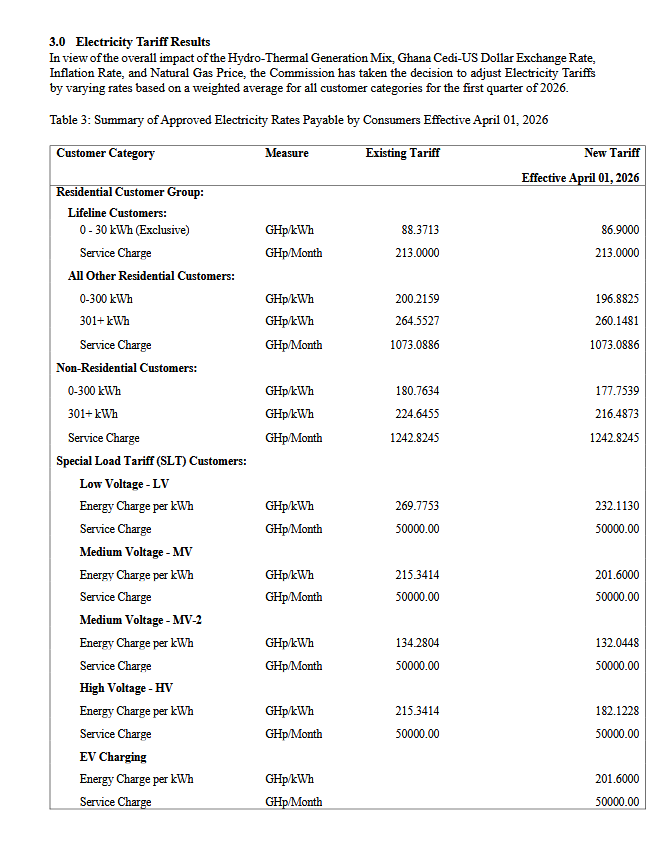
Electricity customers across different categories will experience varying levels of reduction depending on their consumption levels and tariff classification. Residential users, commercial customers and industrial consumers will all benefit from the tariff adjustments, although the exact percentage reductions may differ across categories.
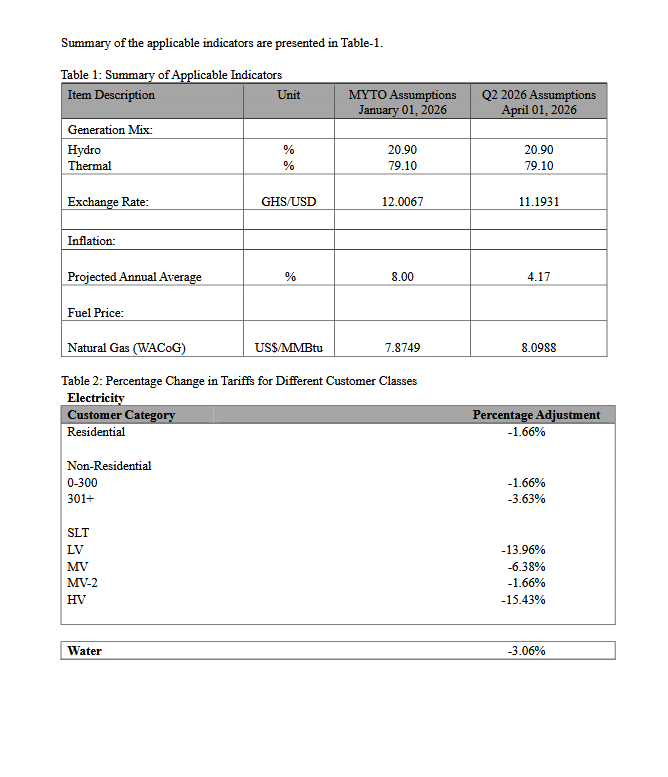
Reports indicate that some non residential consumers could see reductions of up to 15.43 percent, while residential users will experience smaller but still meaningful decreases depending on their usage patterns. These reductions are expected to provide modest relief for households and businesses facing rising living costs.
The electricity generation mix used in the tariff calculations remains largely unchanged, with approximately 20.9 percent of electricity generated from hydro sources and 79.1 percent from thermal plants, according to the regulatory framework guiding Ghana’s power sector.
Water tariff adjustments
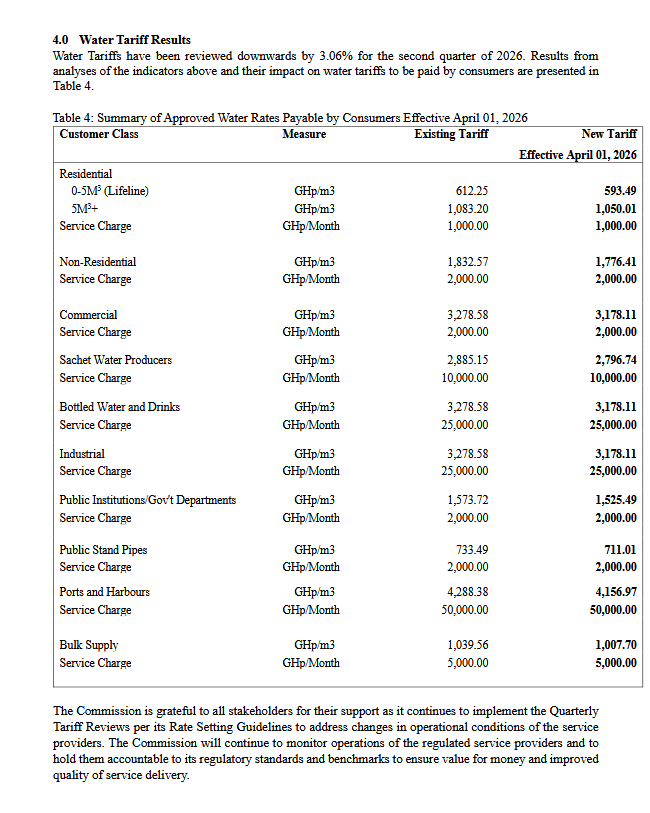
Water consumers will also benefit from the downward revision in tariffs. The PURC noted that residential lifeline customers, who consume smaller volumes of water, will see a reduction in charges for the 0–5 cubic meter consumption bracket. Similar downward adjustments are expected across commercial and industrial water tariffs as well as bottled water production rates.
The commission stated that maintaining affordable water tariffs is critical to ensuring access to safe drinking water while allowing service providers such as the Ghana Water Company Limited to cover operational costs and maintain infrastructure.
Introduction of EV charging tariff
Alongside the tariff reduction announcement, the PURC introduced Ghana’s first commercial electric vehicle charging tariff, signaling a new regulatory step aimed at supporting the country’s emerging electric mobility sector.
Under the new framework, EV charging stations will pay 201.6 Ghana pesewas (GH¢2.016) per kilowatt hour of electricity, in addition to a monthly service charge of GH¢500. The move is intended to create a standardized pricing structure for electric vehicle charging services as Ghana gradually expands its clean energy and transportation initiatives.
Balancing consumer relief and sector sustainability
According to the PURC, the tariff review aims to maintain a balance between providing relief to consumers and ensuring the long term viability of utility service providers. Utility companies require sufficient revenue to maintain infrastructure, invest in system upgrades and guarantee reliable service delivery across the country.
The commission emphasized that the quarterly review mechanism allows tariffs to respond more gradually to changes in economic conditions, helping to avoid sudden large increases that could significantly burden consumers.
The latest tariff reduction comes at a time when Ghana’s energy and water sectors continue to face evolving challenges, including infrastructure investment needs, fuel price fluctuations and currency movements. By adjusting tariffs periodically, the regulator seeks to ensure that the utilities sector remains financially sustainable while maintaining fair pricing for consumers.
For households, businesses and industries, the April 1 adjustments are expected to bring modest cost relief in electricity and water bills, though the long term direction of tariffs will continue to depend on macroeconomic developments and operational costs in the utilities sector.
Overall, the announcement reflects ongoing efforts by regulators to manage utility pricing in a way that supports both consumer welfare and the stability of Ghana’s essential public service providers.