


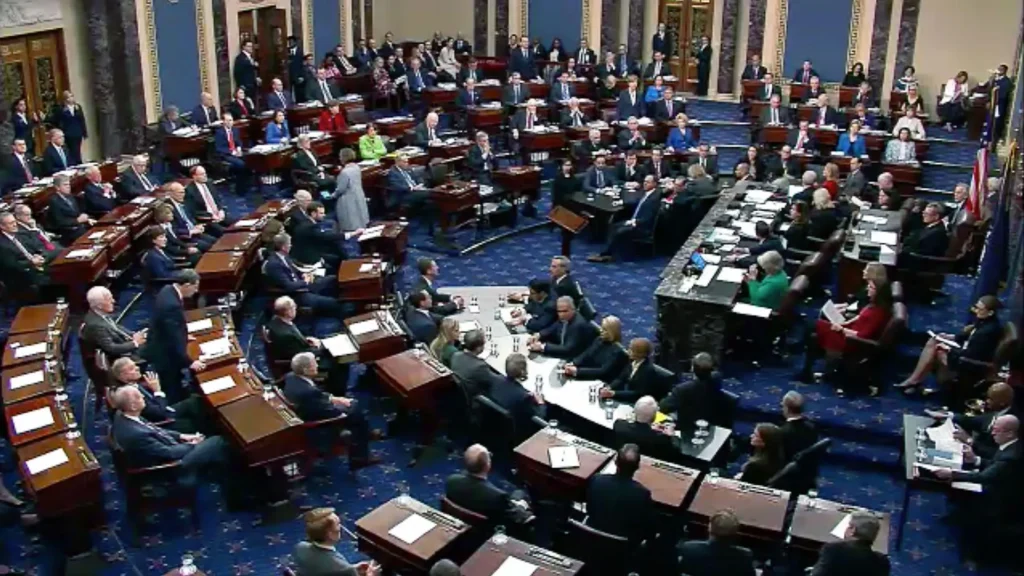
The United States Senate has voted down a resolution aimed at preventing President Donald Trump from continuing military operations against Iran without congressional approval, highlighting deep political divisions in Washington as the conflict in the Middle East escalates.
The measure, introduced by Democratic Senator Tim Kaine, sought to reassert Congress’s constitutional authority over decisions to go to war. Under the proposal, the president would have been required to obtain explicit authorization from lawmakers before continuing military action against Iran beyond defensive operations. However, the resolution failed after a narrow 47–53 vote, effectively allowing the administration to proceed with its campaign alongside Israel.
Partisan divide in the Senate
The vote largely followed party lines. Most Republican senators opposed the measure, arguing that the president should retain the authority to direct military operations as commander in chief during an ongoing conflict. Only one Republican, Senator Rand Paul of Kentucky, broke ranks to support the resolution.
Conversely, nearly all Democrats backed the proposal, although Democratic Senator John Fetterman voted against it, joining Republicans in blocking the measure. The outcome underscored the sharp political divide over U.S. involvement in the widening confrontation with Iran.
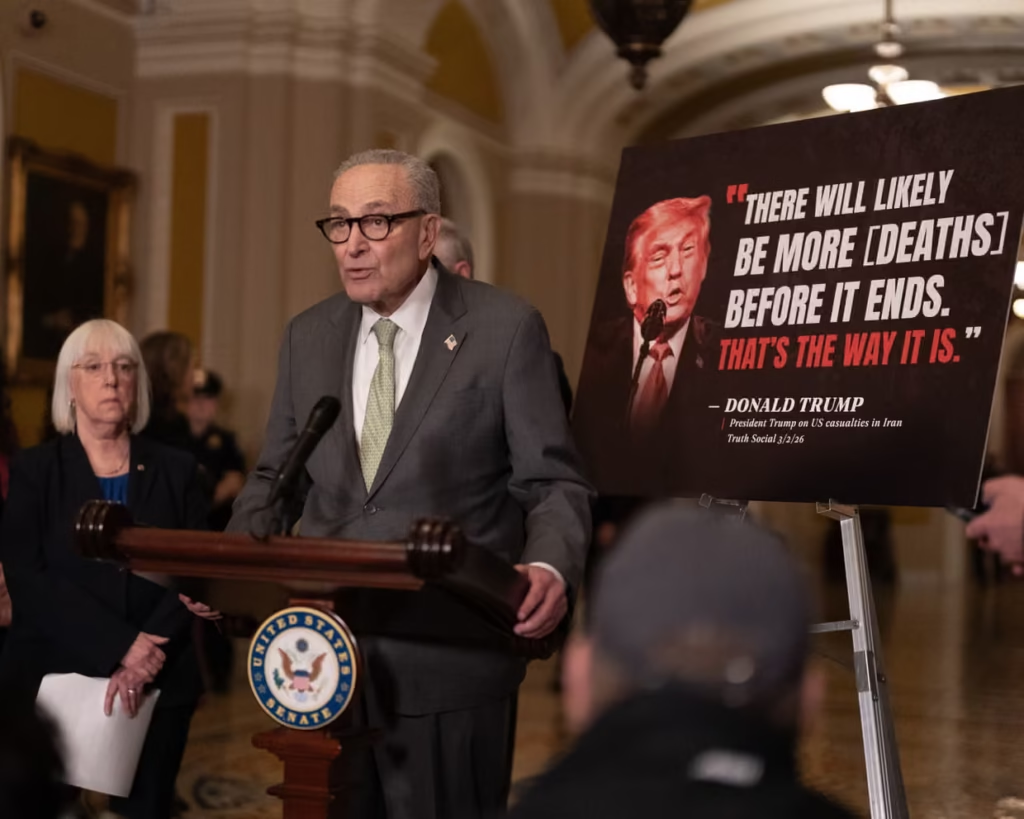
Supporters of the resolution argued that Congress must maintain its constitutional role in determining whether the country enters or continues a war. Senator Kaine and other advocates warned that allowing unilateral military action by the executive branch could lead the United States into another prolonged overseas conflict.
Critics of the war effort have also raised concerns about its legal basis. Some lawmakers and policy experts have argued that launching sustained military operations without congressional approval risks violating the constitutional framework governing war powers.
Arguments from opponents of the resolution
Republican lawmakers who opposed the measure defended the administration’s approach, emphasizing the threat posed by Iran’s military capabilities and regional influence. They argued that limiting the president’s authority during a rapidly developing conflict could weaken the United States’ ability to respond effectively.
Senator Susan Collins was among those who rejected the resolution, stating that Iran’s pursuit of advanced military capabilities and support for militant groups represented a serious threat to U.S. national security and to American allies in the region. She warned that the United States “cannot tolerate a nuclear-armed Iran,” pointing to Tehran’s missile development and regional activities as reasons to support ongoing military operations.
Supporters of the administration also contend that American forces must remain engaged to deter further aggression and protect regional partners. They argue that curbing the president’s ability to act could signal weakness during a critical stage of the conflict.
Growing casualties and escalation
The Senate vote comes amid intensifying hostilities between Iran, Israel and the United States. Since the start of the conflict, at least six U.S. service members have been killed, while casualty estimates in Iran range between over a thousand and 1,500 people as strikes continue across the region.
The conflict has expanded beyond initial targets, with U.S. air and naval operations targeting Iranian military infrastructure and strategic positions. Meanwhile, Iranian forces have launched missile and drone attacks across the region, raising fears of a wider war that could involve additional countries and destabilize global markets.
The mounting casualties and expanding scope of the conflict have intensified debate in Washington about whether the United States risks becoming entangled in another long and costly military campaign in the Middle East.
Uncertain Path in Congress
Although the Senate rejected the resolution, lawmakers are expected to continue debating congressional oversight of the war effort. Similar measures could be introduced in the House of Representatives, where some lawmakers are also pushing for stronger limits on presidential war powers.

However, even if such legislation were to pass both chambers of Congress, it would face significant hurdles. President Trump would almost certainly veto a measure restricting his authority, and overriding such a veto would require a two-thirds majority in both the House and Senate, a threshold that appears unlikely to be met in the current political climate.
Broader debate over war powers
The failed vote has revived a longstanding debate in the United States over the balance of power between Congress and the presidency when it comes to military action. The U.S. Constitution grants Congress the authority to declare war, yet presidents from both parties have often initiated or expanded military operations without formal declarations.
For critics of the administration’s approach, the Iran conflict represents another example of the executive branch bypassing congressional oversight. Supporters of the president argue that modern conflicts require swift decisions that cannot always wait for lengthy legislative approval.
As the war continues and tensions in the Middle East escalate, the struggle between Congress and the White House over control of military power is likely to remain a central issue in American politics.