

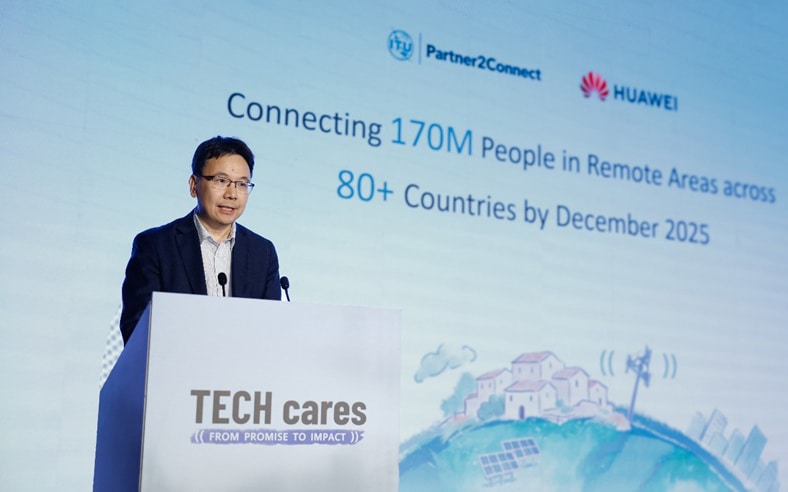
Huawei has announced that it has surpassed its digital inclusion commitment to the International Telecommunication Union (ITU) Partner2Connect (P2C) Digital Coalition, connecting 170 million people in remote and underserved areas worldwide, exceeding the original target of 120 million set for 2025. The achievement was disclosed by Yang Chaobin, Chief Executive Officer of Huawei’s ICT Business Group, during the company’s TECH Cares Forum in Barcelona, Spain, underscoring Huawei’s ongoing role in expanding global digital connectivity and narrowing the digital divide.
Huawei made the pledge to the ITU P2C Digital Coalition in 2022, aligning with the UN‑led initiative’s goal of universal digital access. The Partner2Connect initiative focuses on connecting the estimated 2.9 billion people worldwide who remain offline, many of whom live in rural or underserved communities without reliable internet infrastructure. Huawei’s expanded reach beyond its pledge reflects collaboration with telecom operators, governments, and ecosystem partners to deploy affordable and scalable connectivity solutions.
“Our success in connecting 170 million people demonstrates what collaborative effort can achieve,” Yang Chaobin said, expressing gratitude to Huawei’s telecom customers and partners. He noted, however, that despite rapid advances in technologies such as artificial intelligence (AI), the digital divide continues to persist and could widen without sustained investment in digital infrastructure and skills. “High‑speed digital networks and robust computing capabilities are essential foundations for an inclusive and sustainable AI era,” he added.

The expanded connectivity is expected to improve access to critical services in healthcare, education, finance, and public administration in remote areas, enabling citizens to participate more fully in the digital economy. By bridging connectivity gaps, communities previously cut off from reliable internet can now access online learning, telemedicine, digital banking and e‑government services, which are increasingly essential for socioeconomic development.
Cosmas Zavazava, Director of the ITU Telecommunication Development Bureau, commended Huawei’s achievement and emphasised the importance of inclusive connectivity to global development goals. “Connecting the rural and underserved communities requires innovative business models, inclusivity and the effective use of communication resources as well as community engagement, and sustained investment in local capacity,” Zavazava said. His remarks reflect the ITU’s broader mission to close connectivity gaps and ensure that digital technologies benefit all populations, particularly in low‑income and remote regions.
Huawei representatives also highlighted that digital inclusion extends beyond infrastructure deployment to encompass digital skills empowerment. Jeff Wang, President of Huawei Public Affairs and Communications, stressed the importance of fostering digital skills among diverse population groups, including students, youth, women and the elderly. Huawei collaborates with governments, nonprofit organisations, and educational institutions to deliver digital training and promote STEM (science, technology, engineering and mathematics) education.
One notable initiative is Huawei’s Skills on Wheels programme, launched in 2019. This mobile training initiative has delivered digital skills education to more than 130 000 people across 21 countries, bringing training directly to communities that may lack access to traditional educational facilities. The programme focuses on fundamental digital literacy, vocational ICT skills and support for local educators and trainers, thereby building community capacity for sustained digital engagement.
In rural network innovation, Huawei has continually refined its Rural Series solutions since 2017 to make connectivity deployment more affordable and efficient for remote areas. These solutions are designed to lower the cost of network expansion and accelerate access to broadband services where traditional infrastructure investment can be challenging due to geographic or economic barriers.
A more recent addition to this portfolio is Huawei RuralCow, launched in November 2025, which extends coverage to villages with populations of around 1 500 residents. This solution has been deployed in collaboration with partners such as MTN Nigeria, expanding connectivity to previously underserved communities and stimulating digital inclusion in sub‑Saharan Africa. Through such targeted solutions, Huawei and its partners have been able to help achieve and exceed the P2C pledge while also supporting local economic development and enabling broader access to digital public services.
The impact of expanded connectivity is multi‑faceted. Beyond enabling access to the internet itself, broadband networks serve as platforms for economic engagement, job creation and social inclusion. In many rural areas, improved connectivity can spur local entrepreneurship, provide access to global markets, and support innovations in agriculture, health and education that were previously constrained by isolation.
Huawei’s announcement comes at a time when global digital strategies are increasingly prioritising equitable access and human‑centred digital transformation. As countries continue to digitise public services and promote digital economies, partnerships between technology providers, governments, development agencies and civil society will remain pivotal to achieving universal connectivity and ensuring that no communities are left behind in the digital era.