


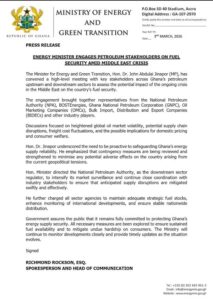
The Ministry of Energy has initiated a comprehensive assessment of the nation’s fuel security in response to mounting global uncertainties tied to the escalating crisis in the Middle East, officials have confirmed. With geopolitical tensions disrupting oil markets and driving up prices internationally, the ministry says it is reviewing national fuel import strategies, refining capacity utilisation, storage buffers and contingency arrangements to ensure that Ghana’s energy needs remain reliably met.
The review comes as crude oil markets experience heightened volatility following intensified conflict in the Middle East, a region that remains pivotal to global oil supply. Major benchmarks such as Brent crude and West Texas Intermediate (WTI) have surged in recent weeks, reflecting investor concerns about potential supply disruptions through critical export routes including the Strait of Hormuz, a narrow maritime passage through which a substantial share of the world’s oil transits daily. Any threat to tanker traffic or infrastructure in the region can rapidly feed through to global prices, adding pressure on import-dependent countries like Ghana.
During a press briefing, officials from the Ministry of Energy indicated that while Ghana has historically maintained adequate fuel reserves, the current risk environment necessitates forward-looking planning and enhanced coordination with strategic partners. “Our preliminary assessments suggest that current stock levels remain within acceptable limits, but we are accelerating scenario planning to prepare for any sustained or sharp increase in crude costs,” a senior energy official said.

Ghana’s fuel supply chain depends heavily on imports of refined petroleum products such as petrol (Premium Motor Spirit), diesel and liquefied petroleum gas (LPG), as the country’s own refining capacity is limited. Although the Ghana National Petroleum Corporation (GNPC) and private sector stakeholders regularly monitor global developments to secure supply contracts, rapid price movements can strain budgets and influence retail pump prices domestically.
The Energy Ministry’s assessment includes consultation with key industry players, including fuel importers, distributors, logistics operators and financial managers responsible for securing foreign exchange for imports. The cross-sectoral review aims to identify risks at each stage of the supply chain, from international shipping costs and freight insurance premiums to port handling capacity and domestic distribution resilience.
One area of focus is the optimisation of Ghana’s strategic fuel reserves, which are held to cushion against temporary supply shortfalls or transport disruptions. Government officials emphasised that although current stock levels are adequate for short-term stability, maintaining and potentially increasing buffer stocks could provide valuable insurance against prolonged market shocks or supply delays.
The ministry is also monitoring developments at Dangote Refinery, a vast refining facility in neighbouring Nigeria that has become a major source of refined products for Ghana and other West African markets. Recent reports indicate rising local pump prices in Nigeria due to surging gantry prices at the refinery, a consequence of rising global crude costs linked to Middle East instability. Although Ghana’s fuel pricing regime and supply contracts differ from Nigeria’s, regional price movements can indirectly affect import costs due to shifts in trade flows and competitive sourcing dynamics.
Experts say that while global price shocks can be difficult to avoid entirely, strategic purchasing, diversified sourcing and strengthened regional cooperation on oil and petroleum product logistics can help mitigate some of the pressures. “What matters most is not only having stocks, but having diversified supply options and clear mechanisms for rapid response when markets tighten,” said a senior policy analyst specialising in energy markets.
The Energy Ministry’s assessment also aims to integrate insights from international partners, including energy analysts, financial institutions and regional bodies such as the Economic Community of West African States (ECOWAS), which tracks macroeconomic impacts of energy price fluctuations across member states. Coordinated data sharing and early warning systems within the region help governments anticipate risks and coordinate mitigation strategies, particularly in countries with similar import dependencies.
At the same time, Ghana’s authorities remain vigilant about the potential impact of rising prices on consumers and businesses. In recent months, global oil price spikes have filtered through to higher transport costs, logistics expenses and inflationary pressures, affecting household budgets and corporate operations. The Energy Ministry says it is aware of the need to balance supply security with economic affordability and will engage relevant ministries on policy measures that can cushion vulnerable populations and critical sectors from undue hardship.
Officials stressed that the review is ongoing and will culminate in specific policy recommendations aimed at fortifying Ghana’s energy security framework. Options under consideration include adjustments to import contracts, enhanced use of fuel hedging instruments, expanded storage capacity and targeted incentives for investment in domestic refining and energy infrastructure.
While international geopolitics remain unpredictable, the government’s proactive stance is intended to ensure that Ghana’s energy landscape remains stable, resilient and capable of absorbing external shocks without severe disruption to daily life or economic activity.
U.S. Seizes Nigerian-Owned Supertanker Over Alleged Crude Theft and Transnational Crime Activities