

The European Union has assured Uganda that existing trade and economic cooperation will continue even after the country graduates from the least developed country category, even as Kampala edges closer to middle-income status.
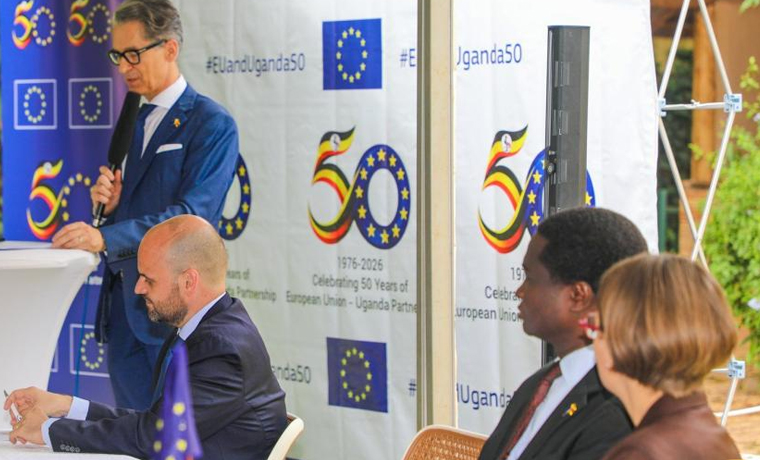
The reassurance comes as the EU and Uganda mark 50 years of diplomatic relations, a partnership both sides describe as resilient, adaptive and economically significant.
Speaking in Kampala, Jan Sadek, Head of the EU Delegation in Uganda, acknowledged that Uganda will eventually lose access to the bloc’s Everything But Arms scheme once it formally exits the least developed country bracket. However, he emphasised that alternative frameworks exist to sustain preferential access to the European market.
Under the EU’s Everything But Arms initiative, Uganda currently enjoys duty-free and quota-free access for nearly all exports to the European Union, except arms and ammunition. The arrangement has enabled more than 95 percent of Ugandan exports to enter the EU market tariff-free, cementing the bloc’s position as Uganda’s third-largest trading partner.
Uganda’s graduation from the least developed country category is progressing through the United Nations system. On March 11, 2024, the Committee for Development Policy formally communicated that Uganda had met the criteria for graduation for the first time. The country will be considered for recommendation at the 2027 triennial review, after which endorsement by the UN Economic and Social Council and the General Assembly would complete the process.
Sadek clarified that once Uganda officially exits the LDC category, the Everything But Arms facility will no longer apply. To maintain preferential access, Uganda would need to sign the Economic Partnership Agreement with the EU.
The European Union, with a population exceeding 500 million consumers, remains one of the world’s most lucrative export destinations. According to EU officials, signing the Economic Partnership Agreement would secure immediate duty-free and quota-free access for Ugandan goods, albeit under different terms than the EBA framework.
While acknowledging that the EPA may not replicate all the advantages of the Everything But Arms scheme, Sadek noted that European consumers continue to show strong demand for Ugandan products, particularly agricultural exports.
On Uganda’s side, John Leonard Mugerwa, Head of International Legal and Social Affairs at the Ministry of Foreign Affairs, stressed that Uganda has not yet formally been declared a middle-income country. He pointed out that the declaration is a UN process and that negotiations remain open.
Mugerwa expressed confidence that Uganda and the EU would ultimately reach consensus on the Economic Partnership Agreement, which has been under discussion since 2007 but stalled due to disagreements among East African Community partner states.
Upon graduation, he explained, Uganda would be eligible to sign the agreement independently. However, the number of products granted preferential access under the EPA is expected to be narrower than under the Everything But Arms scheme.
He added that the proposed agreement contains provisions aimed at strengthening value addition, an area Uganda has identified as critical to unlocking higher export earnings. Enhancing domestic processing capacity, rather than exporting raw commodities, is seen as central to long-term economic transformation.
Sadek welcomed Uganda’s push for value addition, particularly in agriculture, but cautioned that progress may take time. He noted that sectors such as coffee remain structurally conservative, making the transition from raw exports to processed and packaged products gradual rather than immediate.
Uganda has been urged to continue strengthening phytosanitary standards to ensure its products meet EU regulatory requirements, thereby enabling more exporters to access the European market competitively.
The trade relationship has shown strong recent performance. In 2024, total trade between Uganda and the European Union reached a record €2.1 billion, equivalent to approximately UGX 8.8 trillion. Ugandan exports surged by 60 percent, reaching €1.25 billion, driven largely by coffee, fish and fruit shipments.
For the first time in years, the trade balance shifted in Uganda’s favour, with a surplus of about €500 million.
Beyond trade, the EU’s footprint in Uganda spans development cooperation and private sector investment. Over the past five decades, the bloc has channelled more than €5 billion into development cooperation projects and a similar amount into European private investments across sectors including construction, manufacturing, trade and innovation.
The EU has also funded programmes in education, healthcare, infrastructure, energy and refugee support. In Northern Uganda, EU-backed initiatives such as the Development Initiative for Northern Uganda have supported post-conflict recovery, livelihood restoration and local governance strengthening.
As the partnership marks its 50th anniversary, EU officials describe it as one that has “lasted, adapted and delivered,” underscoring a shared interest in maintaining economic ties even as Uganda’s income status evolves.
Shein EU investigation: EU launches formal probe amid digital services concerns