

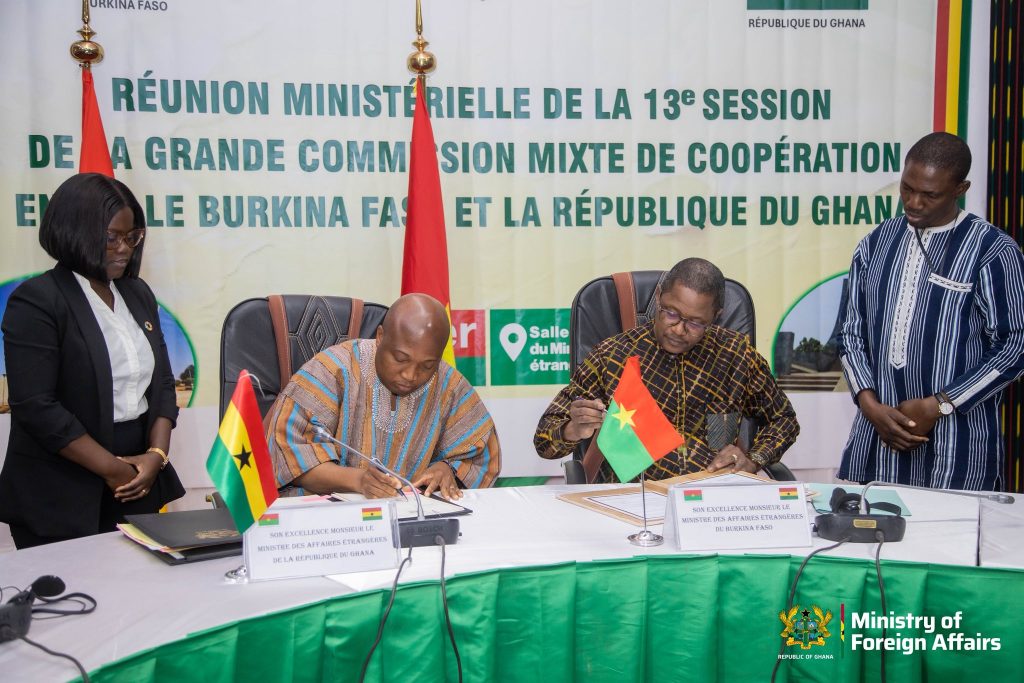
Ghana and Burkina Faso have taken a significant step toward strengthening their bilateral relationship by signing seven major cooperation agreements designed to enhance security, trade, border governance, and disaster responsiveness along one of West Africa’s most strategically important corridors. This landmark development, marked by the reactivation of the Permanent Joint Commission for Cooperation (PJCC) after six years of dormancy, reflects a renewed diplomatic engagement and pragmatic response to shared economic and security challenges facing both nations.
The agreements were finalised at the end of a high level session of the PJCC in Ouagadougou, where Ghana’s delegation engaged with top Burkinabè officials, including Prime Minister Rimtalba Jean Emmanuel Ouédraogo and Foreign Minister Karamoko Jean Marie Traoré. Ghana’s own Foreign Affairs Minister, Samuel Okudzeto Ablakwa, described the meetings as “fruitful and forward looking,” underscoring the shared commitment to deepen cooperation in key areas of mutual interest.
At the core of the new framework is the recognition that security and economic integration are intrinsically linked particularly in a region affected by rising threats from violent extremist groups and transnational crime. Both countries have agreed to establish a renewed security cooperation mechanism that will facilitate intelligence sharing, joint training of security forces, and coordinated efforts to counter terrorism and violent extremism that have increasingly threatened stability in parts of the Sahel and beyond.
Key agreements targeted at trade facilitation and mobility
Among the most commercially impactful accords is the mutual recognition of national driver’s licences, which is expected to remove a long standing regulatory obstacle for transporters along the critical Tema Ouagadougou trade corridor. This route serves as a vital artery for goods moving between Ghana’s ports and Burkina Faso’s landlocked markets. Harmonising driver licensing regulations aims to reduce delays and operational costs for transporters, thus facilitating smoother trade flows between the two nations.

Complementing this is an agreement on transport and road transit, designed to streamline regulatory frameworks that govern the movement of vehicles and goods across borders. By aligning transit rules and procedures, Ghana and Burkina Faso hope to bolster intra regional commerce and support the broader objectives of the African Continental Free Trade Area (AfCFTA), of which both countries are signatories.
In addition to these trade facilitation measures, the two sides signed a framework agreement on cross border cooperation aimed at fostering collaboration across a range of administrative and civil governance functions. The pact establishes mechanisms for periodic consultations between border authorities, allowing local officials to address specific challenges rapidly and coordinate development projects that benefit frontier communities.
Another key accord establishes a joint commission to reaffirm the boundary between the two countries. Given that Ghana and Burkina Faso share a common border stretching over 500 kilometres, clarifying and reaffirming this demarcation is seen as essential for sustaining peaceful coexistence, reducing friction over land use and resource management, and improving governance of border communities.
Addressing humanitarian and security risks
Recognising that security risks extend beyond armed groups to encompass humanitarian vulnerabilities, the two governments also agreed on a cooperation protocol for disaster prevention and humanitarian crisis management. This agreement acknowledges recurring challenges such as flooding linked to the release of water from the Bagré Dam in Burkina Faso, which has historically impacted downstream communities in northern Ghana. By creating a framework for joint disaster preparedness, early warning, and crisis response, both countries aim to reduce the human and economic toll of such emergencies.

In the area of law enforcement, the accords include a cooperation agreement targeting the prevention, management, and eradication of illicit drug cultivation, production, distribution, and trafficking. This measure aligns with the broader regional imperative to disrupt organised crime networks that exploit porous borders and weak governance structures, undermine public safety, and impede economic development.
Strategic and regional implications
The signing of the seven agreements comes amid wider concerns about rising insecurity in the Sahel and the growing need for collective responses to shared threats. Analysts view this expanded cooperation as both a practical and symbolic renewal of bilateral relations that had been less active in recent years. By revitalising the PJCC and operationalising new legal frameworks, Ghana and Burkina Faso are signalling a commitment to functional integration that prioritises security, trade, and joint governance.
The agreements are also expected to contribute to broader West African regional integration efforts by facilitating cross border movement, enhancing trade connectivity, and strengthening coordination among neighbouring states. The Tema Ouagadougou corridor, for instance, not only serves Burkina Faso’s landlocked economy but also acts as a critical hub for trade between West African markets. Efficient management of this corridor has long been recognised as key to improving economic outcomes for millions of people in the region.
At a time when informal cross border trade accounts for significant volumes of commerce including between Ghana and Burkina Faso measures that reduce regulatory bottlenecks and improve transport infrastructure have the potential to boost formal trade, increase revenue generation, and promote economic resilience across the borderlands.
For Ghana, the renewed cooperation underscores its role as a regional anchor in economic and security matters, leveraging its ports, infrastructure, and diplomatic engagement to support its neighbours. For Burkina Faso, deepened ties with Ghana provide access to vital trade routes and logistical support that can help mitigate some of the economic disruptions caused by insecurity and geographic constraints.
Both governments have emphasised that the value of the agreements lies not in their signing but in their implementation and operationalisation. Ghana’s foreign minister stressed that the pacts “are not going to be decorative pieces,” signalling plans for rapid mobilisation of resources, administrative coordination, and stakeholder engagement to translate strategic goals into tangible outcomes for citizens on both sides of the border.
As Ghana and Burkina Faso embark on this renewed phase of cooperation, the dynamic will be closely watched by regional partners and international observers alike. If successfully implemented, these accords could serve as a model for functional cooperation that strengthens security, enhances trade, and fosters shared prosperity in a part of West Africa where collaborative responses are increasingly essential.