

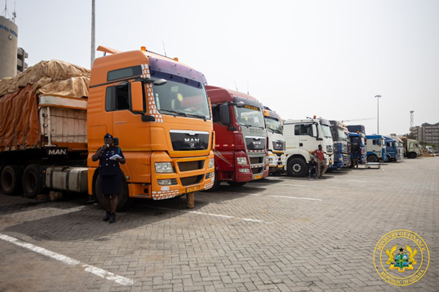
Ghana Link Network Services Limited has confirmed that all six articulated trucks earlier described as “missing” in the ongoing GH¢85 million transit enforcement case have been found and physically verified, asserting that there was never a disappearance of vehicles from its tracking system. The company’s statement challenges media reports suggesting that part of the convoy had vanished following a major Customs operation.
The eight page Bill of Entry 80226125039, which covers a consignment of 18 transit trucks, had been at the centre of controversy after 12 of the vehicles were intercepted by the Customs Division of the Ghana Revenue Authority during an enforcement operation targeting alleged diversion and revenue leakages. The goods on board the trucks which included edible cooking oil, tomato paste and spaghetti were originally declared as transit cargo moving from Akanu to Niger through Kulungugu.
Following the Customs intercept, initial reports in some media suggested that six of the vehicles had broken away from the convoy and were unaccounted for. However, Ghana Link, which operates the Integrated Customs Management System used to electronically track cargo throughout its movement, said that both its digital playback records and on the ground verification confirmed that none of the 18 trucks had gone missing.
“All 18 trucks under BOE 80226125039 have been located on our tracking system,” the company said in a formal release. It explained that its field team had physically verified the locations of all six trucks previously described as outstanding as of Friday morning and shared those details with the Customs Division for further official action.
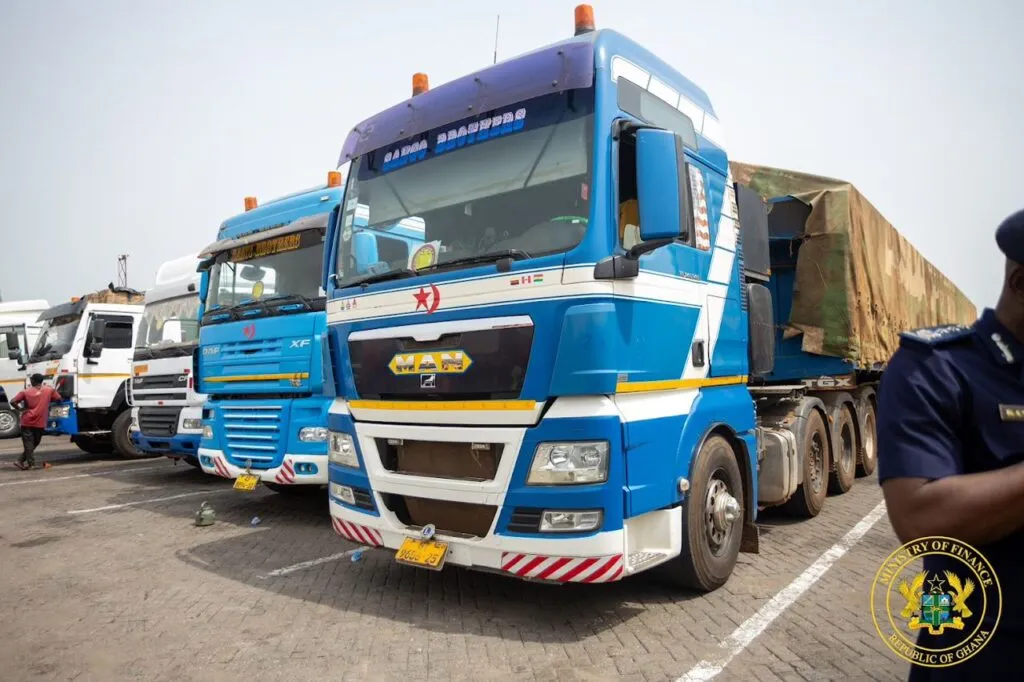
Ghana Link elaborated that the route deviation alerts the system generated should not have been interpreted as evidence of disappearance. According to the statement, the trucks initially followed the transit corridor from Akanu toward Kulungugu until authorities ordered 11 of them to proceed to the Tema Customs Transit Yard as part of the enforcement exercise. Because this yard lies outside the original declared transit route, the tracking system triggered a deviation alert, which was misconstrued in some reports as indicating a loss of signal or disappearance.
“Our playback indicates the trucks were on the declared transit route until authorities directed 11 trucks to move to the Tema Customs Transit Yard,” the statement said. “Because the Yard is not part of the declared transit corridor, an alert was triggered. This should be understood as an enforcement led diversion for control purposes, not evidence that trucks had disappeared.”
The six trucks that had been described as outstanding were ultimately located in clusters at various checkpoints and sites, including Aflao, the Aflao Accra toll booth, the West Point Filling Station at Tsopoli, the Galaxy Filling Station at Dawhenya, and Akanu. Each of these locations was physically confirmed by Ghana Link personnel, and the verified information was handed over to Customs officials for further handling under the law.
Ghana Link emphasised that the evolving picture is not one of trucks vanishing, but rather of a coordinated enforcement action in which 11 trucks were directed to a controlled holding point while the remaining vehicles remained traceable throughout the operation. “We wish to help the media to understand and report correctly,” the company added. “The tracking playback accounted for all trucks under the BOE, including those described as ‘missing’ by the media. This morning, our team went further to physically verify the six locations, and we have handed the information on trucks over to Customs for the next steps.”
The company reaffirmed that its tracking systems are designed to provide evidence based visibility over transit movements and to reduce uncertainty in cargo monitoring, a function it said is essential for protecting government revenue and supporting lawful investigations by the Ghana Revenue Authority, the Revenue Mobilisation Taskforce of National Security, and other state agencies. Ghana Link reiterated that its role is confined to providing tracking data and operational support, and that it remains committed to strengthening trade facilitation and revenue protection in Ghana.
The wider context of the case has exposed systemic concerns within Ghana’s transit trade regime, where cargo diversion and potential revenue leakages have been points of intense scrutiny by both government officials and the public. The interception of the 12 articulated trucks along the Dawhenya Tema Road was described by authorities as a decisive step against smuggling and duty evasion, given the estimated tax exposure exceeded GH¢85 million.
The resolution that all 18 vehicles remain in Ghana and accounted for will likely play an important role as the Ghana Revenue Authority continues its investigations and legal proceedings to ensure compliance with customs and transit laws. Moving forward, the episode underscores the importance of accurate cargo tracking, clear communication between agencies and the press, and the ongoing need for strengthened oversight mechanisms within the transit trade sector.