

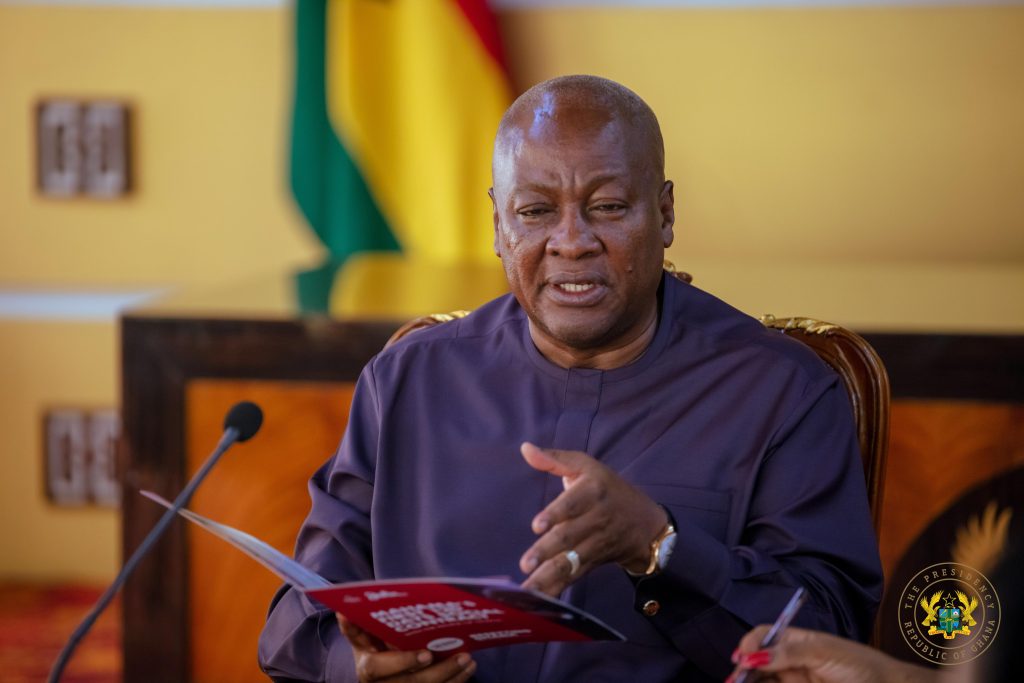
President John Dramani Mahama has reiterated a comprehensive vision for economic transformation in Ghana, emphasising the urgent need to move the nation beyond the export of raw minerals and reposition it as a competitive player in the global extractive and industrial value chain. His remarks, delivered at the Local Content Summit 2026 in Takoradi, Western Region, outlined a roadmap aimed at deepening local content, accelerating industrialisation, and ensuring sustainable economic benefits for communities and businesses across the country.
The summit, organised by the Minerals Commission under the theme “Strengthening local content and indigenisation building a resilient mining sector in Ghana,” brought together policymakers, industry leaders, traditional authorities, and private sector stakeholders to discuss how to extract lasting value from Ghana’s mineral wealth.
At the centre of Mr Mahama’s address was the acknowledgement that while Ghana remains Africa’s leading gold producer and among the top six globally, it has yet to fully participate in the high-value segments of the sector. He noted that many of the most lucrative activities advanced engineering, processing, equipment manufacturing, technical services and refining still occur outside the country.
“We’ve been prolific producers, but we have not yet become full participants in the extractive value chain,” the President said, challenging attendees to consider the long-term legacy of Ghana’s mineral resources. He asked whether, a century from now, the nation’s wealth will be remembered merely in export statistics and royalty payments or as the foundation for world-class industries, resilient communities, and thriving Ghanaian enterprises.

Drawing lessons from countries such as Botswana, Chile and Indonesia, Mr Mahama emphasised that forward-looking local content policies can attract sustainable investment and bolster competitiveness. He stressed that such policies must strike a balance ambitious enough to drive transformation but practical enough to retain investor confidence.
One of the key components of this strategy, the President said, is moving local content beyond transactional procurement toward transformational partnerships. Government plans include a review of mining legislation and regulatory frameworks to enable Ghanaian companies to advance up the value chain — from suppliers of consumables to manufacturers, innovators and owners of mining technology and services. Equity participation, technology transfer and knowledge sharing must become standard industry practice, he said.
Mr Mahama also made a bold declaration that it is no longer acceptable for Ghana to continue exporting raw ores while importing finished products. He set a five-year target to eliminate raw ore exports, pledging to support the establishment of refineries, bullion infrastructure, and mineral-based industrial clusters. Central to this is the downstream processing of bauxite, manganese and lithium in alignment with the global green energy transition.
The President identified human capital development as another critical pillar. Strengthening institutions such as the University of Mines and Technology (UMAT) and technical universities, expanding apprenticeship programmes in collaboration with the mining industry, and prioritising modern skills including automation, robotics, drone technology, data analytics, environmental sustainability and renewable energy integration are core to building a competitive workforce.

Alongside structural and institutional reforms, Mr Mahama also urged stronger participation by Ghanaian entrepreneurs and businesses. He highlighted that the mining sector must embrace innovation and technology to compete globally, positioning Ghana as a hub for AI-assisted exploration, IoT-enabled asset management and blockchain-based supply chain transparency.
The President’s broader vision also emphasises responsible mining and community benefit. He stated that development agreements and community engagement mechanisms would be strengthened to ensure mining operations leave communities better off. Traditional authorities and local government are expected to play more significant roles in monitoring compliance and ensuring community interests are safeguarded. Efforts to combat illegal mining, rehabilitate degraded lands, and clean water bodies remain a priority under the renewed policy framework.
Government leaders also reaffirmed their stance against practices that undermine genuine local participation. The Minister for Lands and Natural Resources, Emmanuel Armah-Kofi Buah, warned that foreign companies using Ghanaian fronts to meet local content requirements will no longer be tolerated. The aim is to foster structured, intentional partnerships that deliver real economic benefits rather than superficial compliance.

Echoing the President’s call, the Chief Executive Officer of the Minerals Commission, Isaac Tandoh, announced reforms including the revocation of more than 300 improperly acquired or dormant mining licences as part of a broader effort to ensure Ghanaian control and participation in the sector. These reforms also involve reviewing existing legal frameworks and introducing new mining categories to support responsible Ghanaian operators.
Mr Mahama’s address at the summit reflects an evolving national priority one where value addition, industrialisation and inclusive participation form the backbone of Ghana’s economic strategy. By reducing dependence on raw mineral exports and enhancing local capacity and ownership, the government aims to ensure that the nation’s natural resources secure prosperity for present and future generations.