

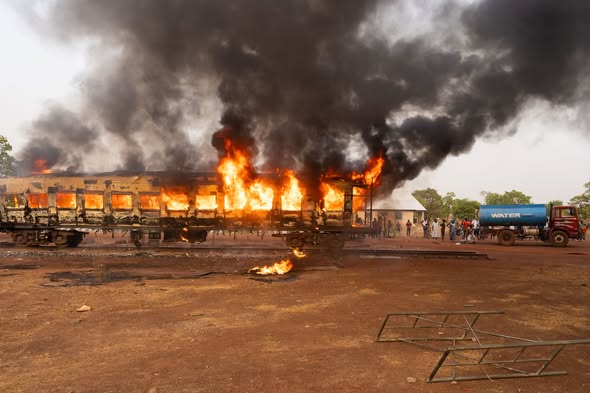
A heritage railway carriage owned by renowned Ghanaian creative artist and author Ibrahim Mahama was completely destroyed in a fire incident in the Northern Region of Ghana on Wednesday, 18 February 2026. The vintage train, part of Ghana’s earliest railway stock and preserved as an important cultural artefact, was engulfed in flames during ongoing repair works when sparks from the restoration process are believed to have ignited the blaze.
The fire broke out while the heritage train was undergoing structural work to address extensive rust and wear. Ibrahim Mahama confirmed the destruction of the train in a Facebook post on Thursday, 19 February 2026, describing the event as a “tragic misfortune” that could possibly have been prevented with greater care during the repair activities.
According to his account, the train was among the most challenging pieces to acquire due to its historical value and condition when it was sourced nearly two years ago. The carriage had been slated as the final item in the restoration queue because it required significant attention due to corrosion accumulated over decades of exposure to the elements.
Although the fire utterly consumed the historic train, there were no reported injuries to individuals present at the site or responding to the emergency. The quick actions of the Ghana National Fire Service and support from members of the local community helped contain the fire more effectively than anticipated, preventing potential losses to other nearby assets and infrastructure.

Ibrahim Mahama expressed gratitude to the Ghana National Fire Service for their rapid response and to residents who aided responders during the unfolding situation. In his reflections, he emphasised the importance of proactive safety protocols and urged the public and craftspeople involved in heritage conservation work to exercise heightened caution, especially during the dry season when fire outbreaks tend to occur more frequently and escalate rapidly.
The destroyed carriage was an iconic piece of Ghana’s railway history, representing one of the oldest train stocks in the country. It was no longer in operational use and had been preserved as part of private efforts to safeguard industrial and cultural heritage. Ghana’s railway system played a key role in the nation’s colonial and post-independence economic development, connecting agricultural and mining regions to ports and markets. Items such as the heritage train represent irreplaceable artefacts from that era, and their loss underscores the challenges inherent in preserving ageing historical equipment.

While the community and preservation circles mourn the physical loss of the train, many stakeholders have also pointed to the incident as a reminder of broader infrastructure challenges across Ghana. The episode comes amidst ongoing concerns about fire safety and emergency preparedness nationwide, as public and private institutions alike work to address recurrent fire outbreaks in commercial hubs, markets and cultural sites. As Ghana enters the dry season typically associated with heightened fire risks authorities and civic organisations have been calling for intensified awareness campaigns and improved safety standards to prevent similar incidents.
Heritage conservation experts and industry stakeholders emphasise that safeguarding historical assets requires not only passion and resources but also stringent safety measures, professional oversight, and appropriate technical expertise. The loss of the train is particularly poignant because it symbolised a tangible connection to the nation’s industrial past, and its destruction represents a cultural setback for those engaged in the preservation of Ghana’s material history.
Despite the emotional blow, Mahama’s public message emphasised resilience and forward looking optimism. By stating that “our hearts may be broken, but our spirits are as high as ever,” he captured both the sadness of the moment and the creative community’s commitment to continue cultural work even in the face of setbacks.

As investigations into the specifics of the blaze continue, many cultural conservation advocates are calling for formal protocols and funding to protect other historical assets across Ghana. The incident highlights the vulnerabilities faced by preservation initiatives and raises questions about how private collectors, civil society and government agencies can collaborate more effectively to ensure that irreplaceable cultural heritage items are restored and maintained in ways that minimise risk.
In summary, the fire that destroyed Ibrahim Mahama’s heritage train is a significant cultural loss for Ghana, representing both the fragility of historical infrastructure and the need for enhanced safety and conservation frameworks. While no injuries were recorded, the event has stirred a broader conversation about heritage protection strategies, emergency readiness, and community roles in safeguarding the nation’s historical identity.