

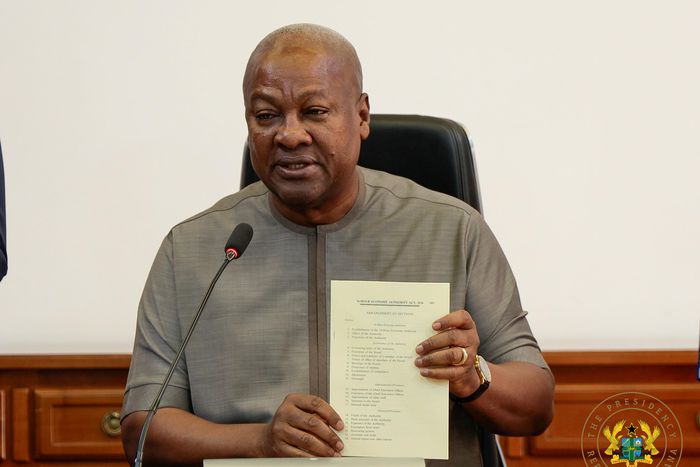
President John Dramani Mahama has officially signed the 24-Hour Economy Authority Bill, 2025 into law, marking a pivotal moment in Ghana’s economic policy direction and setting the stage for the full operationalisation of a transformational economic agenda. The signing, which took place on 19 February 2026 in a brief pre-Cabinet ceremony, concluded the legislative process that began with the Bill’s passage in Parliament on 6 February 2026 and represents a significant milestone for one of the administration’s flagship policy initiatives aimed at accelerating productivity, investment and job creation across the country.
In his remarks following the assent to the new law, President Mahama underscored the importance of transitioning the 24-hour economy concept from strategic planning to active implementation, emphasising that the business community, both local and foreign investors alike, has been anticipating the legal backing needed to mobilise investment, expand operations and increase productivity. The President noted that while due diligence had taken time, it was necessary to ensure the policy’s legal framework was robust and ready for effective execution.
The 24-Hour Economy Authority Bill, 2025 establishes the 24-Hour Economy Authority as the central coordinating body responsible for overseeing the nationwide rollout of Ghana’s 24-Hour Economy and Accelerated Export Development Programme. The law provides the statutory mandate for the Authority to mobilise investment, coordinate strategies among public and private sector actors, and facilitate the development of regulatory frameworks and infrastructure necessary to support economic activity around the clock, every day of the year.

The 24-Hour Economy policy seeks to reframe Ghana’s economic model from one largely dependent on low-value raw exports and periodic production cycles into a more dynamic, production-led economy capable of sustaining high productivity, increased output, and diversified export earnings. At the core of the policy is the goal of ensuring that Ghana’s economic infrastructure, including manufacturing, services, transport, logistics, agro-processing and digital industries, can operate with minimal downtime, capitalising on existing investments and maximising utilisation of resources. This approach reflects broader efforts to unlock under-utilised capacity and drive inclusive economic growth.
The Authority will also be tasked with aligning institutional and sectoral actions, streamlining incentives and addressing bottlenecks that have historically constrained economic performance. It is expected to deepen collaboration between government institutions, private enterprises, industry associations, financial institutions and development partners. Ghana’s Association of Ghana Industries (AGI) has already expressed strong support for the policy and pledged to assist in its implementation by encouraging industry participation and investment in 24-hour operations.
The legislative journey of the 24-Hour Economy Authority Bill was characterised by extensive debate in Parliament, where both the Majority and Minority caucuses engaged on issues related to the operational scope, institutional framework, funding mechanisms and anticipated socio-economic impact. The Bill’s passage signals broad consensus on the need to prioritise productivity, job creation and export competitiveness, key objectives for Ghana’s economic reset and post-pandemic recovery efforts.
The 24-Hour Economy policy has been championed at multiple levels of government, with earlier initiatives such as the 24-Hour Model Market concept introduced by the Ministry of Local Government, Chieftaincy and Religious Affairs to enhance decongestion and boost local market productivity by extending trading hours. These market models are designed to improve incomes for traders, create new business opportunities, and increase revenue generation at the local level.
Beyond its immediate focus on round-the-clock economic activity, the policy also dovetails with other major national development visions, including structural transformation and digitalisation of the economy. President Mahama has highlighted the importance of secure systems and robust cybersecurity protocols to ensure that extended operations, including financial services, healthcare, logistics and other essential services, can be sustained safely and efficiently. Such considerations are critical given the growing reliance on digital platforms for commerce and governance.

Despite broad support, there have been questions raised by some lawmakers regarding the structure and financing of the new Authority, with concerns about resource allocation and the possibility that its establishment might divert funds from other priority areas. This public discourse underscores the need for clear governance, transparency and accountability in the implementation phase to build trust and sustain momentum.
Looking ahead, the 24-Hour Economy Authority is expected to develop and deploy strategic plans, incentive packages and performance metrics that will guide investment decisions and monitor progress. This includes fostering an environment where industries operate competitively, goods and services are produced efficiently, and job creation is accelerated, particularly among youth and women, demographics that are central to Ghana’s socio-economic development agenda.
In conclusion, the enactment of the 24-Hour Economy Authority Bill represents a significant policy advancement for Ghana, institutionalising a forward-looking economic strategy aimed at boosting productivity, investment and inclusive growth. With legal backing now firmly in place, the focus shifts to implementation, collaboration and measurable outcomes that can transform Ghana’s economic landscape and position the country as a more resilient and competitive player in the global economy.