

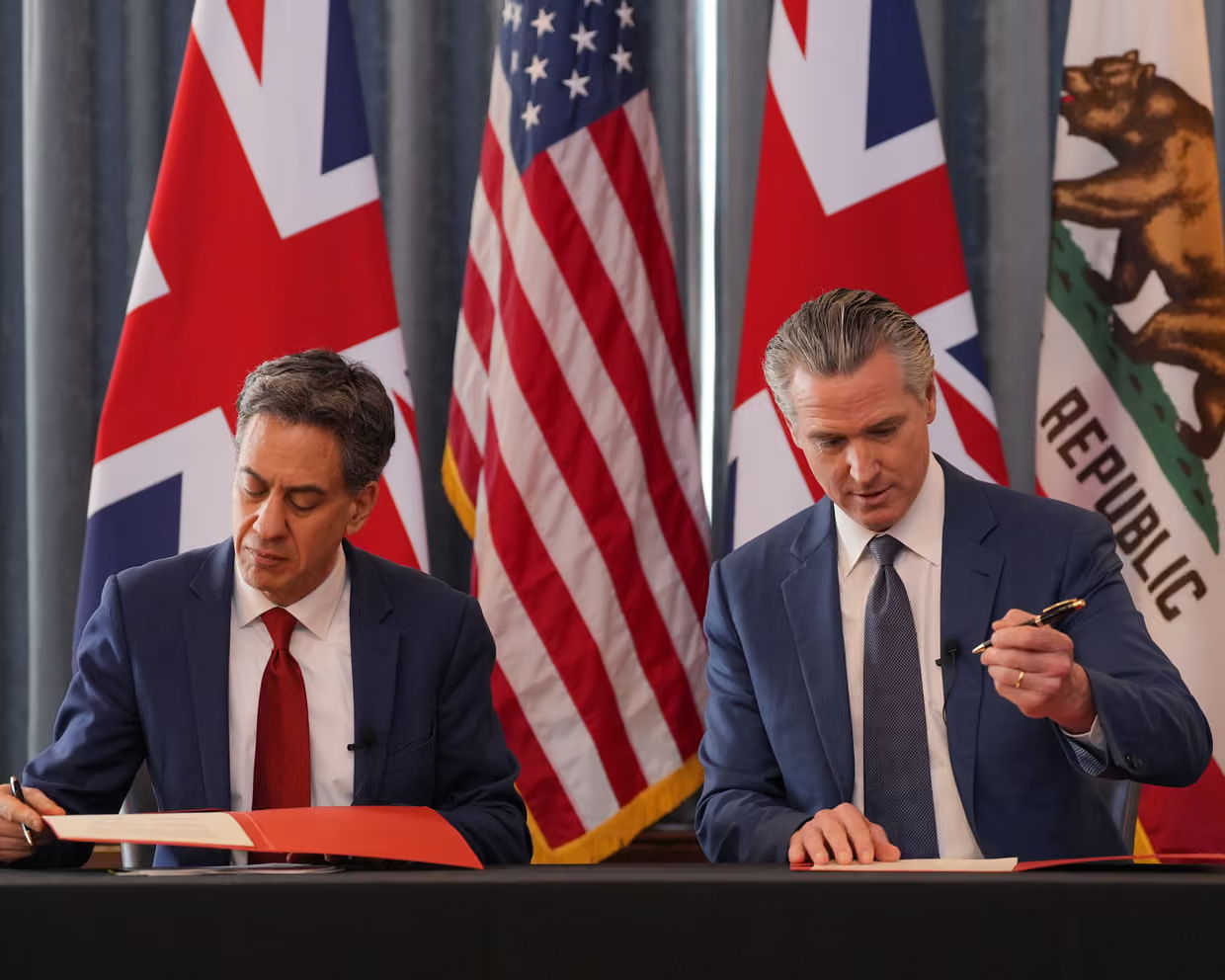
President Donald Trump has sharply criticised a new clean energy partnership between the United States’ largest state and the United Kingdom, accusing California Governor Gavin Newsom of missteps that he claims undermine America’s national energy priorities. Trump’s comments come just weeks after Newsom travelled to Europe and signed a Memorandum of Understanding (MoU) with UK Energy Secretary Ed Miliband to strengthen cooperation on climate action, clean energy technology and investment. The dispute highlights widening divisions in U.S. politics over energy policy, environmental leadership and the role subnational actors like California play on the global stage.
On February 16, 2026, Gov. Newsom and Miliband formalised the UK–California clean energy deal in London, building on decades of cooperation between California and the UK on environmental issues. The MoU includes commitments to deepen transatlantic ties in renewable energy, scale up clean technologies, share expertise on climate resilience and biodiversity protection, and facilitate investment and access for British clean-technology firms in California’s vast market. British clean energy company Octopus Energy announced nearly $1 billion in investment into Californian clean tech as part of broader activity linked to the agreement, signaling strong business support for the partnership. Newsom described California as “the best place in America to invest in a clean economy” and stressed the state’s ongoing commitment to climate action, innovation and economic growth.
However, Trump responded with fierce criticism shortly after the agreement was signed, branding the deal as “inappropriate” in interviews with Politico and other outlets. In his remarks Trump adopted a confrontational tone, unleashing a series of personal attacks on Newsom in addition to critiques of the pact itself. Trump told reporters that “the U.K.’s got enough trouble without getting involved with Gavin Newscum,” using a derogatory nickname for the California governor and adding that Newsom was a “loser” whose “environmental work is a disaster.” He suggested that UK officials would “not be successful” if they tried to replicate California’s approach, and explicitly warned foreign leaders against partnering with Newsom. Trump argued that the deal undermined the United States’ own energy policy and represented foreign “meddling” by a state official outside federal authority.
Policy context and political backdrop
Trump’s rebuke must be understood within a broader policy and political rivalry between the federal government and progressive state leaders like Newsom who have embraced ambitious climate strategies. The Trump administration has spent much of its current term rolling back federal environmental regulations, including eliminating the Environmental Protection Agency’s 2009 endangerment finding, a foundational rule that recognised greenhouse gases as threats to public health and underpinned U.S. climate rules. This rollback has drawn sharp criticism from environmental advocates, Democratic leaders and state governments that have continued to pursue clean energy transitions independently of federal action.

California, often seen as a national leader on climate policy, reported substantial progress in reducing emissions and expanding clean energy infrastructure in recent years claims Newsom highlighted while overseas. At the Munich Security Conference held just days before the UK trip, he characterised Trump’s environmental policies as a temporary setback and reaffirmed California’s intent to uphold its climate commitments. Newsom’s European engagement including partnerships with UK and Ukrainian leaders reflects his broader strategy of positioning California as a global climate pioneer at a time when federal leadership has shifted away from cooperative international climate action.
The disagreement also carries geopolitical implications, given the significance of U.S.-UK ties on issues ranging from trade to security. British officials have emphasised that agreements like the one signed with California are part of a broader effort to accelerate clean energy deployment, boost job creation and strengthen energy security on both sides of the Atlantic. UK Energy Secretary Miliband highlighted the importance of international cooperation to deliver energy solutions that protect people and the environment while fostering economic opportunities.
Reactions and potential consequences
Reactions to Trump’s critique have been sharply divided along partisan lines. Newsom’s team responded by framing Trump’s opposition as rooted in allegiance to fossil fuel interests, particularly coal and oil, and argued that foreign leaders were increasingly choosing California’s vision for clean energy over federal policy under Trump. A spokesperson claimed Trump is “selling out America’s future to China” while Newsom champions climate leadership and investment. Such clashes underscore tensions not only between Republican and Democratic visions of energy policy but also between federal authority and subnational diplomacy.

Critics of Trump’s stance argue that subnational actors like California routinely engage in international cooperation on issues that affect economic and environmental outcomes, and that such partnerships are complementary to, rather than in competition with, U.S. federal interests. They note that subnational agreements do not constitute formal treaties and generally fall within accepted practice for state and provincial governments pursuing economic and technological development.
Looking ahead, the controversy illustrates how energy policy has become a flashpoint in U.S. domestic and international politics, particularly as the 2028 presidential election looms and figures like Newsom emerge on the national stage. Whether the dispute over the UK-California clean energy pact will have lasting effects on transatlantic cooperation remains unclear, but it certainly highlights the deepening divide between contrasting visions for climate policy in the United States.