

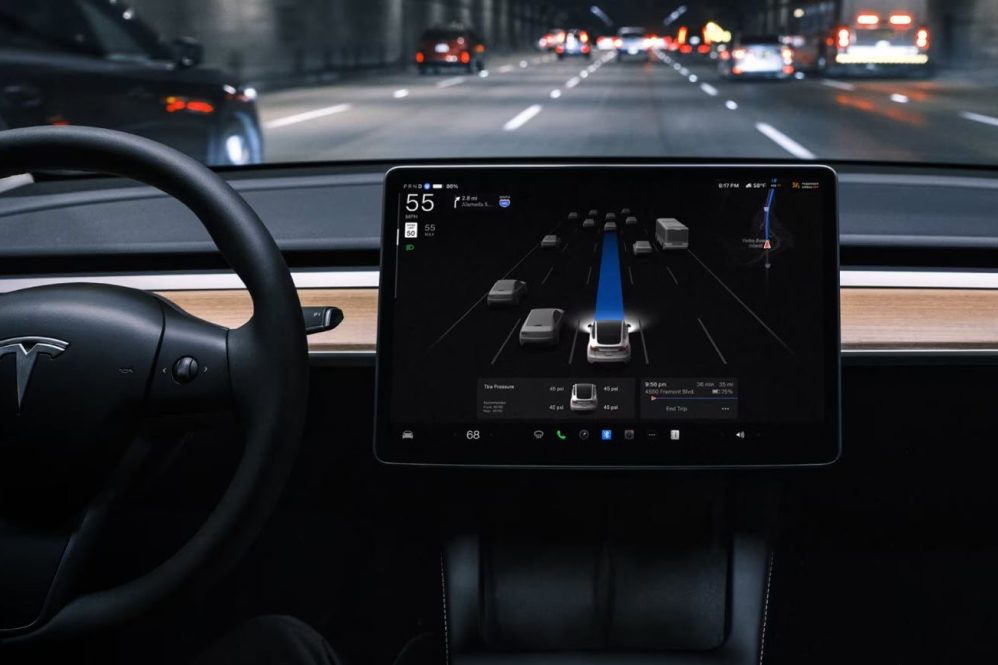
Tesla has removed the option for customers to purchase its Full Self-Driving (FSD) software through a one-time payment, pivoting entirely to a subscription-based model in the United States.
Over the weekend, Tesla eliminated the $8,000 flat-fee purchase option that previously allowed owners to access FSD for the lifetime of their vehicle. The advanced driver-assistance feature is now available exclusively through a $99-per-month subscription plan.
The move follows earlier comments from CEO Elon Musk, who signaled in January that the shift would take effect in the coming weeks. Musk has consistently argued that as FSD capabilities improve, the software’s value will increase, and subscription pricing may rise accordingly. He has previously described Tesla vehicles as potential “appreciating assets,” suggesting that enhanced autonomy could boost long-term vehicle utility.
Tesla first introduced FSD in 2016, with pricing fluctuating significantly over the years. Initially priced at roughly $5,000, the package climbed as high as $15,000 before being reduced to $8,000 in 2024. A subscription option was launched in 2021 at $199 per month and later lowered to $99, making recurring access more affordable compared to the upfront purchase model.

The elimination of lifetime purchases marks a major strategic shift. For years, buyers could opt to pay once and retain access to FSD features for as long as they owned the car. Now, continued access depends on maintaining an active subscription.
The decision also follows Tesla’s recent removal of Autopilot as a standard free feature on new vehicle purchases. Previously, Autopilot provided highway driver assistance at no additional cost, while FSD was positioned as a premium add-on capable of navigating city streets and more complex traffic environments.
Tesla’s transition aligns with a broader industry movement toward subscription-based revenue models in the automotive sector. Automakers increasingly view software as a recurring revenue stream rather than a one-time add-on. For Tesla, scaling active FSD subscriptions has strategic implications beyond immediate revenue. Under a performance-based executive compensation plan approved last year, Musk’s long-term incentives are partly tied to reaching 10 million active FSD subscriptions.

The shift may generate mixed reactions among Tesla owners. While subscriptions lower upfront costs and provide flexibility, some customers previously valued the ability to make a single lifetime investment. If subscription prices rise as capabilities improve, as Musk has suggested, the long-term cost of access could exceed the former one-time purchase option.
As software becomes central to vehicle functionality, Tesla’s move signals a deepening transition from hardware-focused sales to service-oriented monetization. The future competitiveness of its autonomous driving ambitions may now depend as much on subscription growth and user retention as on technical innovation.