

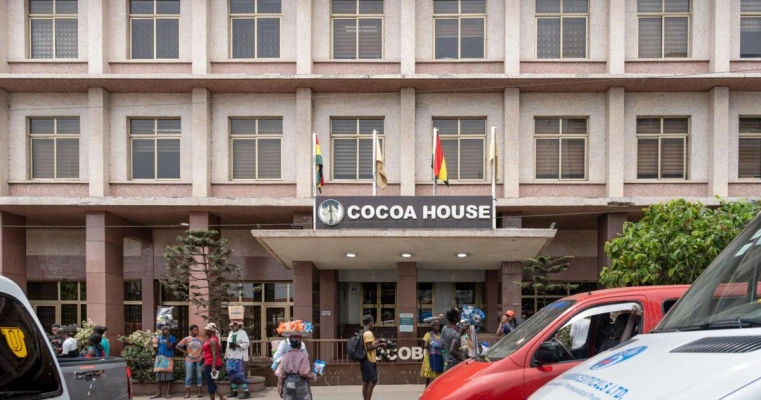
The Ghana Cocoa Board (COCOBOD) has announced that its Executive Management and Senior Staff will take salary reductions in response to a deepening liquidity crisis that has disrupted Ghana’s cocoa industry and left farmers waiting months for payments.
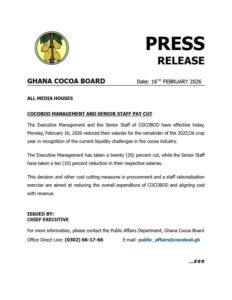
In a press release dated February 16, 2026, COCOBOD’s Chief Executive Dr. Randy Abbey confirmed that Executive Management will reduce their salaries by 20 percent and Senior Staff will take a 10 percent cut for the remainder of the 2025/26 crop year. The board said the decision forms part of broader cost-cutting initiatives designed to reduce expenditure, align operational costs with revenue, and improve financial sustainability.
COCOBOD also said these salary cuts will be complemented by other measures, including procurement reforms and a staff rationalisation exercise, aimed at lowering overall costs as pressures mount.
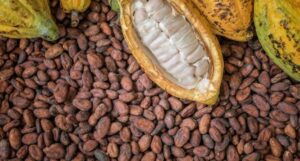
The move comes amid widespread concern over Ghana’s cocoa sector finances. The sector has been grappling with liquidity constraints, delays in payments to farmers, and a build-up of unsold cocoa stocks at ports. Reuters reports that as many as 50,000 tonnes of beans remain unsold, partly because global cocoa prices collapsed from near $13,000 per tonne in late 2024 to around $4,000 in early 2026, well below the high farmgate price set by authorities, leading to a liquidity squeeze for traders and Licensed Buying Companies (LBCs).
The crisis has forced the government into emergency action. President John Dramani Mahama convened an emergency Cabinet session in early February to examine the challenges confronting the cocoa sector, including delayed payments, unsold stocks, and financing shortfalls that have left many farmers unpaid for months.
The financial strain on COCOBOD is also rooted in structural issues with the sector’s traditional financing model. Experts and lawmakers have criticised past syndicated financing lapses that have weakened the board’s creditworthiness and hindered access to fresh funds for cocoa purchases. Without reliable pre-financing, LBCs are under pressure, slowing bean purchases and adding to liquidity problems that ripple through rural economies.
The liquidity crunch has not only affected payments but has also reduced Ghana’s competitiveness. The combination of falling global prices and high fixed farmgate prices has left licensed buyers unable to operate profitably, weakening the entire value chain.
Development partners have tried to support the sector. The International Finance Corporation (IFC) has stepped in with funding, reportedly upwards of $100 million and potentially up to $300 million, to provide liquidity to LBCs and help sustain the supply chain, highlighting how critical external finance has become as the sector faces unprecedented stress.
COCOBOD’s decision to take pay cuts at the top reflects the depth of the sector’s financial strain and signals leadership’s acknowledgment that difficult choices are needed to preserve Ghana’s cocoa value chain, which remains a cornerstone of rural livelihoods and export earnings.