


The International Criminal Police Organization, INTERPOL, has permanently deleted a Red Notice issued against former Ghanaian Finance Minister Ken Ofori-Atta following a ruling by its Commission for the Control of Files. The decision, taken during the Commission’s February 4 session, determined that the notice requested by Ghana’s Office of the Special Prosecutor was predominantly political in nature and therefore inconsistent with INTERPOL’s constitutional rules.
The development marks a significant twist in a high profile investigation that has generated intense political and legal debate in Ghana. While lawyers representing Ofori-Atta have described the ruling as a major vindication, Ghana’s Office of the Special Prosecutor has indicated that it will continue to pursue legal avenues, including extradition proceedings and a pending High Court hearing.
Background to the Red Notice and INTERPOL’s ruling
A Red Notice is a request circulated by INTERPOL to law enforcement agencies worldwide, seeking the location and provisional arrest of an individual pending extradition, surrender, or similar legal action. Although not an international arrest warrant, it serves as a powerful tool in cross border criminal investigations.
The Red Notice against Ken Ofori-Atta was issued at the request of Ghana’s Office of the Special Prosecutor as part of ongoing investigations into alleged corruption and financial misconduct during his tenure as Finance Minister. The OSP has been probing allegations that decisions taken under his leadership resulted in financial losses exceeding GH¢1.4 billion.

However, Ofori-Atta’s legal team challenged the issuance of the Red Notice before INTERPOL’s Commission for the Control of Files, the independent body responsible for ensuring that data processed through INTERPOL channels complies with the organization’s constitution and rules. During its February 4 session, the Commission concluded that the notice violated INTERPOL’s framework, finding that it was predominantly political.
INTERPOL’s constitution strictly prohibits the organization from undertaking activities of a political, military, religious, or racial character. When a Red Notice is deemed to breach this principle, the Commission has the authority to order its deletion. In this case, the Commission directed that the notice be permanently removed from INTERPOL’s databases.
The Office of the Special Prosecutor’s position
Despite acknowledging the deletion of the Red Notice, the Office of the Special Prosecutor has signaled that the investigation into Ofori-Atta remains active and that legal processes in Ghana will continue. The OSP maintains that the probe concerns serious allegations of corruption and financial loss to the state and is not politically motivated.
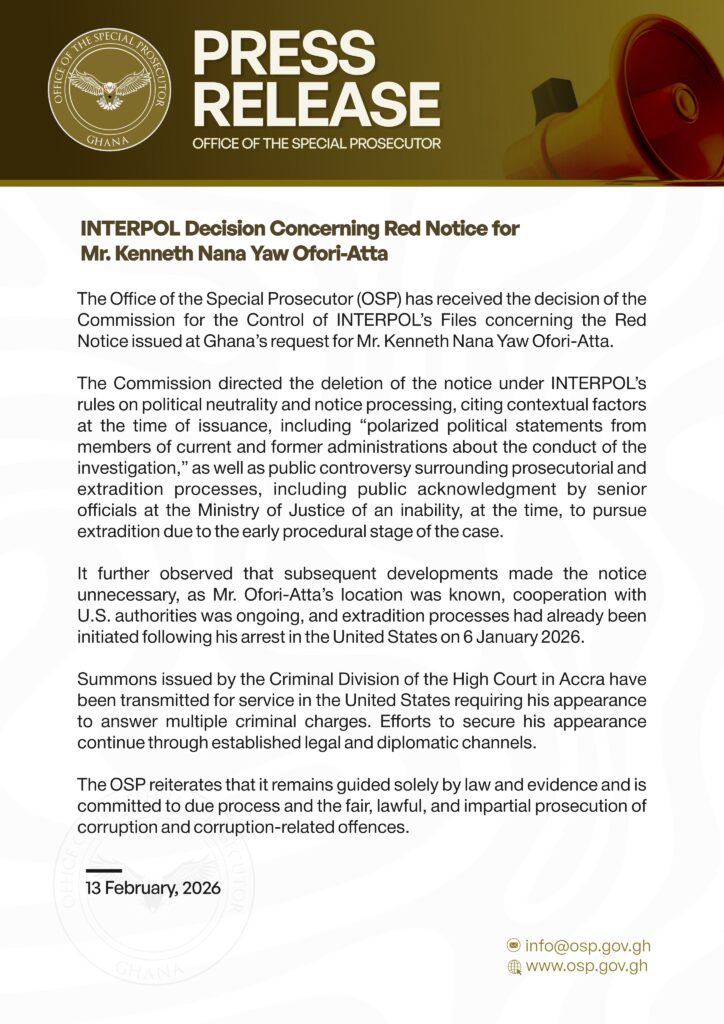
According to the OSP, the removal of the Red Notice does not invalidate the underlying criminal investigation. Instead, it affects only the international alert mechanism facilitated by INTERPOL. The Office has indicated plans to pursue extradition proceedings from the United States, where Ofori-Atta is reportedly based, through bilateral legal channels rather than relying on INTERPOL’s Red Notice system.
In addition, a High Court hearing is scheduled for February 26, where legal questions related to the case are expected to be addressed. The outcome of that hearing could have significant implications for the trajectory of the investigation and any potential prosecution.
Political and public reactions
The deletion of the Red Notice has sparked sharply divided reactions across Ghana’s political landscape. Supporters of the former Finance Minister view the decision as confirmation that the international policing body found the case to be politically influenced. They argue that the ruling strengthens claims that the proceedings were driven more by political rivalry than by credible criminal evidence.
Critics, however, contend that the removal of the notice represents a setback for anti corruption efforts and accountability in public office. They emphasize that INTERPOL’s decision does not constitute a finding of innocence on the substance of the allegations. Rather, it reflects procedural and jurisdictional considerations regarding the nature of the request.
Legal analysts have noted that the Commission for the Control of Files does not determine guilt or innocence in criminal matters. Its mandate is limited to assessing whether data entered into INTERPOL’s systems complies with the organization’s internal rules. Therefore, the substantive allegations of financial misconduct remain within the jurisdiction of Ghana’s domestic legal system.
Broader implications for anti corruption efforts
The case underscores the complexities involved when domestic corruption investigations intersect with international law enforcement mechanisms. It also highlights the delicate balance INTERPOL must maintain between facilitating international police cooperation and avoiding entanglement in political disputes.
For Ghana, the development raises broader questions about the effectiveness of transnational accountability tools and the legal strategies available when suspects reside outside national borders. The government’s next steps, particularly regarding extradition efforts and the High Court proceedings, will be closely watched both domestically and internationally.
As the legal process unfolds, the focus is likely to remain on whether the Office of the Special Prosecutor can substantiate its allegations in court and navigate the procedural hurdles that accompany high profile international cases. The deletion of the Red Notice may have altered the immediate landscape of the case, but it has not brought the controversy to an end.