


The Ministry of Gender, Children and Social Protection has publicly condemned a wave of viral online videos showing a foreign national allegedly recording private encounters with Ghanaian women without their knowledge or consent, a controversy that has ignited national outrage and fresh debate about digital rights, consent and online safety.
Social media platforms including TikTok, Telegram and X (formerly Twitter) erupted in outrage after clips surfaced showing a man identified by his social media handle “Yaytseslav,” reportedly of Russian origin, approaching women in public spaces around Accra, engaging them briefly and documenting their interactions, including intimate moments in private settings. The clips appear to have been shared widely and even monetised through paid channels.
Public reaction has been swift and divided. Many Ghanaians have condemned the apparent non-consensual recordings, stressing that consent to a private encounter does not extend to recording or public distribution of intimate content. “This is a violation of privacy,” one social media user wrote. “Consent to sex is not consent to be recorded and exposed.” Others focused on broader social themes, including discussions about power dynamics, economic inequality and perceptions of foreign visitors.

The videos sparked demands from political leaders for law enforcement action. Davis Ansah Opoku, Member of Parliament for Mpraeso, publicly called for an urgent investigation and arrest of the individual, urging the Ghana Police Service, Cyber Security Authority and National Intelligence Bureau to act swiftly.
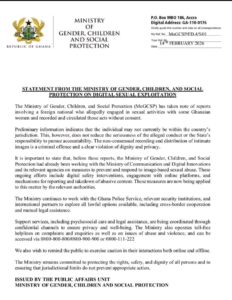
In an official statement issued on 14th February 2026, the Ministry of Gender, Children and Social Protection described the conduct, the non-consensual recording and distribution of intimate images, as a “criminal offence and a clear violation of dignity and privacy,” emphasising that such behaviour is punishable under Ghana’s Cybersecurity Act and constitutional protections. The Ministry acknowledged preliminary reports that the individual might no longer be within the country’s jurisdiction but reiterated that legal responsibility would still be pursued through cross-border cooperation and mutual legal assistance where possible. The statement also highlighted ongoing efforts to build preventative digital safety infrastructure and reporting mechanisms with the Ministry of Communication and Digital Innovations and other relevant agencies.
The Ministry noted coordination with the Ghana Police Service and other security institutions to explore lawful avenues in pursuing accountability. It also outlined psychosocial support and legal assistance being provided through confidential channels for any victims affected by the incident. Toll-free helplines for reporting abuse and related issues were reiterated as 0800-800-800, 0800-900-900 and 0800-111-222.
Beyond the immediate legal questions, the episode has highlighted broader online safety challenges in an era of ubiquitous smartphones, social media and digital content sharing. Legal analysts argue Ghana’s laws already prohibit non-consensual content distribution, but enforcement in digital spaces remains an ongoing challenge. Critics also point to gaps in awareness of digital privacy rights and the rapid pace at which digital exploitation can escalate into widespread viral controversies.
Some commentators have framed the controversy within deeper cultural conversations about gender dynamics and perceptions of foreign individuals, while others have called for a shift toward treating such incidents primarily as serious privacy violations with legal consequences rather than moral judgments about those involved.
No official police action has yet been publicly confirmed by authorities, and it remains unclear whether formal charges have been filed or whether the individual has been located. As the debate continues online, the incident has underscored the need for stronger digital protection mechanisms and clearer enforcement of online privacy and consent laws.
WhatsApp accuses Russian authorities of attempted full shutdown