

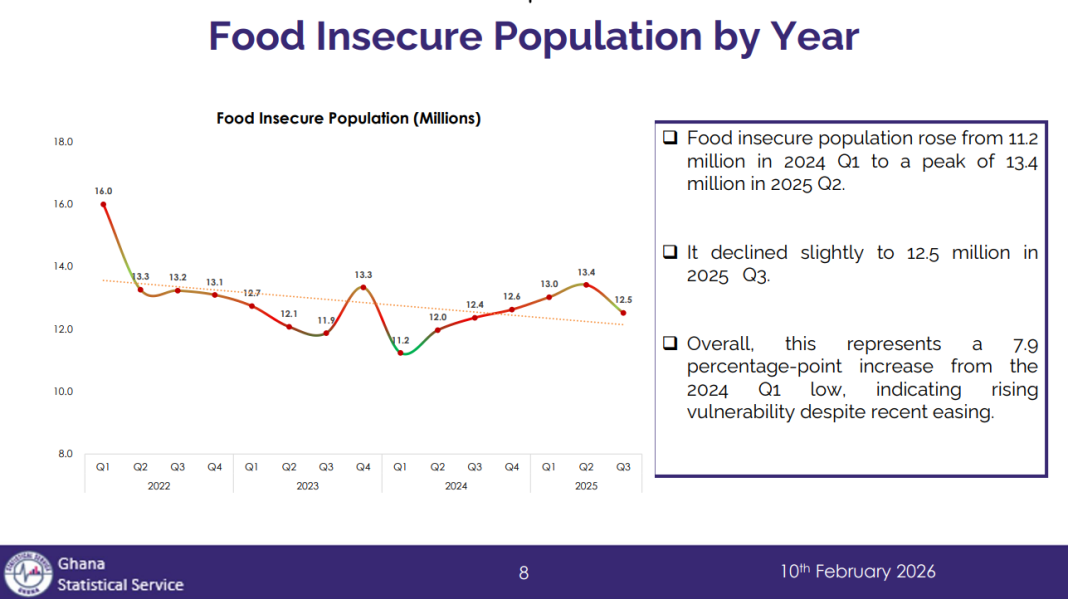
Despite modest signs of improvement in the third quarter of 2025, Ghana continues to grapple with a deep and widespread food insecurity crisis, with approximately 12.5 million Ghanaians remaining food insecure, according to the most recent Quarterly Food Insecurity Report from the Ghana Statistical Service (GSS). This alarming figure representing about 38.1 percent of the national population underscores persistent vulnerabilities in food access, distribution, and resilience, even as some indicators show marginal easing.
Persistent food insecurity despite Q3 easing
The GSS report reveals that food insecurity at the national level declined slightly from 41.1 percent in the second quarter of 2025 to 38.1 percent in the third quarter. In absolute terms, the number of food insecure individuals fell from 13.4 million to 12.5 million over the same period. However, this modest downward trend masks the broader reality that the current level of food insecurity remains significantly elevated compared to early 2024 and far above acceptable thresholds for sustainable development.

Government Statistician Dr. Alhassan Iddrisu emphasized that while the slight easing is a positive signal, it does not diminish the scale of the challenge facing Ghana. He noted that food insecurity is not merely a social welfare issue but a development concern with implications for economic productivity, child health, labour, and national growth.

Gender and regional disparities drive vulnerability
The report highlights pronounced disparities across gender and geographic lines:
- Female‑headed households consistently experienced higher levels of food insecurity than male‑headed households. In early 2025, moderate food insecurity affected up to 44.1 percent of female‑headed households versus 38.7 percent among male‑headed households, and the gap persisted into Q3.
- Rural households are disproportionately affected. Across all measures of food insecurity, rural areas recorded higher vulnerability compared with urban centres, with about 62 percent of rural households reporting worry about food access, compared with roughly 47 percent of urban households.
- Regional differences remain stark. The Upper West, North East, and Savannah regions have some of the highest food insecurity prevalence, while regions like Oti and Greater Accra show relatively lower rates. Notably, the Oti Region’s prevalence declined from 23.8 percent to 18.4 percent in Q3 2025, suggesting localized gains amid broader national challenges.
These disparities point to structural inequalities in income, access to markets, agricultural productivity, and essential services, which disproportionately affect female‑headed and rural households.
Household vulnerability and nutrition outcomes
Household composition also plays a critical role in vulnerability to food insecurity:
- Homes with both children and elderly members recorded some of the highest prevalence levels, averaging around 44 percent.
- Households with malnourished children experienced an average food insecurity prevalence of about 44 percent nationally.
- In rural, female‑headed households with underweight children, the crisis was most acute, with food insecurity exceeding 80 percent in the third quarter of 2025.
These figures highlight the interconnected nature of food insecurity and nutrition, with implications for growth, cognitive development, and long‑term human capital formation.
Education: A protective factor
The GSS report also highlights education as a buffer against food insecurity. Households headed by individuals with no formal education reported food insecurity rates close to 50 percent, whereas those headed by persons with tertiary education experienced much lower rates, around 15 percent.

This stark contrast underlines the role of education in improving employment opportunities, income levels, and overall resilience against food shocks. Strengthening education and workforce skills, particularly among vulnerable populations, could be a critical part of reducing food insecurity sustainably.
The triple burden of hardship
A worrying trend documented in the report is the “triple burden” faced by many Ghanaians individuals who are simultaneously food insecure, multidimensionally poor, and unemployed. Between Q2 and Q3 of 2025, the number of people experiencing all three conditions rose to 227,519, indicating a 9.4 percent increase in just one quarter.
This intersection of food insecurity, poverty, and joblessness underscores the compounding effects of economic vulnerability, suggesting that isolated interventions are insufficient. Comprehensive strategies that link food security efforts with employment creation, poverty reduction, and social protection are urgently needed.
Policy recommendations and future interventions
The GSS report calls for targeted, data‑driven interventions rather than blanket policies. Key recommendations include:
- Nutrition‑sensitive social protection, particularly for female‑headed and large dependency households.
- Integration of food security strategies with job creation, education, and climate resilience initiatives.
- Strengthened community nutrition and livelihood programmes.
- Improved monitoring systems and use of high‑frequency data to respond to emerging threats.
These steps are essential to move beyond short‑term stabilisation and build long‑term resilience across Ghana’s food systems and vulnerable communities.
Despite marginal improvement in Q3 2025, the reality remains stark: approximately 12.5 million food insecure Ghanaians reflect a deeply entrenched crisis. With vulnerable populations, deep gender and regional disparities, and a growing triple burden of hardship, food insecurity in Ghana is both a persistent challenge and a critical development priority that demands strategic, targeted, and sustained action.