

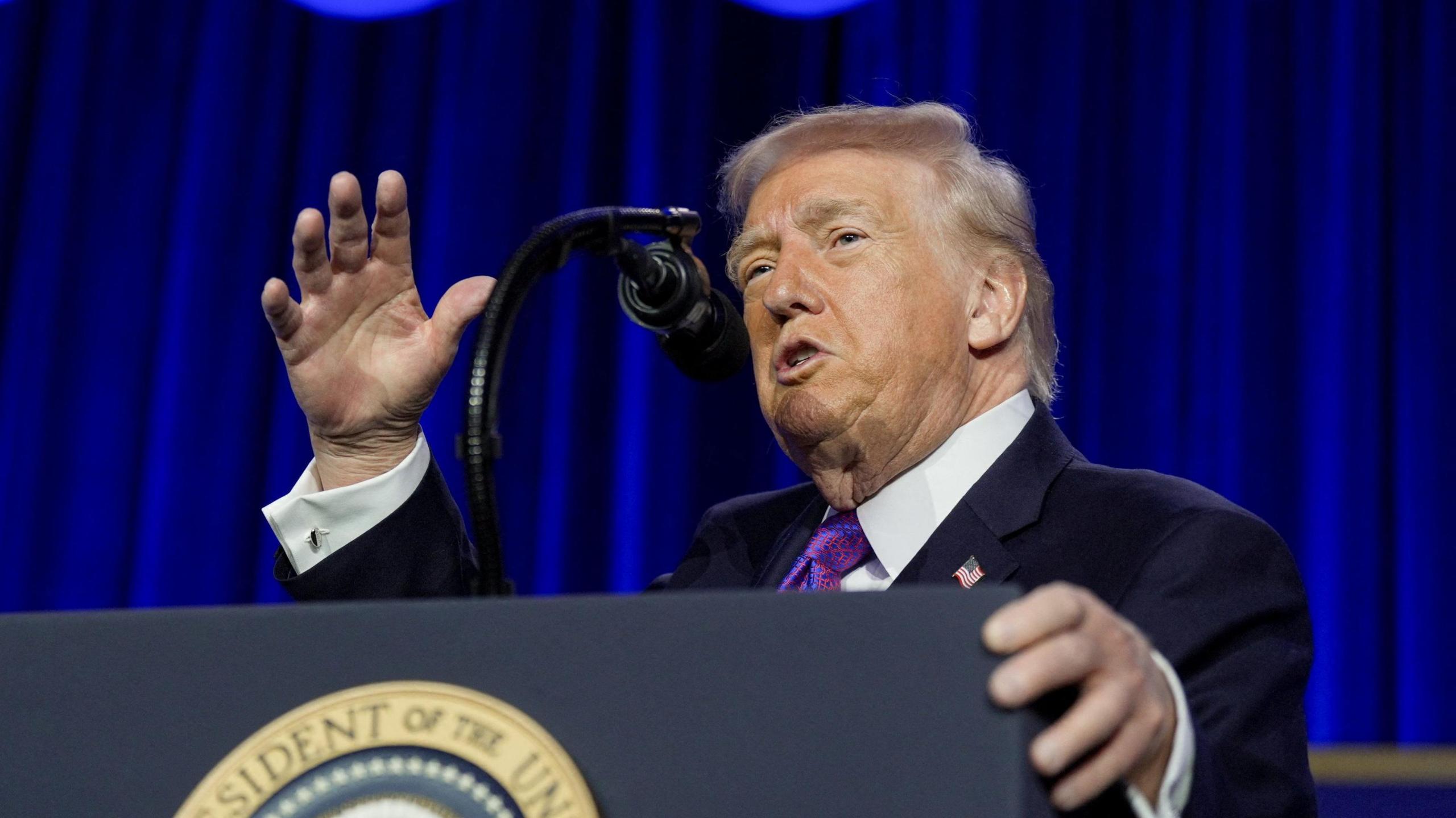
President Donald Trump has issued a dramatic threat to block the opening of the new Gordie Howe International Bridge a major infrastructure project linking Detroit, Michigan, and Windsor, Ontario in an escalating dispute with Canada over trade and economic issues. The threat, made in a lengthy social media post, represents one of the most serious recent confrontations in the increasingly strained relationship between the United States and its northern neighbour, as Trump seeks leverage amid broader trade disagreements and tariff pressures.
The Gordie Howe International Bridge, a $4.7 billion cable-stayed international crossing, has been under construction since 2018. It is fully funded by the Canadian government and is expected to open in early 2026 pending final testing and administrative clearances. The bridge will connect Interstate 75 in Michigan with Highway 401 in Ontario, carry six lanes of traffic, and include infrastructure for pedestrians and cyclists. It is designed to relieve congestion at existing crossings and strengthen one of North America’s busiest trade corridors.
In his message, Trump asserted that the United States had been treated “unfairly” by Canada, and argued that the U.S. should receive compensation for its contributions, as well as shared ownership of the bridge asset itself. “We will start negotiations, IMMEDIATELY. With all that we have given them, we should own, perhaps, at least one half of this asset,” he wrote, adding that the bridge should not open “until the United States is fully compensated for everything we have given them” and until Canada “treats the United States with the Fairness and Respect that we deserve.”
Trump’s demand reflects broader grievances that extend beyond the bridge project itself. In his post, he referenced trade issues including Canadian tariffs on U.S. goods, limited placement of U.S. products such as certain alcoholic beverages on Canadian shelves, and Canada’s growing economic ties with China. These complaints come as the United States, Canada, and Mexico prepare to renegotiate aspects of the U.S.-Mexico-Canada Agreement (USMCA), a trilateral trade pact originally signed during Trump’s first presidential term.
Bridge backlash and political reactions

Trump’s threat sparked immediate reactions from U.S. and Canadian political leaders, particularly in Michigan, where the bridge is seen as a vital piece of infrastructure. Michigan Governor Gretchen Whitmer stressed that the project built by union workers from both sides of the border would benefit the state’s economy and improve connections for the automotive industry. She affirmed that the bridge will open “one way or another” and expressed her support for attending the official ribbon-cutting ceremony.
Other political figures sharply criticised the president’s approach. U.S. Senator Elissa Slotkin, a Democrat from Michigan, described any attempt to delay or cancel the bridge’s opening as “punishing Michiganders for a trade war he started,” warning that blocking the project would have “serious repercussions” for the state’s economy, disrupt supply chains, and cost jobs. Similarly, Senator Gary Peters highlighted the critical importance of U.S.-Canada trade ties and condemned threats that could undermine business confidence and regional economic integration.
From the Canadian perspective, business organisations and government officials have not directly responded in detail to the threat, but observers have noted that the crossing has significant value as a symbol of cross-border cooperation and as a practical enhancement of trade infrastructure. The bridge is expected to facilitate commercial traffic and greatly reduce delays for truckers transporting goods between the two countries.
Economic and strategic significance of the Bridge
The Gordie Howe International Bridge is more than a transportation link; it represents decades of planning and cooperation. Negotiations between Michigan and Canadian officials began in the early 2000s, and the project has been developed through a bi-national effort involving multiple government agencies. Once open, it will complement existing crossings such as the Ambassador Bridge and the Detroit-Windsor Tunnel, which currently handle a significant share of trade traffic between the U.S. and Canada.
The bridge’s location spanning the Detroit River makes it strategically important for North American supply chains, particularly for the automotive sector, where parts and finished vehicles flow regularly across the border. Studies have suggested that the new bridge could cut up to 20 minutes off crossing times and save truckers billions in fuel and time over the next three decades, significantly boosting efficiency for cross-border commerce.
How Trump might block the opening

What remains unclear is how Trump intends to physically or legally block the bridge’s opening, given that it is under the jurisdiction of binational authorities and largely funded and delivered by Canada. While the president has wide executive powers in matters of federal infrastructure and border policy, the specifics of any legal mechanism to halt the opening have not been articulated. Analysts suggest that formal blocking actions could involve federal agencies or regulations related to trade, national security reviews, or port-of-entry designations, but such moves would almost certainly face legal challenges and pushback from state and international entities.
Broader context: U.S.–Canada trade relations
Trump’s threat against the bridge comes amid escalating trade tensions between the U.S. and Canada during his second term. In recent months he has imposed steep tariffs on Canadian imports, criticised Canadian trade policies, and hinted at punitive measures should Ottawa pursue deeper ties with China. In response, Canada has sought alternative economic partnerships and reaffirmed its support for multilateral cooperation. This climate of mutual economic friction has heightened sensitivities around major bilateral projects such as the Gordie Howe Bridge.
As the Gordie Howe International Bridge nears completion and officials work toward an early-2026 opening, the dispute underscores the complexity of modern international infrastructure projects and their vulnerability to broader geopolitical dynamics. Whether Trump’s threat evolves into formal action or remains a negotiating tactic, the episode illustrates the interplay of domestic political strategy, international trade policy, and regional economic interests in shaping North American relations.
In the coming weeks, as trade negotiations progress and political leaders from both countries respond, the future of the bridge and its role as a symbol of cooperation or contention will continue to attract attention across diplomatic and economic spheres.