

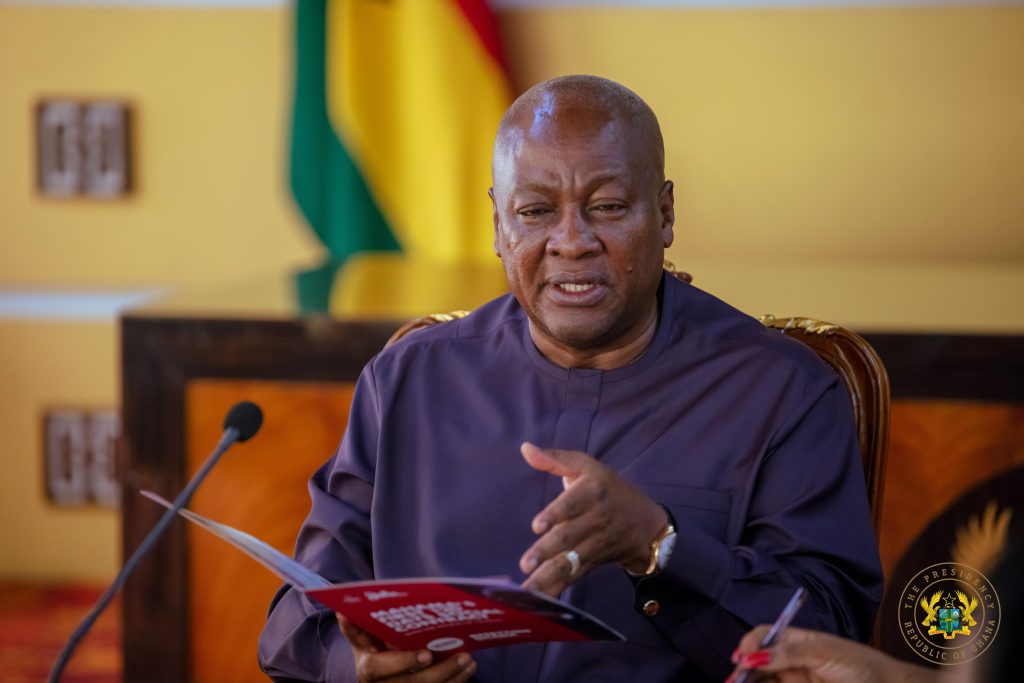
President John Dramani Mahama has convened an emergency Cabinet session to address mounting and complex challenges confronting Ghana’s vital cocoa industry. The decision underscores the urgency of a situation that has raised deep concerns among farmers, industry stakeholders, government officials, and cocoa market participants.
Cocoa Ghana’s premier agricultural export and a cornerstone of the national economy has been under increasing strain in recent months, with financing shortfalls, delayed payments to farmers and licensed buying companies (LBCs), and operational difficulties at the Ghana Cocoa Board (COCOBOD) combining to threaten both production and market confidence.
The emergency Cabinet session is expected to bring together ministers, policy experts, senior government officials, and key industry players to conduct an in-depth review of the sector’s fiscal, operational, and strategic challenges and to chart an effective way forward. The goal is to frame immediate intervention measures that can stabilise the cocoa value chain and restore confidence among producers, buyers, and international partners.
The strain on Ghana’s cocoa sector
At the heart of the crisis are reports of severe financing constraints that have made it difficult for COCOBOD to fulfil payments to cocoa farmers and LBCs in a timely manner. These delays have heightened fears that farmers and industry actors may face cash-flow pressures that could reduce planting, harvesting, and overall productivity if not addressed quickly.

The Licensed Cocoa Buyers Association of Ghana (LICOBAG) has warned that Ghana may need to secure emergency financing to purchase approximately 300,000 tonnes of cocoa beans through September 2026. Without such funding, industry representatives have cautioned that operations across the cocoa value chain could be severely disrupted, placing the upcoming crop season at risk.
COCOBOD has acknowledged the existence of a significant funding gap and is actively engaging with the Ministry of Finance on potential remedies. Among the options under consideration is a review of the traditional syndicated loan financing model that has long supported cocoa procurement, with discussions focused on restructuring terms to improve sustainability and resilience.
Farmer dissatisfaction and market pressures
Alongside financing difficulties, cocoa farmers have expressed dissatisfaction with the producer price announced for the 2025/2026 crop season, arguing that it does not adequately reflect rising production costs and prevailing market conditions. Stakeholders warn that prolonged dissatisfaction could weaken farmer commitment to cocoa cultivation and encourage a shift to alternative crops.
There are also concerns that unattractive pricing may fuel cross-border cocoa smuggling, particularly into neighbouring countries where farm-gate prices may be higher. Smuggling has historically posed challenges to Ghana’s cocoa industry by reducing officially recorded output, weakening export revenues, and distorting market dynamics.
Deepening financial woes at COCOBOD

Financial disclosures have revealed the depth of COCOBOD’s fiscal challenges. By the end of 2024, the institution had accumulated total debt estimated at GH¢32.91 billion and was operating with a negative equity position of GH¢3.8 billion, meaning liabilities exceeded assets by a significant margin.
COCOBOD has also acknowledged defaults on forward cocoa supply contracts during the 2023/24 season. These contracts required the delivery of over 333,000 tonnes of cocoa at fixed prices, but production and operational challenges prevented fulfilment. With global cocoa prices surging during the same period, the shortfall resulted in an estimated loss of nearly US$1 billion in potential export revenue.
Additionally, concerns have been raised about the implementation of a US$350 million cocoa rehabilitation programme aimed at restoring aging and diseased farms. Despite substantial funding, progress has reportedly been slower than expected, with questions emerging about efficiency, oversight, and value for money.
Political and public reactions

The announcement of the emergency Cabinet meeting has triggered strong reactions across the political spectrum. Some lawmakers and policy analysts have criticised broader economic and exchange rate policies, arguing that they have compounded COCOBOD’s challenges and worsened liquidity pressures within the sector.
Others have emphasised the need for greater transparency, improved governance, and clearer communication with farmers and buyers to rebuild trust. Observers note that cocoa is not only an agricultural commodity but also a strategic national asset whose performance directly affects rural livelihoods, export earnings, and fiscal stability.
Strategic importance and policy direction
Ghana’s cocoa sector employs hundreds of thousands of smallholder farmers and remains one of the country’s most important sources of foreign exchange. Any prolonged disruption to the industry has the potential to ripple through the broader economy, affecting employment, trade balances, and government revenues.
The emergency Cabinet session is expected to focus on short-term financing solutions, ensuring timely payments to farmers and LBCs, and strengthening oversight mechanisms at COCOBOD. Longer-term discussions are likely to include reforms aimed at improving financial discipline, enhancing production incentives, modernising farm rehabilitation efforts, and tightening measures against smuggling.
By elevating the cocoa crisis to the highest level of government decision-making, President Mahama’s administration has signalled its recognition of the sector’s strategic importance. The outcomes of the emergency Cabinet meeting will be closely watched by farmers, industry players, and international partners as Ghana seeks to stabilise and safeguard one of the pillars of its economy.