

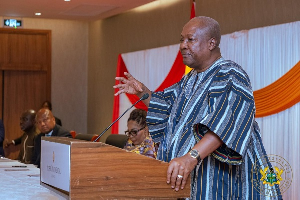
President John Dramani Mahama delivered a landmark address to the National Assembly of Zambia in Lusaka on 5 February 2026, as part of his official state visit. His speech, delivered to legislators, government officials and distinguished guests, underscored the deep historical ties between Ghana and Zambia, outlined shared development priorities for Africa, and articulated a compelling vision for the continent’s economic transformation and collective prosperity.
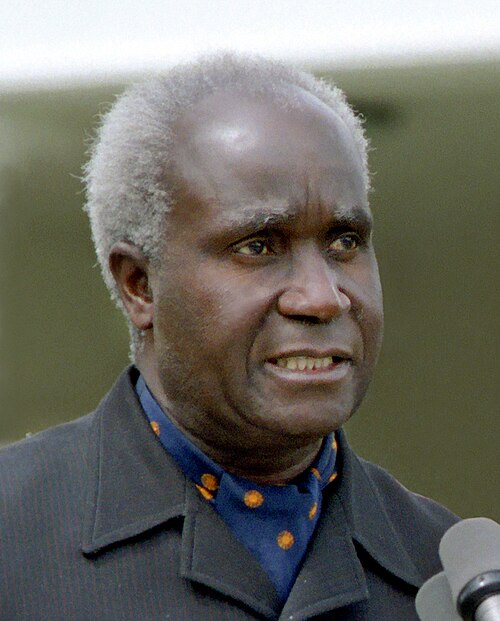
He began by expressing deep appreciation for the warm hospitality extended to his delegation and highlighted the enduring friendship between the Republic of Ghana and the Republic of Zambia a bond rooted in shared history, values and the Pan-African ideals championed by founding leaders like Osagyefo Dr. Kwame Nkrumah and Dr. Kenneth David Kaunda. This historic solidarity, he said, was forged during the struggles for independence and has endured through decades of mutual respect and cooperation.
“Rt. Honourable Speaker, Honourable Members of Parliament, Honourable Ministers of State, Senior Government Officials, Members of the Diplomatic Corps, Distinguished Ladies and Gentlemen, I am deeply honoured to address this august House and to convey warm fraternal greetings from the Government and people of the Republic of Ghana,” he said. He expressed profound gratitude for the gracious hospitality shown to him and his team since arriving in Lusaka.
President Mahama recounted Ghana’s support for Zambia’s liberation struggle, noting that generations of Zambian freedom fighters drew inspiration from Pan-African ideals fostered at institutions such as the Kwame Nkrumah Ideological Institute in Winneba. He said that the friendship between the two nations remains grounded in shared democratic values, peace, and a common aspiration for dignity and development.
He then transitioned to the challenges facing Africa today, arguing that while political independence had been achieved, the pressing task now is economic transformation. In his words, “Our forebears won us independence and nationhood. Now we must win the fight for economic transformation and prosperity for our people.” He noted the changing global context, where humanitarian aid is shrinking, defence spending is rising and traditional multilateral systems are under strain, leaving Africa vulnerable.
President Mahama called this situation a “pandemic of unfulfilled potential,” pointing out high unemployment, fragile health systems and economic models that extract wealth without building local capacity. He urged African nations to confront this reality with transparency, pragmatism and unity of purpose. He referenced his Accra Reset Initiative, a development strategy centred on fiscal discipline, productive investment, good governance, macroeconomic stability, job creation and inclusive growth.
The President highlighted Ghana’s progress under this agenda, noting significant economic improvements: inflation had declined sharply and macroeconomic stability had been restored, including currency appreciation and successful debt restructuring handled with dignity and sovereignty.
He stressed that Ghana’s success should serve as a model for regional confidence and cooperation, and he identified Zambia as a natural partner given economic complementarities in mining, agriculture, energy and manufacturing. He urged Africa to take greater control of its natural resources, moving away from large concessions to foreign investors and instead encouraging indigenous participation and value addition.
“To achieve economic transformation, Africa must exercise greater sovereignty over its natural resources,” President Mahama declared. He outlined national efforts in Ghana, including the establishment of the Ghana Gold Board, which increased gold exports significantly and generated substantial forex inflow. He also highlighted efforts to refine minerals domestically rather than exporting raw ores, along with a revised sliding royalty system to ensure better revenue capture.
Mahama reaffirmed the need for Africa to build regional prosperity platforms such as shared manufacturing zones, integrated infrastructure networks, and digital connectivity. He spoke of negotiating collectively on issues like minerals, trade and climate finance making unity a concrete strategy rather than a slogan.
He then addressed governance and leadership, emphasising that transparent, accountable institutions are essential for sustainable development and combating corruption. “Abuse of public trust must be punished,” he asserted, while noting that strong democratic institutions like Parliament and the judiciary are key to public confidence.
The President praised Zambia’s macroeconomic achievements and reiterated Ghana’s desire to deepen trade, investment and financial cooperation. He also expressed confidence in Zambia’s democratic process as the country prepares for its general elections in August 2026.
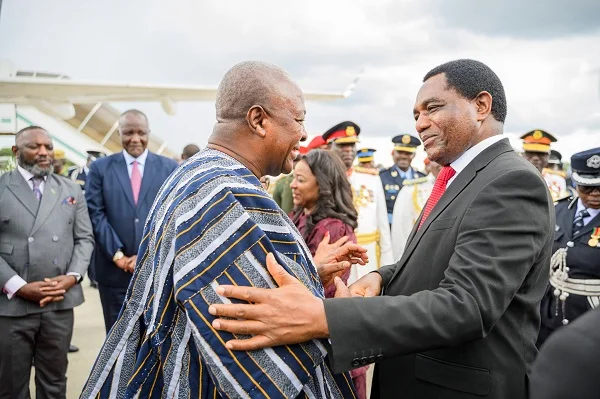
A milestone of the visit, he announced the revitalisation of the Permanent Joint Commission for Cooperation between Ghana and Zambia, aimed at fostering collaboration in sectors including trade, agriculture, education, energy, tourism and youth development. As part of this cooperation, Ghana and Zambia signed ten Memorandums of Understanding, including an agreement on visa-free travel for all passport holders a significant step toward African Continental integration and free movement of people.
President Mahama reaffirmed the role of peace and security as indispensable foundations for development, underscoring cooperation on defence training, intelligence sharing and peacekeeping.
He also discussed Africa’s moral imperative for justice and dignity, especially as the African Union Champion for Reparations. Ghana will soon sponsor a United Nations resolution on slavery reparations and invited Zambia to be a co-sponsor of this initiative.
As African Union Champion for Gender and Development, he highlighted Ghana’s achievements in promoting gender equality, including the election of the first female Vice President and the implementation of the Affirmative Action (Gender Equity) Act mandating at least 30 per cent female representation in public appointments. He announced plans for a Women’s Development Bank to support female-led enterprises and urged collective action on women’s financial inclusion.
President Mahama concluded his address by reaffirming Ghana’s commitment to boosting intra-African trade through the African Continental Free Trade Area (AfCFTA), reducing barriers, harmonising standards and fostering private-sector partnerships to accelerate industrialisation and value addition.
“Our people are the true custodians of this partnership. The presence of Ghanaians in Zambia and Zambians in Ghana enriches both societies,” he remarked. He thanked the Assembly for the honour of his invitation and reaffirmed Ghana’s dedication to deepening cooperation, mutual respect and shared destiny across the continent.
He ended with a message of unity and hope:
“May God bless the Republic of Zambia. May God bless the Republic of Ghana. And may Africa continue to rise.”