

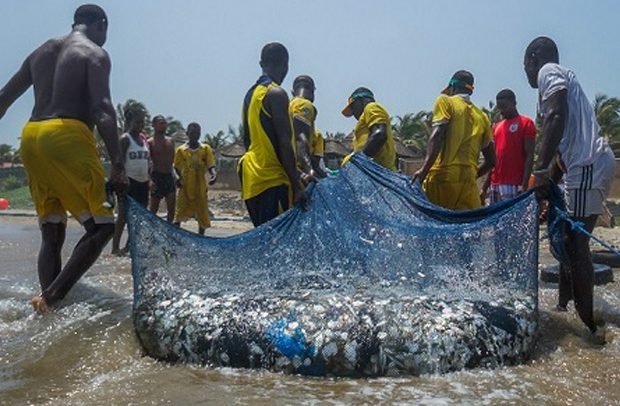
The Environmental Justice Foundation (EJF) has issued a strong appeal for Ghana’s fisheries sector to move more quickly toward a system of transparent vessel registration, underscoring that greater openness is essential for sustainability, legality and accountability in the sector. This call comes amid growing recognition that Ghana must modernise how it tracks and discloses information about fishing vessels operating in its waters with far-reaching implications for coastal communities, the economy and marine ecosystems.
During the organisation’s latest analysis, EJF highlighted the need for the government, including the Ministry of Fisheries and Aquaculture Development (MoFAD) to fully implement the principles of the Global Charter for Fisheries Transparency, particularly those relating to vessel information. According to EJF, publishing detailed and up-to-date records of fishing vessels on official platforms is critical to combating illegal, unreported and unregulated (IUU) fishing and strengthening overall governance in the sector. This register should not only appear on MoFAD’s website but also be included in the Food and Agriculture Organization’s (FAO) Global Record of Fishing Vessels, making Ghana’s data visible on a global scale.
At the heart of EJF’s recommendations is the call for public disclosure of key vessel details, such as the date of infractions, vessel names, International Maritime Organization (IMO) numbers, ownership structures and the nature of sanctioned offences. The organisation further asserts that sanctions and enforcement actions should be made publicly accessible at least once a year, detailing any penalties, settlement procedures and compliance measures applied. These disclosures, EJF believes, are the foundation for accountability and a transparent regulatory environment that inhibits illicit behaviour at sea.
EJF also pressed for beneficial ownership transparency meaning that the true individuals or entities that benefit from fishing activities must be disclosed at the point of vessel registration and made available to the public in a user-friendly format. This demand seeks to prevent the widespread practice of hiding ownership behind opaque corporate structures or front companies, a tactic that allows foreign interests to profit from fishing activities without proper oversight or legal liability.

In its recent report titled Ghana Transparency Gap Analysis: Evaluating Transparency in Ghana’s Fisheries Sector, released in January 2026, EJF found that while Ghana has made partial progress toward transparency, significant gaps remain. The organisation acknowledged that the newly adopted Fisheries and Aquaculture Act provides a legal foundation for routine publication of licence lists, details of out-of-court settlements and provisions for mandatory Automatic Identification System (AIS) tracking. However, the report warned that weaknesses persist, particularly around public access to vessel ownership information, which undermines efforts to enforce the law effectively.
EJF underscored the importance of strengthening existing regulations and updating the current Fisheries Regulations to close loopholes. For instance, the organisation emphasised that measures such as the ban on transhipment a practice often associated with illegal fishing must not be diluted in future regulations but instead reinforced to align with international transparency principles. Additionally, the foundation called on authorities to ensure that ships controlled by foreign entities cannot be registered under the Ghanaian flag unless they operate within robust and transparent access arrangements consistent with the Global Charter’s principles.
The push for transparency has not emerged in isolation. Ghana recently demonstrated its political will to reform the sector when MoFAD endorsed the Global Charter for Fisheries Transparency at the 2025 Our Oceans Conference, reaffirming its commitment to beneficial ownership transparency and broader governance standards. This endorsement was followed by the publication of sanctions that resulted in the suspension of licences for four industrial trawlers a concrete step toward accountability. Despite these advances, EJF stresses that full implementation of all ten charter principles remains a work in progress.
The stakes are high. Ghana’s fisheries sector employs roughly 10% of the population and supports more than three million people along the value chain, including fishmongers, traders and processors. Yet, the prevalence of illegal fishing and unsustainable practices threatens to deplete fish stocks, undermine livelihoods, and erode the rights of coastal communities that depend on marine resources for food security and economic survival. Without transparent systems to monitor, regulate and enforce the law, these challenges are likely to worsen.
Experts agree that transparency is not merely an administrative formality, but a strategic tool for sustainable fisheries management. Open access to vessel registries, ownership information and infringement data enables stakeholders — from local fishers to international partners to scrutinise activities, detect irregularities, and hold offenders accountable. Moreover, transparent frameworks help deter corruption, strengthen compliance and ensure that legal fishers can compete fairly without being undercut by operators who flout the rules.
In calling for accelerated transparency reforms, EJF echoes broader regional and global movements to strengthen fisheries governance. Nations across West Africa and beyond are embracing similar principles, recognising that sustainable fisheries are central to environmental health, economic stability and community resilience. For Ghana, the path forward will require not only legal reforms and regulatory updates, but also political resolve and collaborative action among government agencies, civil society, industry players and coastal communities.

As Ghana continues to grapple with the complex challenges affecting its fisheries sector, the push for a transparent vessel registry and open access to critical data represents a fundamental step toward restoring trust, safeguarding marine ecosystems and ensuring that the benefits of Ghana’s rich marine resources are equitably and sustainably shared.