


Ghanaian actress and entrepreneur Fella Makafui has taken firm legal action after a deeply disturbing comment was made about her young daughter, Island Frimpong, under a harmless family video she shared on X (formerly Twitter). What began as a sweet moment between a mother and her child quickly turned into a national conversation about child protection, online boundaries, and accountability on social media.
The incident has triggered widespread outrage across Ghanaian social media, with many calling for justice and stronger consequences for harmful online behavior involving minors.
The post, the comment, and the public reaction
Fella Makafui had posted a short, affectionate video of her daughter Island, a post that was widely viewed as a celebration of motherhood and family life. However, the post took a disturbing turn when an X user identified as @ghatu_ replied with a comment written in Twi, implying a sexual fantasy involving the child’s private parts.
Though the comment did not contain explicit imagery, its meaning was widely understood and immediately condemned by users who saw it. Screenshots of the reply circulated rapidly, sparking shock, anger, and disbelief. Many users described the comment as predatory, dangerous, and unacceptable, especially in a society increasingly concerned about child safety.
Makafui initially responded publicly, calling out the user and demanding accountability. As the post gained traction, social media erupted with outrage, trending hashtags, memes condemning the act, and calls for the individual to face legal consequences.

While the overwhelming majority of Ghanaians stood firmly with Makafui, a small but vocal group attempted to shift blame onto her, arguing that posting a child online exposes them to risk. This narrative was swiftly rejected by many, who insisted that the responsibility lies entirely with the adult who made the comment, not the parent sharing a family moment.
Fella Makafui’s response and legal action
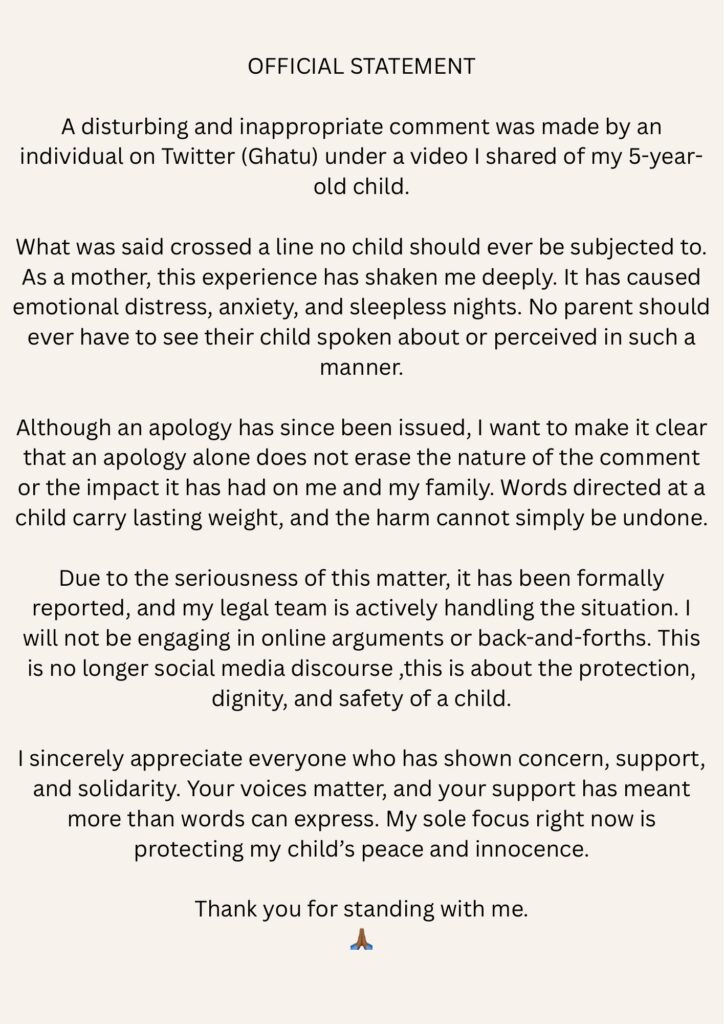
In a more detailed statement released on Monday, Fella Makafui opened up about the emotional toll the incident had taken on her as a mother. She revealed that the comment caused her sleepless nights, anxiety, and deep emotional distress, explaining that the violation went far beyond the online space.
Makafui made it clear that while the user later attempted to apologize, she does not believe an apology alone can undo the psychological harm caused or erase the seriousness of the act. She emphasized that comments sexualizing children even indirectly must be treated as grave offenses.
As a result, she confirmed that the matter has been handed over to her legal team, stating that she is pursuing accountability not out of revenge, but to send a clear message about protecting children in digital spaces.
Her decision has been widely praised as courageous, with many commending her for standing not only for her child, but for other parents and children who may be vulnerable to similar online abuse.
A wider conversation on child protection and social Media responsibility
Beyond the individual case, the incident has reignited an important national discussion about online safety, moral responsibility, and the enforcement of laws against harmful digital conduct. Child rights advocates, legal commentators, and public figures have used the moment to call for stricter enforcement of cybercrime and child protection laws.
Many have stressed that normalizing or excusing such comments even as “jokes” creates a dangerous environment where predatory behavior can thrive unchecked. The consensus across much of social media has been clear: sexualizing a child in any form is unacceptable and must carry consequences.
For Fella Makafui, the issue goes beyond public outrage. It is about setting a precedent that children deserve protection everywhere including online and that parents should not be silenced or blamed for speaking out.
As the legal process unfolds, the incident stands as a sobering reminder that social media platforms must be spaces of responsibility, and that silence is not an option when children are harmed, even through words.